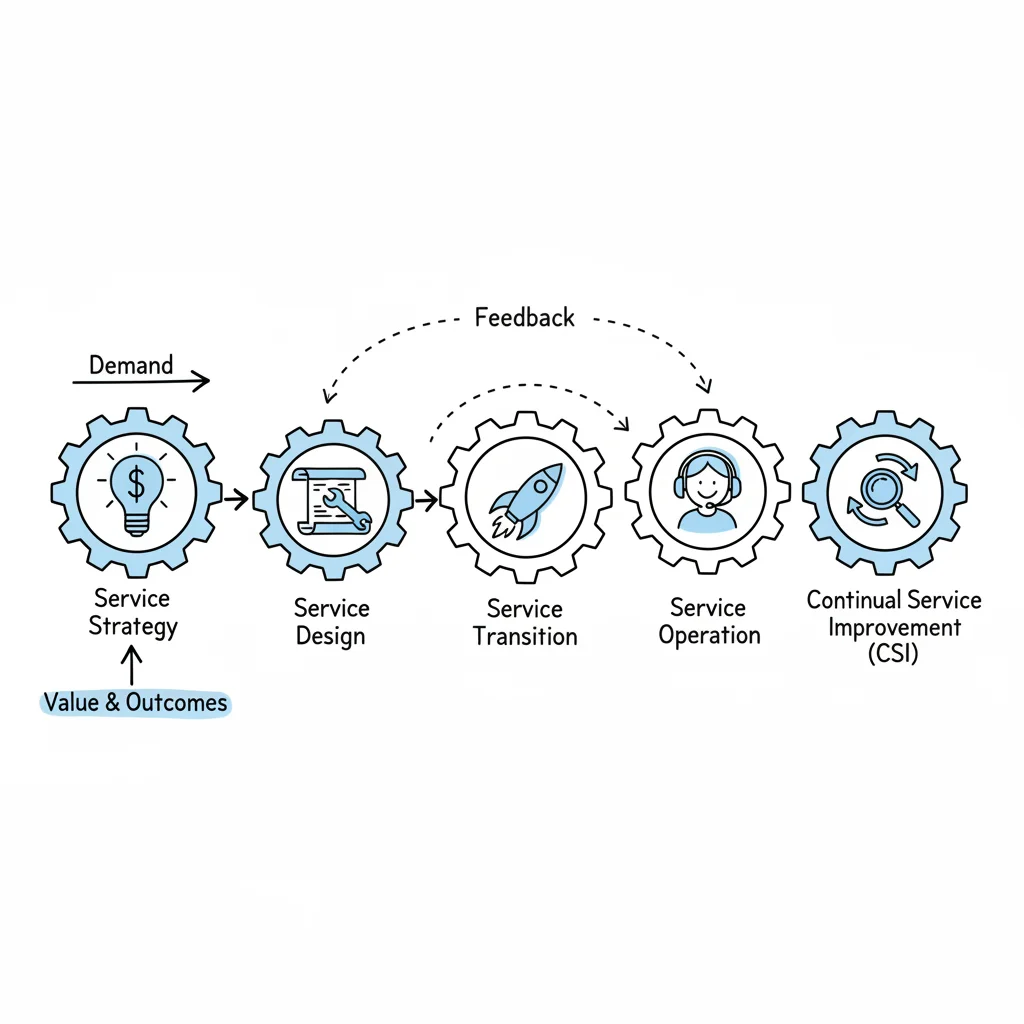
What Is ITIL Service Management Explained
What Is ITIL Service Management Explained: A Framework for Modern IT Professionals
ITIL (Information Technology Infrastructure Library) Service Management is a globally recognized framework—a comprehensive collection of best practices—designed to help organizations deliver high-quality IT services that genuinely align with overarching business objectives. For IT professionals, understanding ITIL is less about memorizing strict rules and more about adopting a proven methodology. Think of it as a professional playbook for managing technology effectively and consistently, ensuring your IT operations reliably support and drive organizational success.
At MindMesh Academy, we believe that mastering frameworks like ITIL is crucial for career advancement, providing a standardized language and a structured approach to IT service delivery that is highly valued across the industry.
Understanding the Core of ITIL
 Caption: ITIL encourages a structured, proactive approach to IT service delivery, moving beyond reactive "firefighting."
At its heart, grasping what is ITIL service management means making a fundamental paradigm shift. It's about transitioning IT operations from a purely reactive, "firefighting" mode—where you only address issues after they've disrupted services—to a proactive, value-driven approach. Instead of simply fixing broken components, ITIL provides a structured way to plan, build, deliver, operate, and continually improve the services you offer to customers and internal stakeholders.
This framework equips IT teams with a common language and standardized processes, fostering a shared understanding that ensures everyone—from the AWS cloud engineer deploying infrastructure to the IT director planning the annual budget—is working towards unified goals. The tangible result is IT operations that are more predictable, reliable, and efficient, all while directly supporting the organization's strategic aims, a critical skill for any IT professional seeking certification.
The Business Impact of ITIL
Implementing ITIL best practices has a profound, measurable impact on both operational efficiency and financial outcomes. It's no coincidence that the global IT Service Management (ITSM) market, which heavily relies on the ITIL framework, is projected to reach approximately $22.1 billion by 2028. This significant growth underscores the continuous investment businesses are making in structured service management to gain a competitive edge. You can explore more about ITSM market trends to see the full picture.
So, why are companies investing so heavily? Because the returns on this investment are substantial:
- Improved Service Quality: ITIL enables you to consistently meet and often exceed user expectations, leading to more reliable systems.
- Reduced Operational Costs: By optimizing processes and minimizing waste, ITIL helps organizations achieve greater efficiency and significant cost savings.
- Enhanced Customer Satisfaction: Reliable and responsive services result in happier, more productive users and customers.
- Better Risk Management: Proactive identification and mitigation of potential problems prevent major outages and security breaches.
Ultimately, ITIL transforms the IT department from a perceived cost center into a strategic partner that actively contributes to business growth and innovation.
By focusing on value creation through optimized processes and effective resource management, ITIL ensures that every technology-related activity contributes directly to achieving key business outcomes, making it an indispensable tool for modern organizations and a foundational skill for IT professionals.
To begin your journey into ITIL, here's a concise overview of its fundamental building blocks. This table highlights the core components that we'll delve into in more detail, crucial for anyone preparing for ITIL Foundation certification.
ITIL At a Glance: Core Components
| Component | Brief Explanation |
|---|---|
| Guiding Principles | The universal recommendations and core beliefs that steer an organization's decisions and actions within ITIL. |
| Service Value System | A holistic model illustrating how all components and activities work together to create value for stakeholders. |
| Four Dimensions | A comprehensive perspective considering people, technology, partners, and value streams for service creation. |
| ITIL Practices | Practical toolkits and capabilities used to achieve specific service management objectives and deliver value. |
This high-level overview establishes the framework's landscape, providing a foundational map of the key concepts that make ITIL so effective and relevant for today's IT professional.
Reflection Prompt: Consider your current role or a past project. How much of your team's effort is reactive "firefighting" versus proactive planning and improvement? How might ITIL principles shift that balance?
The Four Dimensions of Successful Service Management
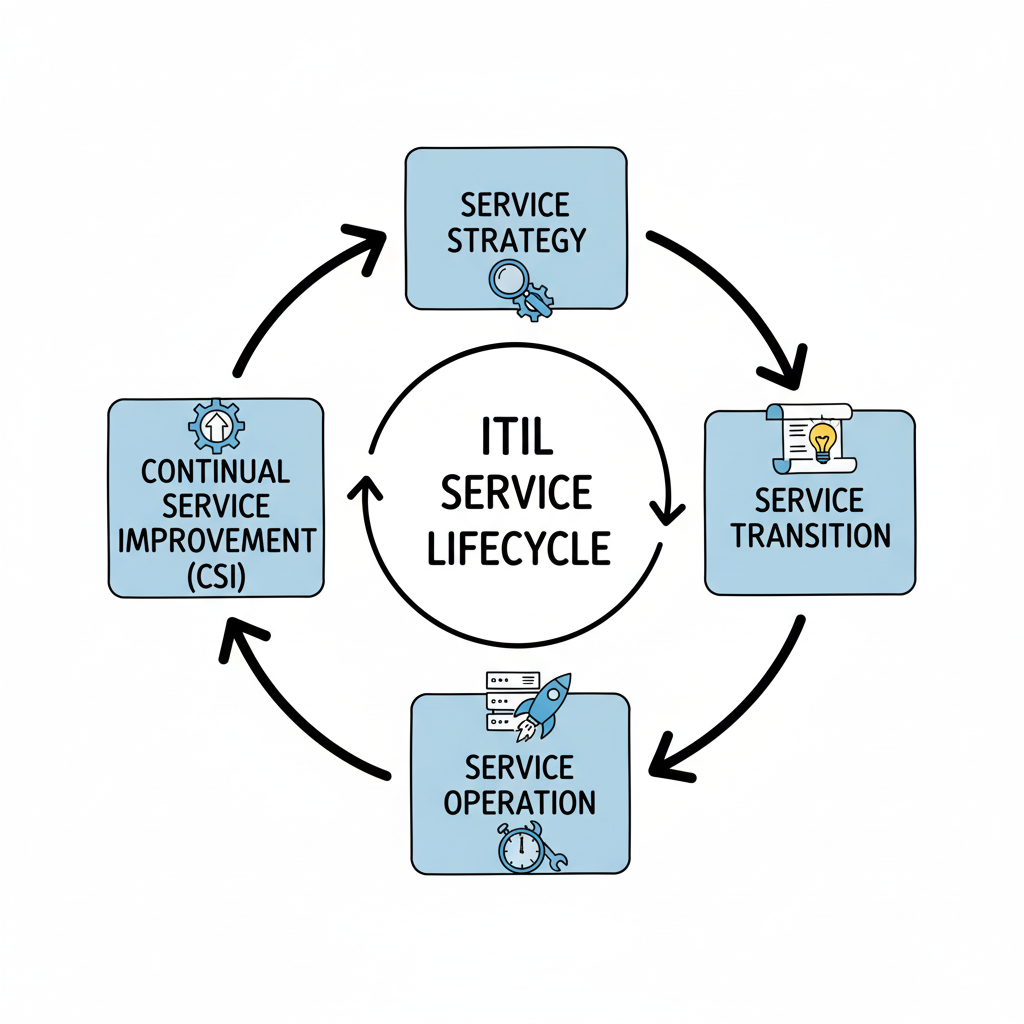 Caption: The Four Dimensions Model ensures a balanced, holistic perspective on IT service management, preventing critical aspects from being overlooked.
When it comes to ITIL, successful service management demands a holistic view, not just focusing on isolated components. To deliver services that genuinely benefit the business, IT professionals must consider every single factor that contributes to their success.
That's precisely what the Four Dimensions Model facilitates. It's a framework designed to ensure your approach is balanced, comprehensive, and that no critical element is overlooked.
Think of it like a project manager (PMP-certified, perhaps) overseeing the launch of a new AWS cloud service. You wouldn't just focus on the EC2 instances; you'd also consider the team's skills, the security policies, third-party integrations, and the deployment pipeline. Every aspect is essential for a high-performing and reliable service. ITIL treats service management with the same rigor, emphasizing four core dimensions that must work in harmony.
1. Organizations and People
This first dimension addresses the human element of service management. It encompasses an organization's culture, its formal hierarchical structures, and, critically, the skills, competencies, and roles of its personnel. A culture that champions open communication, collaboration, and continuous learning is just as vital as having a certified Azure architect or a skilled DevOps engineer on staff.
For example, a strong Organizations and People dimension means that an incident response team, even under pressure, communicates effectively, leverages shared knowledge bases, and has clearly defined roles. Without this, even the most advanced technology can fail due to human-process breakdowns. This dimension reinforces that ultimately, people are at the heart of value delivery in any IT service.
2. Information and Technology
This is the dimension most IT professionals immediately associate with "IT." It covers all the tools of the trade—the hardware, software, data assets, cloud platforms (like AWS or Azure), and network infrastructure required to deliver a service. It also includes the information itself, ranging from detailed knowledge base articles and customer records to critical performance analytics and operational data.
A key aspect here is ensuring your technology truly supports your business goals. An outdated or poorly integrated ticketing system, for instance, can create frustrating bottlenecks and hinder productivity, irrespective of your team's expertise. The right technology should empower efficiency and innovation, not impede it. For IT professionals pursuing certifications in cloud platforms, understanding how these technologies integrate into a service delivery model is paramount.
The Four Dimensions Model ensures that no single aspect of service management is overemphasized or neglected. By considering all four dimensions together, organizations can create a robust system that delivers consistent value to stakeholders and stands up to the rigors of modern IT environments.
3. Partners and Suppliers
Very few organizations operate in complete isolation. This dimension accounts for all external relationships: cloud providers (AWS, Azure), software vendors, managed service providers, and even outsourced service desk teams.
Effective management of these partnerships is absolutely critical for seamless service delivery. For instance, a robust Service Level Agreement (SLA) with your network provider is non-negotiable if you need to guarantee high availability for your own customer-facing applications. This dimension focuses on ensuring that your partners' performance and your own service objectives are perfectly aligned and mutually beneficial.
4. Value Streams and Processes
Finally, this dimension examines how work gets done within the organization. It defines the specific workflows and procedures that guide activities from inception to completion, transforming a customer's demand or an opportunity into a valuable outcome. The goal here is to meticulously map and optimize this journey to be as smooth and efficient as possible.
- Value Streams: These are the end-to-end journeys, representing the series of steps an organization undertakes to create and deliver a valuable product or service to its consumers. For example, a "New Employee Onboarding" value stream might involve HR, IT, and facilities, each with their own processes.
- Processes: These are the foundational building blocks that support the larger value streams. A process is a set of interconnected activities designed to achieve a specific objective, such as "incident resolution" or "change enablement."
By continually refining these workflows, organizations can identify and eliminate inefficiencies, reduce delays, and significantly enhance the overall experience for their users and customers.
For a deeper dive into this core concept, MindMesh Academy offers a comprehensive ITIL Four Dimensions Model study guide to help you thoroughly understand this critical aspect of ITIL.
Key Takeaway: The Four Dimensions provide a powerful analytical lens. Before initiating any major IT project or service change, ask yourself: How does this impact our people and their skills? What information and technology are required? Are our partners aligned? And how will this integrate into our existing value streams and processes?
How the ITIL Service Value System Creates Value
So, how does everything within ITIL actually work together to produce tangible benefits? The unifying element is the ITIL Service Value System (SVS). Think of it as the complete operational model for any IT-enabled organization. Its sole purpose is to take an opportunity or a demand—such as a request for a new software feature, a PMP-managed project, or an AWS infrastructure upgrade—and systematically transform it into real, measurable value for the business.
The SVS is not merely a collection of isolated processes. It's an integrated and adaptable system where every component has a specific purpose and works in harmony with the others, ensuring the entire organization is pulling in the same value-focused direction. This holistic approach is key for IT professionals aiming for high-level certifications that emphasize strategic IT management.
The Key Components of the SVS
The SVS derives its strength and flexibility from several interconnected components. Each plays a distinct role in the journey from initial input (demand/opportunity) to valuable outcome.
- Guiding Principles: These are the enduring, universal recommendations that inform an organization's decisions and actions. They act as the "true north," keeping IT teams aligned with fundamental best practices, regardless of shifting goals or strategies. Examples include "Focus on Value" and "Collaborate and Promote Visibility."
- Governance: This component provides the framework for how the organization is directed and controlled. It ensures that all IT activities align with business objectives, comply with regulations, and manage risk effectively—a crucial area for IT leaders and managers.
- Service Value Chain: This is the operational heart of the SVS, comprising a set of interconnected activities that an organization performs to create and deliver valuable products or services to its consumers. We'll explore this in more detail shortly.
- Practices: These are the practical toolkits for getting work done efficiently. Think of them as specialized sets of resources—people, processes, information, and tools—designed to accomplish specific objectives, such as incident management, service request management, or change enablement.
- Continual Improvement: This is not a one-off project but an embedded, recurring activity across all levels of the organization. It ensures that performance is constantly reviewed, learned from, and enhanced to consistently meet and exceed stakeholder expectations. This mindset is vital for maintaining relevance in rapidly evolving fields like cloud computing (AWS, Azure).
When these components operate synergistically, they form a powerful system capable of adapting and responding to virtually any business need or technological shift. For a more detailed breakdown of how these elements fit together, our guide offers a valuable big-picture view of the ITIL Service Value System.
The Service Value Chain in Action
At the very core of the SVS, you'll find the Service Value Chain. Crucially, this is not a rigid, linear, step-by-step process. Instead, it's an incredibly flexible operational model made up of six key activities that can be combined and reused in various sequences to create what ITIL calls "value streams."
Imagine it as a modern, agile production line. A demand for a new service (like an Azure-hosted application) is the raw material entering one end, and delivered value is the finished product emerging from the other. The Service Value Chain activities are the different stations along that line. Depending on the service you're developing or supporting, you might use these stations in a different order, repeat some, or even bypass others entirely to optimize the flow.
The six core activities are:
- Plan: Establishes a shared understanding of the vision, current status, and direction for all four dimensions and products/services.
- Improve: Drives the continual enhancement of products, services, and practices across the board, leveraging feedback and performance data.
- Engage: Focuses on understanding stakeholder needs, maintaining transparency, and building strong relationships with customers, users, and suppliers.
- Design & Transition: Ensures that new and changed services meet stakeholder expectations for quality, cost, and time-to-market, and can be operated effectively.
- Obtain/Build: Guarantees that all necessary service components are acquired or built to specification and are available when and where needed.
- Deliver & Support: Concentrates on the day-to-day delivery and support of services to meet agreed-upon expectations, managing incidents and service requests.
For example, implementing a new feature in an AWS application might involve Engage (gathering requirements), Design & Transition (architecting the solution and planning deployment), Obtain/Build (developing and testing the code), and finally Deliver & Support (deploying the feature and providing ongoing support), with Plan and Improve running concurrently throughout.
When these activities are optimized and running smoothly, the business impact is undeniable, leading to significant gains for any IT department. The infographic below illustrates the kind of real-world results you can expect.
 Caption: A well-implemented ITIL Service Value System directly translates to measurable improvements in efficiency, cost savings, and enhanced customer experience.
As you can see, a well-oiled Service Value System directly leads to measurable wins in efficiency, cost savings, and most importantly, the customer's experience.
Reflection Prompt: Consider a recent IT project or service delivery challenge you faced. Which Service Value Chain activities were involved? Could a more structured approach using these activities have improved the outcome or efficiency?
The Real-World Benefits of Adopting ITIL
It’s easy to get absorbed in the theoretical aspects of ITIL, but for any IT professional or business leader, the most pressing question remains: Why should we bother with ITIL? The answer isn't about organizing IT for its own sake; it’s about the tangible, measurable improvements it brings to the entire business and, by extension, to your career trajectory.
When you adopt the principles of ITIL service management, you’re essentially laying down a blueprint for a more stable, predictable, and efficient IT operation. It provides your teams with a clear roadmap for handling everything from a user’s forgotten password to a massive strategic system overhaul (e.g., migrating an on-premises data center to AWS or Azure). This ensures every action, big or small, consistently aligns with what the business is trying to achieve.
The certification paths offered by AXELOS, the official custodians of ITIL, demonstrate the depth and breadth of expertise this framework offers.
 Caption: AXELOS ITIL certification paths provide a structured way for IT professionals to develop deep expertise in service management.
As shown, there are specific modules designed to build deep expertise, from Foundation to Strategic Leader. This isn't just about earning a certificate; it's about systematically building your organization's and your personal capabilities from the ground up, making you a more valuable asset in the IT landscape.
Driving Business Performance
At its core, ITIL fosters a common language and standardizes processes, ensuring everyone is on the same page. Consider the impact: when your Incident Management practice is robust, you drastically reduce costly downtime for critical systems (like an e-commerce platform hosted on Azure). When your Change Enablement process is solid, you minimize the risk of a new software release or infrastructure update from taking down a critical business service. This proactive risk mitigation is a hallmark of high-performing IT teams.
This structured approach creates a powerful ripple effect of positive outcomes. Team productivity often soars because clear, documented processes eliminate guesswork and wasted effort. Customer satisfaction receives a major boost because the services they rely on become more dependable and responsive. ITIL helps shift the IT department from being a reactive cost center that just fixes things to a proactive, strategic partner that actively drives business value and innovation.
"Implementing ITIL isn't just an IT project; it's a fundamental business improvement initiative. It provides the essential structure needed to effectively manage risk, control costs, and ultimately deliver more strategic value from all your technology investments."
Measurable Improvements and Cost Savings
The benefits of ITIL are not merely theoretical; they are quantifiable. A comprehensive ITSM Academy Report highlighted impressive results, finding that 80% of organizations experienced a reduction in service-related problems after integrating ITIL into their operations. This represents a significant step towards creating a more stable and responsive IT environment, directly impacting business continuity.
Furthermore, 73% of IT organizations reported substantial improvements in their overall service quality and user experience. And crucially for the bottom line, 70% of these organizations successfully lowered their operational costs by more than 10%. These figures present a compelling case for adopting ITIL, proving its value in both operational efficiency and financial stewardship. You can dig into the specifics by checking out the full report on ITSM trends.
Ultimately, investing in ITIL is an investment in the overall health and future resilience of your business. The key advantages for IT professionals and organizations alike boil down to:
- Better Risk Management: The ability to proactively identify and neutralize potential service disruptions before they impact critical business operations.
- Increased Service Availability: With standardized processes for handling incidents and problems, organizations experience less downtime and much faster recovery times.
- Improved Resource Utilization: Your team's valuable time and talent are focused on high-value work and innovation instead of constantly putting out fires.
- Alignment with Business Goals: A clear framework ensures that every single IT activity directly supports the company's strategic objectives and contributes to overall success.
Common ITIL Practices in Action
Theory provides the foundation, but to truly understand what ITIL service management is all about, you need to see its practices in real-world scenarios. The framework is built on dozens of practices—think of them as specialized playbooks or methodologies for handling specific types of work within the IT service lifecycle. Let's explore a few of the most common and impactful practices to see how they bring order and efficiency to the dynamic world of IT.
Incident Management: Putting Out the Fire
Imagine your company's mission-critical application, perhaps an AWS-hosted e-commerce site, experiences a complete crash during a peak sales event. Panic sets in. This is precisely when Incident Management springs into action.
Its primary and singular goal is to restore normal service operation as quickly as possible. The priority is immediate service restoration and containing the impact, not necessarily to immediately discover the deep-seated root cause.
A typical Incident Management flow might look like this:
- An automated monitoring system (e.g., CloudWatch for AWS) flags a service outage, automatically logging a high-priority incident.
- The designated on-call support team (Tier 1 or Tier 2) receives an immediate alert and begins rapid investigation.
- They apply a quick workaround or fix—perhaps restarting a problematic service, rolling back a recent configuration change, or failing over to a redundant system—to get the application back online.
- Once the service is restored and confirmed, the incident is closed, and details are passed on for further analysis.
This practice is entirely focused on immediate response and recovery, minimizing business disruption. For anyone looking to deepen their understanding of effective incident handling, MindMesh Academy offers a complete breakdown of ITIL incident management.
Problem Management: Finding the Root Cause
Okay, the e-commerce application is back up and running. The immediate crisis has been averted. However, the underlying issue that caused the crash—the vulnerability, bug, or misconfiguration—is still lurking. This is where Problem Management strategically intervenes.
The goal here is fundamentally different from Incident Management. It's not about speed; it's about methodical investigation and analysis. The problem management team wants to identify the definitive root cause of recurring incidents or a major incident, aiming to prevent its recurrence.
They'll meticulously dig through logs, analyze performance data, cross-reference similar incidents, and might discover that a recent software patch introduced a memory leak that destabilizes the server under heavy traffic. The outcome isn't a quick fix, but a structured plan for a permanent resolution, often involving a Request for Change (RFC).
Change Enablement: Deploying Fixes Without Breaking Things
So, the development team has engineered a permanent fix for that software bug found by Problem Management. Excellent! But you can't simply push it directly to the live production servers without careful consideration. Doing so without proper controls is a recipe for introducing new incidents.
This is where Change Enablement (the modern ITIL 4 term for what was often called Change Management) steps in. This practice provides a structured and controlled process for making any type of change to the IT environment, from deploying a critical bug fix or launching a new feature to upgrading underlying infrastructure.
It's all about managing risk effectively. The process typically involves assessing the potential impact of the change, obtaining necessary approvals from stakeholders (e.g., CAB - Change Advisory Board), meticulously scheduling the deployment for a low-impact window, and communicating clearly with all affected parties.
Change Enablement acts as the crucial gatekeeper, allowing organizations to strategically improve their systems and services without accidentally causing new incidents or disruptions. It’s what builds and maintains a stable, predictable, and resilient IT environment.
Comparing Key ITIL Practices
It's common for IT professionals to initially confuse these three practices due to their close relationship. The key to differentiation lies in understanding their distinct primary goals and the triggers that initiate them. This table provides a clear breakdown.
| Practice | Primary Goal | When It's Used (Trigger) |
|---|---|---|
| Incident Management | Restore normal service operation as quickly as possible. | An unexpected interruption, degradation, or outage of a live service occurs. |
| Problem Management | Identify, understand, and eliminate the root causes of incidents. | A major incident occurs, or patterns of recurring incidents are identified. |
| Change Enablement | Maximize successful IT changes by assessing and minimizing risk. | A change is needed to add, modify, or remove anything from the IT environment. |
As you can see, Incident, Problem, and Change Enablement work in concert as a powerful trio. They transform a reactive, "firefighting" IT department into a proactive, strategic one that effectively manages and continually improves services. For anyone looking to build or manage a top-tier support operation, understanding these essential service desk best practices is a great next step.
How ITIL Is Evolving with AI and Automation
Think of ITIL not as a static, dusty old rulebook, but as a living, adaptable guide. It's constantly evolving to integrate new technologies, and currently, nothing is reshaping the IT world more profoundly than artificial intelligence (AI) and automation. These forces are fundamentally changing the game, propelling service management from a reactive, "wait-for-it-to-break" model to a much smarter, predictive, and intelligent approach.
This isn't mere science fiction. We're talking about AI-powered analytics that can pinpoint the subtle warning signs of a system failure (e.g., an abnormal load on an Azure VM) long before it actually manifests. Imagine receiving an alert about an unusual memory pattern on a server, providing your team with hours to proactively address the issue before it escalates into a full-blown critical incident.
For IT professionals on the ground, this shift is monumental. Automated service desks, driven by sophisticated chatbots and virtual agents, can now handle a vast array of routine requests—like password resets, software access requests, or basic troubleshooting—almost instantly. This not only gets users what they need faster but, more importantly, liberates skilled technicians from the repetitive burden of low-impact tasks, allowing them to focus on complex problem-solving and strategic initiatives.
Smarter Operations with AI
The integration of AI extends far beyond basic automation. Modern ITSM tools are increasingly leveraging machine learning to analyze vast quantities of incident data, identify patterns indicative of root causes for recurring issues, and even suggest permanent fixes. This significantly augments the Problem Management practice, transforming mountains of historical data into real, actionable intelligence.
This isn't just a niche trend. A recent ITSM.tools survey involving 176 professionals indicated that AI is the single biggest technological influence on service desks today, particularly with the rapid advancements in generative AI. You can find more details on top ITIL trends and see how they're reshaping the industry.
By automating the mundane and providing sharp, data-driven insights, these intelligent tools empower IT teams to concentrate on high-value work that truly matters to the business.
Instead of constantly firefighting, IT professionals can dedicate their invaluable time and expertise to strategic projects that drive business innovation, such as optimizing core cloud services, developing new applications that create a competitive advantage, or enhancing cybersecurity postures.
Preparing for the Future of ITSM
This ongoing evolution underscores that ITIL isn't just about solving today's problems—it's about proactively preparing your organization and your career for whatever comes next. The foundational ITIL Guiding Principles—delivering value, continually improving, and collaborating—remain the bedrock. The key difference is that the tools and technologies we use to embody those principles are becoming exponentially more powerful and intelligent.
To better understand how this integration is unfolding, it's worth exploring the role of AI for ITSM. Adopting the ITIL framework now builds the perfect, robust foundation to seamlessly plug in these new advancements as they arrive, ensuring your IT operations remain efficient, resilient, and perfectly aligned with your business goals for years to come. This proactive embrace of ITIL and emerging tech is a powerful asset for any IT professional's growth.
A Few Common ITIL Questions
As you begin to integrate ITIL concepts into your professional understanding, a few recurring questions frequently arise. Let's tackle some of the most common ones to clarify any lingering confusion and reinforce your grasp of the framework.
What's the Real Difference Between ITIL and ITSM?
This is arguably the most common point of confusion, and it's entirely understandable. Let’s clarify it with a simple analogy that resonates with IT professionals.
Think of ITSM (IT Service Management) as the entire discipline of managing IT as a service. It's the "what" we're trying to achieve—the comprehensive approach to designing, delivering, managing, and improving the way information technology is used to create business value. It covers everything from strategic planning and service design to operational support and continual improvement across all areas of IT.
Now, think of ITIL (Information Technology Infrastructure Library) as a famous, time-tested cookbook or a set of expert-curated blueprints. ITIL doesn't invent IT service management, but it provides a detailed, globally recognized collection of proven recipes, techniques, and best practices for how to implement and perform ITSM effectively. It’s the most popular and comprehensive guide for achieving the goals of ITSM.
So, ITSM is the overall objective—managing IT as a service to drive business value. ITIL is the most popular and comprehensive framework that shows you how to do it effectively, providing practical guidance and structure.
Do I Absolutely Need an ITIL Certification to Use It?
The short answer is no, you don't need a certificate hanging on your wall to start applying ITIL's fundamental wisdom. The core concepts of the framework are publicly accessible, and any IT professional can begin to adopt its principles to improve aspects like their incident management process or service request fulfillment tomorrow.
However, getting certified is incredibly valuable and often a significant career accelerator. Think of it as the difference between learning to cook from online videos versus attending a formal culinary school program. Certification provides a structured learning path, ensures everyone on your team is speaking the same standardized language (e.g., "Change Enablement" means the same thing to all), and formally validates your expertise to employers and peers. A certified team will almost always be more cohesive, efficient, and successful because they are all working from a common, proven playbook. For IT professionals, an ITIL certification can open doors to new roles and responsibilities in service management, project management (complementing PMP), and operations.
While you don't strictly need a certification to begin applying ITIL, it acts as a massive accelerator for both individual career growth and organizational success. It ensures a shared understanding and consistent application, leading to smoother, faster, and more successful implementations.
Is ITIL Just for Giant Corporations?
This is a widespread myth. While ITIL is indeed a cornerstone for many massive global enterprises (e.g., Fortune 500 companies managing vast AWS or Azure infrastructures), its principles are inherently designed to be flexible and scalable. The core philosophy of ITIL is not rigid adoption but rather "adopt and adapt."
A small startup, for instance, isn't going to implement a sprawling, multi-layered Change Enablement process with a large Change Advisory Board, as a multinational corporation might. That would be inefficient overkill. Instead, that startup can selectively pull out the bits and pieces of ITIL that address their most pressing pain points right now.
Perhaps they focus solely on establishing a solid Incident Management process to stop constant "firefighting." Or they might streamline their Service Request Management practice to keep employees happy and productive with quick access to common IT needs. By being selective and pragmatic, even a small, agile IT team can derive immense value from ITIL's concepts, proving that the framework is applicable and beneficial across organizations of all sizes.
Ready to master the concepts of ITIL and ace your certification exam? MindMesh Academy provides expert-curated study guides, practice tests, and evidence-based learning tools to help you succeed. Prepare for your ITIL exam with confidence and elevate your IT career at https://mindmeshacademy.com.

Written by
Alvin Varughese
Founder, MindMesh Academy
Alvin Varughese is the founder of MindMesh Academy and holds 15 professional certifications including AWS Solutions Architect Professional, Azure DevOps Engineer Expert, and ITIL 4. He's held senior engineering and architecture roles at Humana (Fortune 50) and GE Appliances. He built MindMesh Academy to share the study methods and first-principles approach that helped him pass each exam.