What Is DevOps Methodology Explained Simply
What Is DevOps Methodology Explained Simply: A Guide for Certification Success
DevOps isn't merely a buzzword; it represents a profound transformation in how IT professionals approach software development and delivery. For anyone pursuing certifications like AWS Certified DevOps Engineer, Microsoft Certified: Azure DevOps Engineer Expert, or even general IT service management certifications like ITIL 4, understanding DevOps is fundamental. At its core, DevOps is a cultural philosophy that seamlessly merges software development (Dev) and IT operations (Ops) into a single, highly collaborative unit.
The overarching goal of DevOps is to dismantle traditional team silos and foster a unified approach. Its shared mission? To deliver high-quality software faster, more reliably, and with greater efficiency. It’s about evolving what was once a disjointed, often chaotic, assembly line into a smooth, automated, and continuously improving workflow.
What Is The DevOps Methodology Really About?
To grasp the essence of DevOps, let's consider a common organizational challenge. Imagine a large enterprise where the software development team (the "builders") is hyper-focused on creating new features, while the IT operations team (the "maintainers") is solely responsible for keeping systems stable. These teams often have conflicting priorities, leading to tension, delays, and a significant "wall of confusion" between them. Developers push for rapid change; operations prioritizes stability, often resisting those changes.
This historical friction resulted in endless finger-pointing, agonizingly slow release cycles, and a painful inability for organizations to adapt quickly to market demands. This scenario isn't just theoretical; it's a common problem addressed in many certification exams focusing on organizational culture and process improvement.
The DevOps methodology emerged precisely to tear down that wall. It's much more than a collection of new tools or processes—it's a cultural overhaul designed to align Dev and Ops teams, ensuring they work collaboratively towards a singular objective: delivering exceptional value to the customer, and doing it with speed and consistency.

The Four Pillars Of DevOps (CAMS)
To provide structure to this transformative philosophy, industry experts John Willis and Damon Edwards introduced the CAMS acronym. Think of CAMS as the four foundational pillars upon which any successful DevOps practice is built. They are interconnected and collectively drive a powerful cycle of continuous improvement—a concept often emphasized in ITIL and other service management certifications.
Here's a breakdown of what CAMS represents and its relevance to IT professionals:
| Pillar | Core Concept | Certification Relevance |
|---|---|---|
| Culture | This is the bedrock: shared responsibility, collaboration, and collective ownership across the entire software lifecycle. Blame games are replaced by collective problem-solving. | Crucial for PMP (team dynamics), ITIL (organizational change), and any DevOps certification. |
| Automation | Automate repetitive, error-prone tasks like building, testing, and deploying code. This significantly boosts speed, consistency, and reliability. | Direct application for AWS Certified DevOps Engineer (e.g., CodePipeline), Azure DevOps Engineer (e.g., Azure Pipelines). |
| Measurement | "You can't improve what you don't measure." DevOps thrives on data and feedback from every stage to identify bottlenecks, optimize performance, and make smarter, data-driven decisions. | Essential for ITIL Service Improvement, SRE practices, and monitoring aspects of cloud certifications. |
| Sharing | Break down knowledge silos. Teams openly share tools, best practices, and feedback, fostering a transparent learning environment where everyone grows and contributes. | Supports Agile principles, knowledge management in ITIL, and collaborative aspects of team-based certifications. |
These pillars are not rigid rules but a guiding framework. Embracing them means combining a cultural mindset with practical applications and powerful tools. This leads to a clear, streamlined path from an initial idea to a functional feature in the customer's hands. By adopting these principles, organizations can build, test, and release software with remarkable speed and quality, fundamentally changing their competitive landscape.
Reflection Prompt: How might applying the 'Measurement' pillar of CAMS help you identify and address performance bottlenecks in a system you currently manage or are studying for?
To truly appreciate what DevOps is all about, we need to understand the problems it was designed to solve. Not long ago, software development was a deeply segmented world, often rigid, inefficient, and fraught with friction. This was the era of silos, often exemplified by the Waterfall methodology.
In a typical Waterfall setup, the development team would spend months building a piece of software in isolation. Once they deemed it "complete," they would metaphorically "throw it over the wall" to the operations team. The Ops team, whose primary role was system stability, was then expected to deploy this entirely new code and keep it running smoothly.
This handoff was frequently problematic. Developers, focused on feature creation, had minimal insight into the live production environment. The Ops team, conversely, viewed every new code release as a potential threat to system stability. This fostered a culture of blame, agonizing delays, and painful release cycles, where even a minor bug could stall a project for weeks.
The Rise Of Agile Thinking
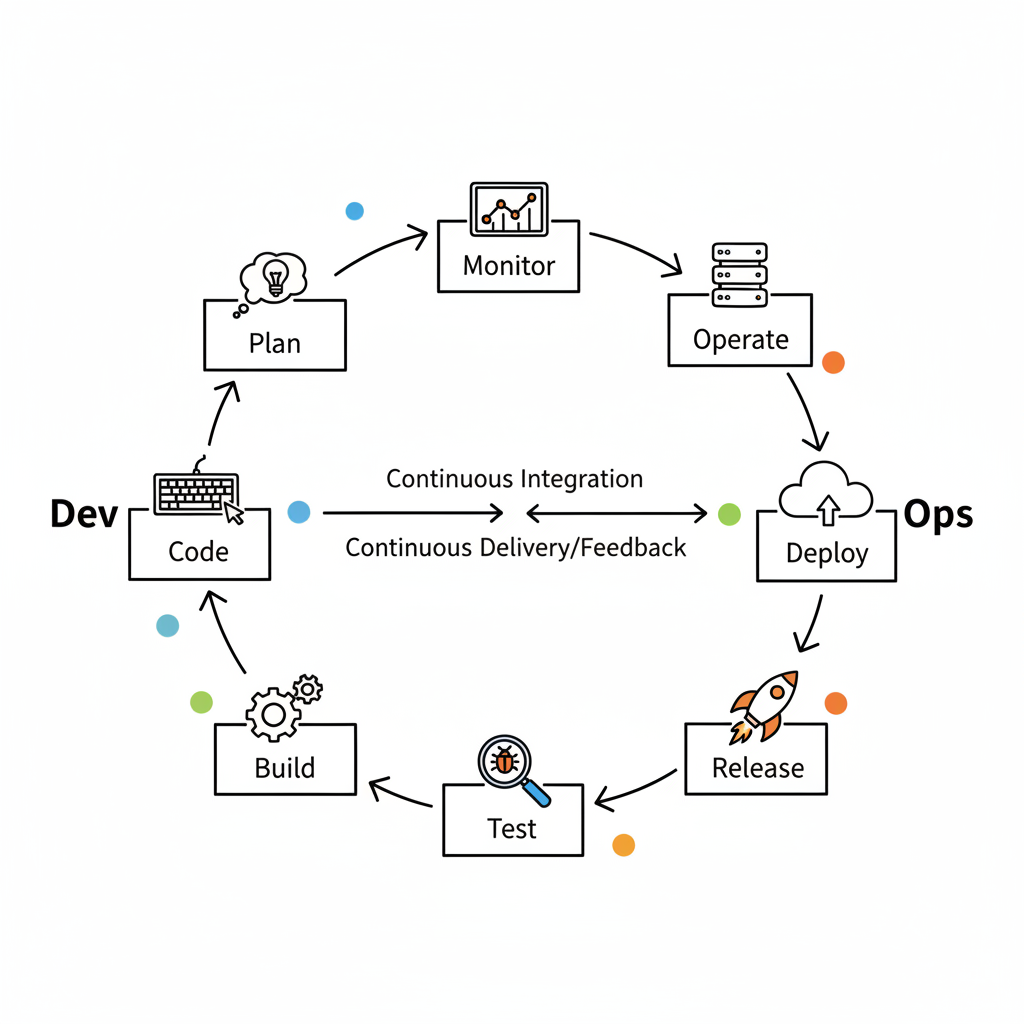
The first significant challenge to this traditional model came with the advent of Agile development. Agile methodologies, a core component of many project management certifications like PMP or ScrumMaster, revolutionized the development process by breaking down large projects into smaller, iterative cycles called sprints. This injected much-needed speed and flexibility into the development phase, but in doing so, it highlighted a major bottleneck elsewhere: operations.
Development teams were suddenly delivering code much faster. However, the operations team remained constrained by slow, manual deployment processes. This disparity intensified the friction. The faster developers moved, the higher the "wall of confusion" between Dev and Ops grew, setting the stage for an even more profound shift. If you want to dig into this foundational change, our complete guide to the Scrum framework is a great place to start.
The problem was evident: You can’t build a high-speed race car (Agile development) and then expect it to perform on a bumpy, unpaved road (traditional operations). The entire system, from end to end, required an upgrade.
The Formalization Of A Movement
This growing friction sparked a critical conversation within the tech community. The concept of DevOps began to coalesce between 2007 and 2009, born directly from this widespread industry frustration. The movement gained its name in 2009 when Patrick Debois coined the term 'DevOps' and organized the inaugural DevOpsDays conference in Ghent, Belgium. This event provided a formal platform for the idea of integrating these previously siloed teams.
This isn't merely a history lesson; it's the narrative of how an entire industry recognized that to build superior software, it first needed to build better, more interconnected teams. DevOps was not just a clever idea; it was a necessary evolution for modern IT.
Understanding The Core DevOps Principles
To truly grasp DevOps, one must look beyond specific tools and trendy processes. At its heart, DevOps is a guiding philosophy—a distinct way of thinking that informs every decision and collaboration. These core beliefs are the engine powering the entire cultural shift, which is often a key area of focus in certification exams on organizational transformation.
It all begins with an almost unwavering focus on the customer. In a genuine DevOps environment, every line of code, every deployment, and every server configuration is evaluated by a singular metric: the value it brings to the end-user. This customer-centric perspective becomes the team's north star, ensuring all technical efforts directly align with what the business and its users truly need.
It’s about constantly asking "why" before diving into the "how." Instead of mechanically churning out features from a backlog, teams are continually questioning how their work will genuinely improve the customer's experience. This aligns closely with the "Value Streams" principle in ITIL 4.
You Build It, You Run It
This customer-centricity naturally leads to the principle of end-to-end responsibility. The old paradigm—where developers would "throw code over the wall" to operations—is completely replaced. It's superseded by a simple yet powerful mantra: "You build it, you run it."
This means a single, unified team owns a feature throughout its entire lifecycle: from initial concept, through development, deployment, day-to-day operations, and even eventual retirement. This fosters a deep sense of pride, accountability, and a holistic understanding of the system. When developers are responsible for the operational health of their own code, especially during off-hours, they become intrinsically motivated to build resilient, stable, and observable systems from the outset. This concept is central to Site Reliability Engineering (SRE) practices, which are increasingly intertwined with DevOps.
This shift in ownership is a true game-changer. It eliminates the blame game between Dev and Ops because there is no longer a distinct "them" versus "us." The team collectively succeeds or fails.
The results speak for themselves. Studies consistently show that high-performing DevOps teams experience significantly fewer production failures, a direct benefit of this ingrained sense of ownership.
Reflection Prompt: How might adopting the "You Build It, You Run It" principle change the way a development team approaches unit testing or logging in their applications?
Foster Cross-Functional, Autonomous Teams
DevOps cannot thrive in a company culture dominated by silos and rigid handoffs. Its success hinges on building cross-functional, autonomous teams. These are small, self-contained groups equipped with all the necessary skills—coding, operations, quality assurance (QA), security, etc.—to deliver their piece of the puzzle without external dependencies.
Think of them not as a traditional hierarchical army, but more like a special operations unit. They can move quickly, make agile decisions, and creatively solve problems because all the required expertise resides within the team itself. This structure shatters communication bottlenecks that typically slow things down, a key benefit for passing certifications focused on team efficiency.
These teams are also empowered to select the tools and processes that best suit their needs, fostering a culture of innovation and intelligent experimentation. You can learn more about the thinking behind this in our in-depth guide on the foundations of DevOps philosophy.
Embrace Continuous Improvement
The final pillar is a profound commitment to continuous improvement. In the world of DevOps, nothing is ever truly "done" or static. Every workflow, every tool, and every process is viewed as a work in progress, constantly open to refinement and enhancement. This mindset transforms failures from catastrophic events into invaluable learning opportunities. This adaptive approach is frequently tested in ITIL and Agile-focused certification exams.
This principle comes to life through several key practices:
- Blameless Postmortems: When an incident occurs, the objective is not to assign blame, but to understand why it happened at a systemic level to prevent recurrence.
- Feedback Loops: Teams establish mechanisms to collect data and feedback at every stage of the process, using this information to drive smarter, iterative improvements.
- Experimentation: Teams are actively encouraged to try new approaches, measure their outcomes, and openly share what they've learned—whether successes or failures.
This is the principle that ensures the entire DevOps endeavor is sustainable. It guarantees that a DevOps transformation is not a one-off project but an ongoing journey of incremental betterment, every single day.
Key Practices in the DevOps Lifecycle
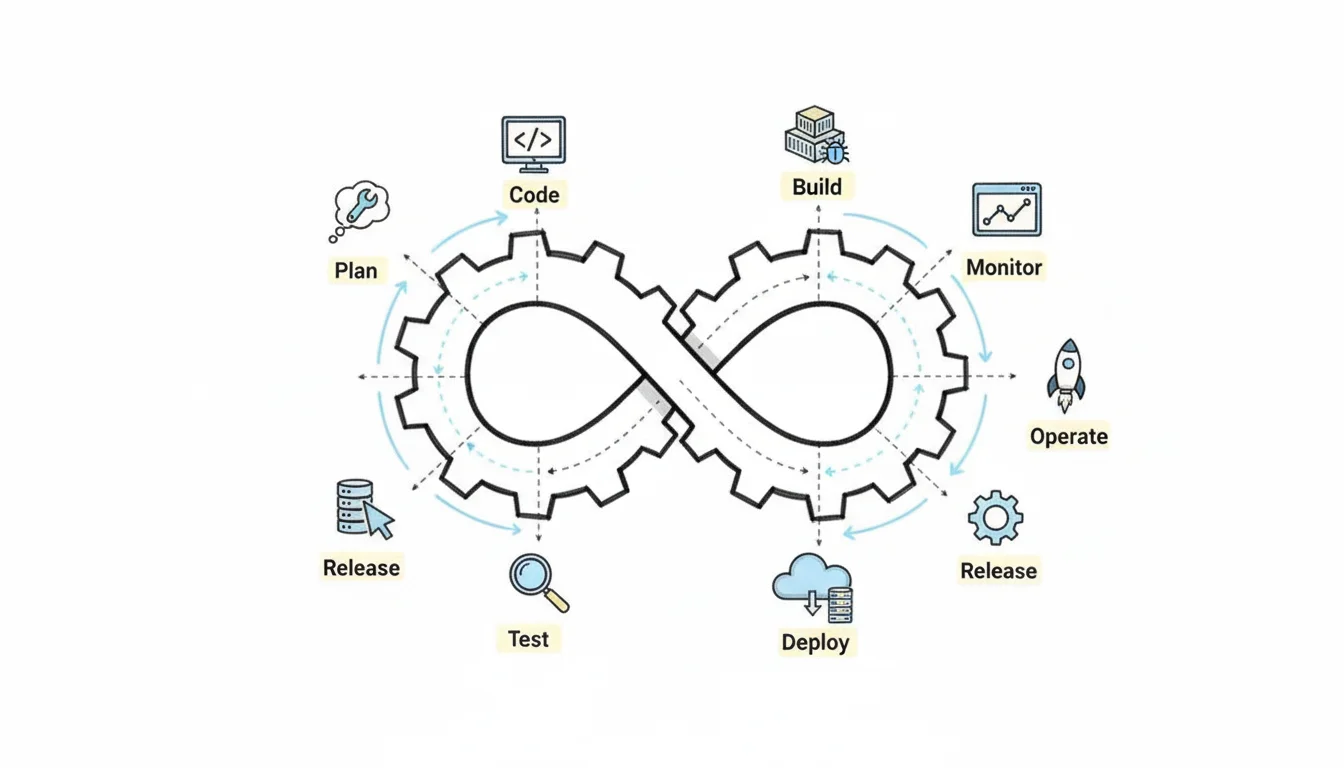
If the DevOps principles define the "why," then the practices articulate the "how." These are the hands-on, day-to-day activities that bring the philosophy to life. They are the intricate gears that power the entire machine, creating a smooth, automated, and observable path from a developer’s initial line of code to the hands of the end-user.
Envision it as a highly sophisticated, automated assembly line. Code enters one end, and a fully tested, validated, and ready-to-use piece of software emerges from the other. This assembly line is constructed upon a foundation of interconnected practices that ensure the entire process is fast, reliable, and consistent—crucial aspects for any IT professional managing software delivery.
Continuous Integration and Continuous Delivery (CI/CD)
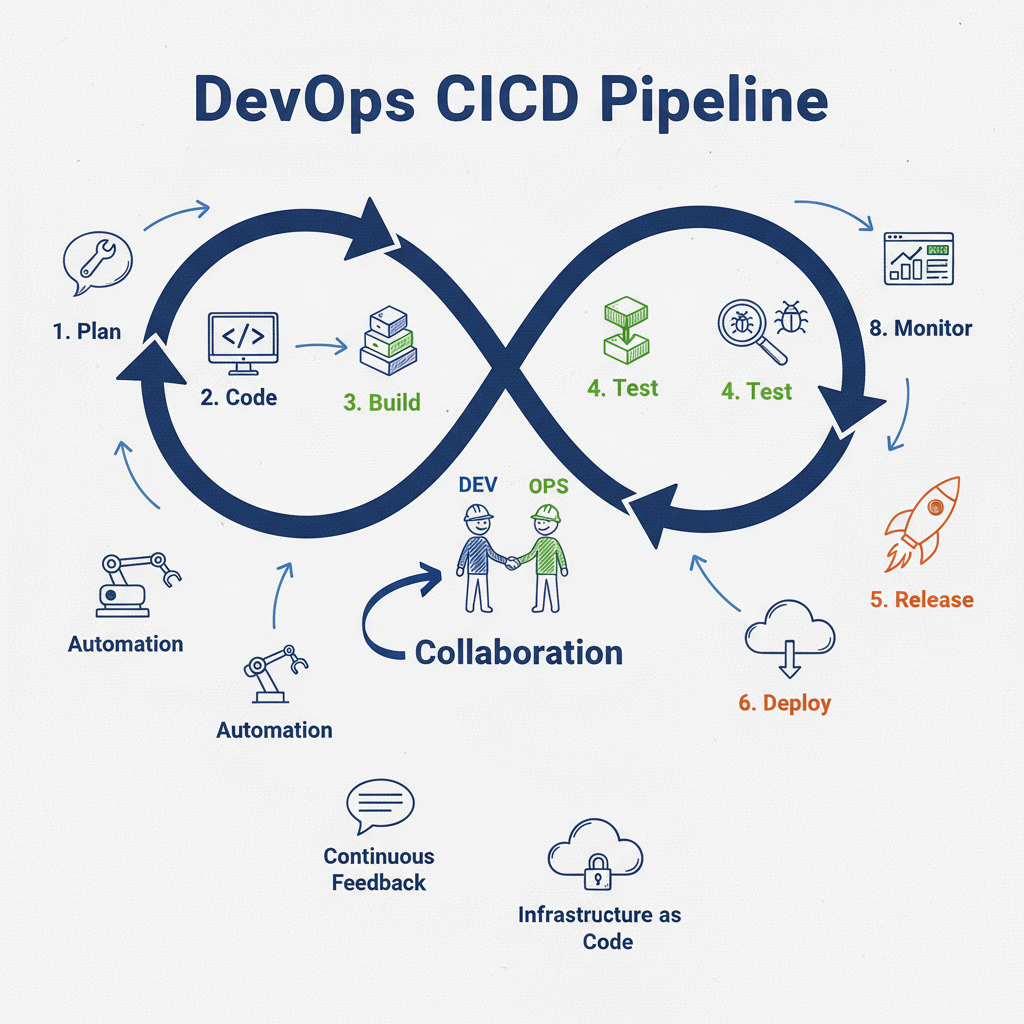
The absolute engine of the DevOps assembly line is the CI/CD pipeline. This is arguably the most fundamental practice, as it automates the entire journey of building, testing, and deploying software. It's essentially two complementary parts working in harmony, often a central theme in AWS and Azure DevOps certification exams.
- Continuous Integration (CI): This practice involves developers merging their code changes into a central shared repository (like GitHub or GitLab) not just once a week, but multiple times a day. Each time code is pushed, an automated build and test sequence is triggered. The primary goal is to catch integration bugs early and frequently, preventing them from accumulating into massive, complex problems later.
- Continuous Delivery (CD): This practice takes over seamlessly from CI. Once the code is successfully built and passes all automated tests, it is automatically packaged and prepared for release to various environments (e.g., staging, production). While the final deployment to production might still require a manual approval "button press," the software is always in a deployable state. An even more advanced version, Continuous Deployment, fully automates that final step, shipping validated changes directly to users without human intervention if all checks pass.
A robust CI/CD pipeline is the backbone of any high-performing team. To delve deeper into its intricacies, you can explore our guide on designing and implementing build and release pipelines for a much deeper look, particularly relevant for Azure DevOps professionals.
Infrastructure as Code (IaC)
You've automated the software delivery process, but what about the environments where it runs? That’s where Infrastructure as Code (IaC) becomes indispensable. Instead of a systems administrator manually configuring servers, databases, and networks via clicks—a process highly susceptible to human error and inconsistency—IaC allows you to define and provision your entire infrastructure using simple, version-controlled configuration files. Tools like AWS CloudFormation, Azure Resource Manager (ARM) templates, or Terraform are prime examples of IaC in action, critical for cloud certifications.
Think of IaC as a detailed architectural blueprint for your IT environment. Just as a blueprint ensures every house is built to precise specifications, IaC files guarantee that your server environments are consistent, repeatable, and easily scalable across development, testing, and production.
This approach effectively eliminates the infamous "it works on my machine" problem by ensuring that development, testing, and production environments are identical and provisioned in an automated, consistent manner.
Monitoring and Feedback Loops
Operating any complex system without a robust quality control and observation mechanism would be disastrous. In DevOps, continuous monitoring and automated testing establish that essential feedback loop. It’s insufficient to simply ship software rapidly; you must actively understand how it performs once it's in the hands of users. This is a vital component of any IT operations or SRE role, frequently assessed in certification exams.
This involves a couple of critical activities:
- Automated Testing: Tests are developed in conjunction with the code and executed automatically at every stage of the CI/CD pipeline. These go beyond simple checks, encompassing unit tests, integration tests, end-to-end tests, security tests, and performance tests that serve as critical quality gates, preventing faulty code from ever reaching users.
- Continuous Monitoring: Once the software is live, monitoring tools (like Prometheus, Datadog, or cloud-native services like AWS CloudWatch and Azure Monitor) continuously collect data on performance metrics, error rates, resource utilization, and user behavior. This real-time information is invaluable. It alerts teams to potential problems, often before customers even notice, and feeds directly back into the development cycle to guide the next set of improvements and features.
Each practice is meticulously designed to create a tight, continuous cycle of learning and improvement. That, fundamentally, is the heart of a successful DevOps culture.
To consolidate these concepts, here is a quick breakdown of these core practices and the specific challenges they address, offering a succinct overview useful for exam preparation.
DevOps Practices Breakdown
| Practice | What It Is | Problem It Solves |
|---|---|---|
| CI/CD | Automating the build, test, and deployment of code into a single, seamless pipeline. | Manual, slow, and error-prone release processes; reduces integration conflicts ("merge hell"). |
| IaC | Managing and provisioning infrastructure (servers, networks, databases) through machine-readable definition files. | Inconsistent environments across dev, test, and production; eliminates manual configuration errors. |
| Monitoring & Feedback | Continuously tracking application performance, system health, and user behavior to inform development. | Discovering bugs from angry customers; operating blind without data on new features' impact. |
Ultimately, these practices are not just about specific tools or automation; they are about constructing a more resilient, responsive, and reliable way to deliver continuous value to your users.
Reflection Prompt: Consider a recent software release you're familiar with. How could implementing CI/CD or IaC have prevented potential issues or sped up delivery?
What Are the Real-World Benefits of a DevOps Culture?
So, why are leading organizations worldwide fully embracing DevOps? The answer transcends merely following the latest trend; it lies in the tangible and powerful business results achieved when teams fundamentally alter how they collaborate. Moving beyond the buzzwords, a genuine DevOps culture provides a significant competitive advantage by profoundly improving how organizations operate, innovate, and ultimately serve their customers. These benefits are often highlighted in business value sections of certification exams.
The most immediately noticeable benefit is speed. It’s a transformative capability. By automating the entire process from code commitment to production release, DevOps dramatically reduces release cycles from months or weeks to mere hours. Top-tier DevOps teams can deploy code on-demand, frequently multiple times a day. This means new features and critical bug fixes reach users faster than ever, enabling businesses to react to market shifts almost instantaneously.
Driving Stability and Reliability
Counterintuitively, moving faster in a DevOps model doesn't mean breaking more things; the opposite is true. Speed, when coupled with the right practices, enhances stability. By pushing out small, frequent changes rather than massive, high-risk overhauls, it becomes significantly easier to pinpoint and resolve any issues that arise.
Practices like extensive automated testing and continuous integration act as integrated quality checks, catching bugs early in the development process, long before they can wreak havoc in production. This proactive approach drastically reduces the rate of failed changes. In fact, studies show that high-performing DevOps teams report their changes are substantially less likely to fail compared to their less mature counterparts. The ultimate outcome is a more resilient, reliable, and trustworthy service for your users—a critical goal for IT operations and SRE certifications.
A core tenet in DevOps is that speed and stability are not adversaries. They are two sides of the same coin, creating a virtuous cycle where rapid, reliable releases form the foundation for constant innovation and improvement.
Fostering a Healthier and More Engaged Culture
Perhaps the most impactful benefits of DevOps are not technical but cultural. By dismantling the artificial walls between developers and operations, DevOps eradicates the toxic "us vs. them" mentality that often leads to finger-pointing and organizational gridlock. When teams share collective responsibility for the entire software lifecycle, a powerful sense of collective ownership and shared purpose takes root. This cultural shift is increasingly recognized as a key success factor in PMP and ITIL certifications.
This collaborative atmosphere significantly impacts employee well-being and engagement. When individuals have the autonomy to solve problems and witness the immediate, positive impact of their work, job satisfaction dramatically increases. This leads to several major cultural wins:
- Reduced Burnout: Automation handles repetitive, mundane tasks, freeing engineers to focus on creative problem-solving and high-value work.
- Higher Morale: A culture of shared success, continuous learning, and blameless postmortems cultivates a psychologically safe environment where people feel supported and motivated.
- Stronger Ownership: The "you build it, you run it" philosophy empowers teams, naturally leading to higher-quality work and greater accountability.
Ultimately, all these benefits are interconnected, creating a powerful engine for sustained business growth. Faster delivery yields quicker feedback, which informs better product decisions. Enhanced stability builds customer trust and loyalty. And a more engaged, innovative team becomes an organization's most valuable asset, enabling it to adapt, thrive, and consistently stay ahead of the competition.
Choosing The Right Tools For Your DevOps Toolchain
While DevOps fundamentally represents a cultural shift, its principles cannot be fully realized without the appropriate technology. This is where your DevOps toolchain comes into play.
It's not a single, monolithic product. Instead, consider it more like a specialized mechanic’s workshop than a universal magic wrench. You assemble a collection of specialized, integrated tools that work in concert to automate the entire software delivery process, from the very first line of code written to monitoring its performance in production.
The critical aspect is selecting tools that integrate seamlessly, creating an automated and fluid workflow. Each tool performs its specific function and then smoothly passes the baton to the next, eliminating the need for manual handoffs. This tight integration is precisely what delivers the speed, reliability, and consistency that DevOps is renowned for. Getting a handle on the vast landscape of available DevOps tools is the essential first step toward constructing a pipeline that truly works for your organization and often a key area of study for DevOps certification exams.
Planning and Source Control
The DevOps journey commences long before any code is written. This initial phase is all about aligning everyone involved and establishing a single, authoritative source of truth for the entire project.
- Plan: This is where you meticulously map out what needs to be built. Tools like Jira, Azure Boards, or Trello are excellent for defining features, tracking progress, managing backlogs, and ensuring developers, project managers (PMP principles at play), and other stakeholders are perfectly aligned.
- Code & Control: Version control is an absolute imperative. Git is the undisputed industry standard, and platforms like GitHub, GitLab, or Azure Repos provide a centralized, cloud-based home for all your codebase. This forms the foundation: every change is meticulously tracked, and multiple developers can collaborate efficiently without conflicting with each other’s work.
Building and Testing Automation
As soon as code is committed, automation should immediately kick in. This represents the core of the CI/CD pipeline, where raw code is transformed into a product ready for rigorous testing.
The primary objective here is to detect and resolve bugs as early in the development cycle as possible. By automating the build and test process, every single code change is validated instantly, preventing problematic code from ever progressing further down the pipeline.
The power of this stage lies in its unwavering consistency. By automating builds and tests with tools like Jenkins, CircleCI, AWS CodeBuild, or Azure Pipelines, you eliminate the notorious "it works on my machine" problem and establish a repeatable, reliable process for validating software quality across all environments.
- Build: Automation servers or services like Jenkins, GitLab CI/CD, AWS CodeBuild, or Azure Pipelines act as the engines of the pipeline. They automatically retrieve the latest code from the repository, compile it, and package it into an executable artifact, all without manual intervention.
- Test: Tools such as Selenium for UI/acceptance testing, JUnit or NUnit for unit tests, Cypress or Playwright for end-to-end tests, and various security scanning tools (SAST/DAST) then take over. They run an extensive battery of automated tests to confirm that the new code functions as intended and, crucially, doesn't introduce regressions or break existing functionality.
Deployment and Operations
Once the code is successfully built and has passed all its automated tests, it’s time to deliver it to the intended environment. This final phase of the journey focuses intensely on consistency, scalability, and vigilant monitoring.
- Release & Deploy: This is where containerization truly shines. Tools like Docker package your application and all its dependencies into a lightweight, portable container. Then, an orchestrator like Kubernetes (a common topic in cloud and DevOps certifications) takes over, managing these containers at scale to handle automated deployment, scaling, and daily operations. For serverless architectures, services like AWS Lambda or Azure Functions provide similar benefits without direct server management.
- Operate & Monitor: The job isn't finished simply because the code is live. Continuous monitoring tools such as Prometheus, Grafana, Datadog, New Relic, or cloud-native services like AWS CloudWatch and Azure Monitor become your eyes and ears. They constantly observe application performance, log errors, track resource utilization, and feed real-time operational data back to the team. This crucial feedback closes the loop, informing the next round of planning and making DevOps a true, perpetual cycle of continuous improvement.
Answering Your Top DevOps Questions
Diving into DevOps often raises common questions, especially for IT professionals trying to understand its interplay with existing methodologies and career paths. Let's clarify some of the most frequently asked questions to illuminate its real value and how to embark on a DevOps journey.
Here are the answers to the questions we hear most often from teams and individuals just beginning their DevOps journey.
Is DevOps Just a Fancy New Name for Agile?
Not precisely, though they are certainly close relatives. Consider it this way: Agile methodologies are primarily focused on making the software development process itself faster and more flexible. It empowers developers to build and iterate rapidly in short, efficient bursts. Project Management Professional (PMP) and Scrum certifications heavily emphasize Agile practices within the development sphere.
DevOps, however, takes the core principles of Agile and expands them dramatically. It extends these same principles to encompass the entire software delivery pipeline—from the initial idea, through development, testing, deployment, and all the way to running and monitoring the application in production. Its ultimate goal is to break down the traditional wall separating the "devs" who create the software from the "ops" professionals who manage and maintain it.
So, if Agile makes the development team more efficient and responsive, DevOps makes the entire end-to-end value stream—from concept to live feature—faster, more reliable, and continuously observable.
Do I Have to Be a Coder to Get into DevOps?
While a foundational understanding of coding or scripting significantly aids in a DevOps role, it is not a strict prerequisite for every position within a DevOps culture. A healthy DevOps environment requires a diverse mix of skills: deep expertise in operations, robust quality assurance (QA), strong security knowledge, and adept project management are all crucial components. What truly matters most is cultivating a mindset that embraces automation, collaboration, and continuous learning.
The real goal is to build a team of "T-shaped" individuals—professionals who possess deep expertise in one specific area (the vertical bar of the 'T') but also have a broad working knowledge across other related disciplines (the horizontal bar). For example, an operations specialist might acquire scripting skills (e.g., Python, PowerShell) to automate infrastructure, or a QA expert might learn to develop automated testing pipelines. If you're looking for a career in this space, this excellent guide on finding remote DevOps engineer jobs offers some great pointers.
The objective isn't to transform everyone into a full-stack developer. It’s about dismantling rigid job titles and fostering a truly cross-functional team that shares skills, understands diverse perspectives, and communicates effectively.
What's the Single Biggest Challenge When Adopting DevOps?
In almost all cases, the biggest hurdle to successful DevOps adoption is culture, not technology. Acquiring and implementing new tools is relatively straightforward. However, changing deeply ingrained ways of working and organizational behaviors that have existed for years is the profoundly difficult part. The true challenge lies in transforming the human element within an organization. This cultural resistance is a common theme in change management and organizational transformation discussions within certifications like PMP and ITIL.
This kind of organizational transformation necessitates several critical shifts:
- Transitioning away from a "blame game" culture towards one of shared responsibility and collective problem-solving.
- Encouraging teams that historically operated in silos (like development and operations) to genuinely collaborate and integrate their workflows.
- Cultivating a psychologically safe environment where it is acceptable to fail, provided that valuable lessons are learned and applied.
Without strong, visible leadership and widespread buy-in from all levels of an organization, this cultural shift is nearly impossible. The tools serve merely as enablers; it is the people and the culture that truly make DevOps thrive and deliver its promised benefits.
Reflection Prompt: Thinking about your own organization or a company you've studied, what specific cultural barriers might hinder a successful DevOps adoption, and how could they be addressed?
At MindMesh Academy, we believe that mastering the concepts behind certifications is the definitive key to sustained career success. Our platform offers expert-curated study materials and evidence-based learning techniques to help you not just pass your exams, but truly understand and apply the material in real-world scenarios. Start your learning journey with us today!

Written by
Alvin Varughese
Founder, MindMesh Academy
Alvin Varughese is the founder of MindMesh Academy and holds 15 professional certifications including AWS Solutions Architect Professional, Azure DevOps Engineer Expert, and ITIL 4. He's held senior engineering and architecture roles at Humana (Fortune 50) and GE Appliances. He built MindMesh Academy to share the study methods and first-principles approach that helped him pass each exam.