Pass Your Test ITIL Foundation Exam An End-to-End Guide
Mastering the ITIL 4 Foundation Exam: Your Comprehensive Guide to Certification Success
For IT professionals seeking to elevate their careers and speak the universal language of IT service management, the ITIL Foundation exam is a pivotal step. This comprehensive guide, brought to you by MindMesh Academy, offers an end-to-end roadmap designed to equip you with a deep understanding of the material, effective preparation strategies, and the confidence to ace your certification. We’ll meticulously break down everything you need to know to not just pass, but truly master the concepts required to earn this valuable credential.
Why the ITIL Foundation Is a Career Game Changer
Earning your ITIL Foundation certificate transcends merely adding another line to your resume. It's about acquiring a globally recognized framework—a universal language of IT service management. Major global organizations, from Microsoft and Sony to IBM, leverage ITIL to streamline their IT operations and drive business value.
Consider ITIL your strategic playbook for aligning IT services directly with core business objectives. It fundamentally shifts the perception of IT within an organization, transforming it from a perceived cost center into a proactive department that actively creates and delivers value. This certification is your gateway to a professional world focused on enhancing service quality, boosting operational efficiency, fostering innovation, and significantly improving customer satisfaction. It powerfully signals to employers that you possess the foundational knowledge to manage IT risks, implement best practices, and contribute to tangible business improvements.
Reflection Prompt: How might understanding ITIL principles change your current approach to IT projects or service delivery in your organization?
A Globally Recognized Standard
The widespread adoption of ITIL underscores its enduring relevance. By 2023, over 1 million professionals worldwide had achieved an ITIL certification, cementing its status as a cornerstone of the modern IT industry. Its influence continues to grow, serving as a benchmark for excellence in service management.
Perhaps even more compelling, a significant 70% of IT recruiters identify ITIL certification as a key differentiator when screening candidates for service management roles. This statistic highlights the tangible advantage you gain in a competitive job market. For those interested in exploring this further, Axelos offers additional data on ITIL's global impact, illustrating why this certification remains a highly strategic career investment.
What This Guide Will Cover
This guide will meticulously walk you through every stage of your ITIL Foundation certification journey, leaving no stone unturned. Our aim is to build your confidence and knowledge from the ground up.
Here’s a detailed overview of what we’ll explore:
- Exam Structure Deep Dive: We will thoroughly dissect the ITIL Foundation exam format, including the number of questions, critical time limits, and the all-important passing score.
- Syllabus Breakdown: You’ll gain a clear and concise understanding of the core concepts crucial for the exam, ranging from the overarching Service Value System to the essential ITIL Practices.
- Strategic Study Plan: We'll unveil proven methods like spaced repetition and adaptive learning, showing you how to optimize your study time for maximum retention and efficiency.
- Common Pitfalls and How to Avoid Them: Learn from typical mistakes made by other candidates, ensuring your preparation path is as smooth and effective as possible.
Our ultimate goal is to empower you with the knowledge and strategy needed to approach your ITIL Foundation exam not just ready, but truly confident in your ability to succeed.
What to Expect on Exam Day: The ITIL Foundation Exam Structure
Before you can effectively tackle the ITIL Foundation exam, it’s imperative to thoroughly understand its structure. Visualize it as a pilot's pre-flight checklist: knowing the instrument panel is the foundational step toward a smooth and successful flight. A complete understanding of the exam's mechanics eliminates day-of surprises, allowing you to channel all your energy into accurately answering the questions.
Let’s lift the curtain and reveal the core mechanics of this crucial IT certification test.
How the Exam Is Scored and Timed
The ITIL Foundation exam is structured as a multiple-choice assessment. You will encounter 40 questions and be allocated precisely 60 minutes to complete them. This translates to roughly 90 seconds per question, demanding a focused balance of speed and accuracy in your responses.
Crucially, it is a closed-book exam. No notes, textbooks, or digital resources are permitted. This design choice is deliberate: the exam evaluates your genuine absorption of core ITIL principles, not your ability to quickly reference information.
To achieve a passing score, you must answer 26 out of the 40 questions correctly, which equates to 65%. A significant advantage is that there's no penalty for incorrect guesses. If you encounter a question that stumps you, always make an educated guess and then move on. Never leave a question unanswered.
This straightforward and transparent format contributes to the ITIL Foundation's consistently high pass rate, typically hovering between 92% and 94%. With over 200,000 candidates globally taking this exam annually, its accessible design makes it one of the most popular entry-level IT certifications available. For a deeper exploration into certification costs and success rates, gogotraining.com offers valuable insights into the ITIL exam journey.
The "What" and "Why," Not the "How-To"
The questions on the ITIL Foundation exam are crafted to assess your knowledge at the initial two levels of Bloom's Taxonomy, a hierarchy of educational objectives. While this might sound academic, it provides a crucial lens for how you should approach your studies.
- Level 1 (Knowledge): This assesses your ability to recall facts, definitions, and specific concepts within the ITIL framework. Can you define "Incident Management" or list the ITIL Guiding Principles?
- Level 2 (Comprehension): This goes deeper, testing your capacity to explain principles and understand their underlying purpose. Can you articulate why a particular ITIL practice is used or how the Service Value System facilitates value creation?
What does this mean for your study approach? The ITIL Foundation exam primarily focuses on the "what" and the "why" of the framework. You won't be tasked with solving complex, multi-stage case studies or designing intricate service management processes from scratch. Your study efforts are best invested in mastering definitions, grasping the core concepts, and understanding how these elements interrelate to form a cohesive system. Avoid getting bogged down in implementation details; concentrate on foundational understanding.
Reflection Prompt: How will knowing the exam focuses on "what" and "why" influence your study methods compared to a more "how-to" focused certification (e.g., a hands-on AWS or Azure exam)?
Exam Logistics: Taking the Test
When it comes to the practicalities of taking the exam, PeopleCert, the official examining body, provides flexible options to suit your preferences.
Here's a concise overview of the key exam details:
ITIL Foundation Exam at a Glance
| Exam Component | Details |
|---|---|
| Question Format | 40 Multiple-Choice Questions |
| Time Limit | 60 Minutes (1 hour) |
| Passing Score | 65% (26 out of 40 correct) |
| Exam Style | Closed-Book |
| Cognitive Level | Bloom's Levels 1 & 2 (Recall & Comprehension) |
With these critical details in mind, you can select the most suitable environment for your exam:
The most popular choice is the online proctored exam. This allows you to take the test conveniently from your home or office, provided you have a stable internet connection, a functioning webcam, and a microphone. A remote proctor monitors you via webcam to ensure adherence to exam regulations.
Alternatively, if you prefer a structured, dedicated testing environment, you can opt to take the exam at a physical accredited test center. Many candidates find the quiet, distraction-free atmosphere conducive to optimal focus.
By thoroughly familiarizing yourself with these essential logistical components, you are already well on your way. You understand the rules of the game, and now you’re poised to develop a winning strategy.
A Deep Dive into the ITIL 4 Foundation Syllabus
Understanding the ITIL Foundation exam format is merely the first step; true success hinges on mastering the actual content. The official ITIL 4 Foundation syllabus serves as your definitive roadmap. Do not merely skim it; treat it as the blueprint for your entire study plan. Every concept listed within this syllabus is fair game for an exam question.
The objective here isn't rote memorization of acronyms and definitions. Instead, it's about developing a profound grasp of how the various components of ITIL interconnect and collaborate to empower IT departments to deliver genuine, measurable value to the business. Let's thoroughly explore the core elements you'll need to know intimately.
The Service Value System (SVS)
At the very core of ITIL 4 is the Service Value System (SVS). Envision the SVS as the powerful engine driving the entire ITIL framework. It illustrates precisely how every single component and activity within an organization orchestrates to transform business opportunities and demand into tangible value.
Consider a sophisticated, well-oiled machine. At the input end, you have an opportunity—for example, a pressing business need like, "Our customers urgently require a new, high-performance mobile application!" This opportunity enters the SVS, and through a series of integrated activities, the output is realized as tangible value—a fully functional, user-friendly, and high-performing mobile app that delighted customers love.
The SVS comprises several interconnected elements that you must understand thoroughly for the exam:
- The ITIL Guiding Principles: These are the foundational philosophies and universal recommendations that steer every decision and action within service management. They're essentially the common-sense truths that guide behavior.
- Governance: This defines how the organization is strategically directed and controlled, providing the framework within which the SVS operates.
- The Service Value Chain (SVC): This is the operational heart of the SVS, a flexible set of six core activities (Plan, Engage, Design & Transition, Obtain/Build, Deliver & Support, Improve) that organizations perform to create value in response to demand.
- ITIL Practices: These are the specific organizational resources designed to perform work or accomplish an objective. They are the toolkits, such as Incident Management or Change Enablement, that translate the SVC activities into action.
- Continual Improvement: This is the ongoing commitment and systematic approach to enhancing service quality, ensuring that performance consistently meets and exceeds business requirements.
Key Takeaway: The SVS provides a holistic, end-to-end view of how an organization creates value using its IT services. Each component plays a vital role in this value co-creation process.
The Four Dimensions Model
To successfully deliver a valuable service, one cannot simply focus on the technology in isolation. The Four Dimensions Model compels you to adopt a holistic perspective, ensuring that every critical aspect is comprehensively addressed. Neglecting even one of these dimensions significantly increases the risk of delivering a service that is inefficient, excessively costly, or fundamentally fails to meet user expectations.
Here are the four interdependent dimensions you must consider for effective service management:
- Organizations and People: This dimension addresses the human element and organizational structure. It encompasses the company's culture, leadership, required skills, roles, responsibilities, and overall workforce capability needed to deliver and manage services.
- Information and Technology: This dimension covers the information, knowledge, and technological assets necessary for service delivery and management. This includes databases, applications, infrastructure, artificial intelligence, machine learning, and automation tools.
- Partners and Suppliers: This dimension focuses on managing relationships with external entities that contribute to service delivery. This includes contracts, agreements, and the overall collaborative ecosystem with third-party vendors and partners.
- Value Streams and Processes: This dimension examines how the organization’s various parts work together in an integrated, coordinated manner to facilitate value creation. It involves understanding the steps involved in delivering a product or service, from demand to value realization.
Imagine launching a new cloud application (Information and Technology) without adequately training your support staff (Organizations and People), securing robust agreements with your cloud provider (Partners and Suppliers), or clearly defining the steps for handling user requests (Value Streams and Processes). Such an oversight in any dimension could lead to service outages, frustrated users, and a significant failure to deliver intended value.
This next flowchart offers a quick visual reminder of the exam's structural elements, which is beneficial to keep in mind as we delve into the syllabus topics.
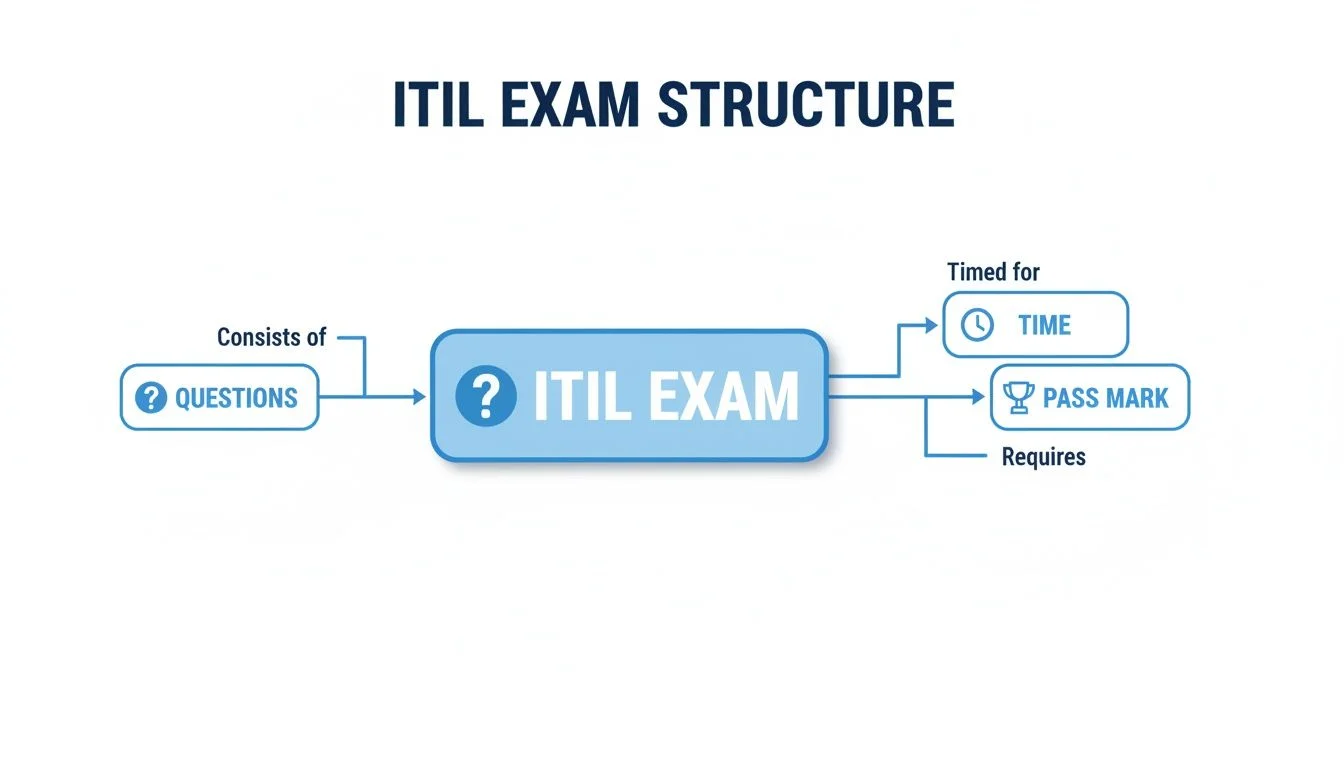
As illustrated, the exam is a race against the clock. You must demonstrate both speed and accuracy across those 40 questions to achieve the 65% passing score within a mere 60 minutes.
Key ITIL Practices You Must Know
ITIL 4 encompasses a total of 34 management practices, but there's no need to panic! The Foundation exam specifically focuses on a select subset of the most essential ones. You are not required to know every single practice in detail, but you absolutely must possess a firm understanding of the purpose and core concepts of those included in the syllabus.
For example, consider Incident Management as the immediate IT firefighter. Its sole purpose is to restore normal service operation as quickly as possible when an unplanned interruption occurs, minimizing business impact. Conversely, Problem Management functions as the meticulous detective who arrives after the incident, investigating the root cause to prevent recurrence and proactive eliminate future incidents.
The exam frequently tests your ability to distinguish between these similarly named yet distinct concepts. It's crucial to understand that an incident is the "fire" (an unplanned service interruption), a problem is the "faulty wiring" that caused the fire (the underlying cause of one or more incidents), and a service request is simply a user asking for a new service or a standard operational item (like requesting a new laptop or a password reset). Knowing these distinctions is often the key to selecting the correct answer on scenario-based questions.
Nailing these critical distinctions is often what differentiates a successful pass from a near-miss. For a comprehensive checklist of every topic you need to cover, we highly recommend checking out our guide on the full ITIL 4 Foundation syllabus. Gaining comfort and proficiency in these core areas is paramount to approaching your exam with the confidence required to achieve certification.
Your Step-By-Step ITIL Foundation Study Plan
Successfully passing your ITIL Foundation exam isn’t about sheer brute force; it’s about deploying a smart, efficient, and strategic approach. Mindlessly plowing through a textbook page by page is a common pitfall that often leads to burnout and poor knowledge retention. To truly ingrain the complex ITIL concepts, you need a structured plan built upon scientifically proven learning techniques.
This is precisely where methodologies like Spaced Repetition and adaptive learning prove invaluable.
Think of your memory as a muscle that strengthens with intelligent exercise. Spaced Repetition works by strategically scheduling reviews of topics at increasing intervals, precisely when your memory of that information is about to fade. Each subsequent review reinforces the neural connections, making the knowledge progressively more durable and accessible. This approach is far superior to cramming, which typically results in knowledge degradation shortly after the exam.
Adaptive learning takes this effectiveness a step further. It intelligently analyzes your performance on practice questions and exercises, pinpointing your specific strengths and, more importantly, your weaknesses. It then dynamically adjusts your study path, prioritizing content on the topics where you struggle most. This ensures that your valuable study time is spent shoring up your knowledge gaps, rather than reviewing concepts you’ve already mastered.
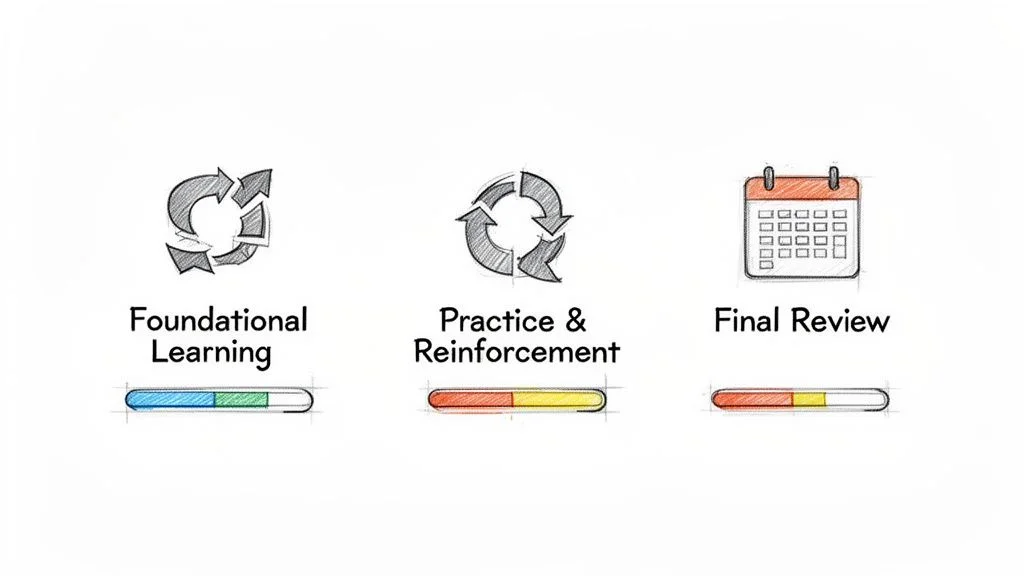
We can systematically break down your entire ITIL Foundation preparation into three distinct, progressive phases. Each phase builds upon the last, guiding you from an initial understanding to being fully exam-ready.
Phase 1: Foundational Learning
The initial phase is dedicated to constructing a robust knowledge base. Resist the urge to rush this critical step. Your primary objective here is not mere memorization of definitions but a genuine understanding of the core concepts presented in the ITIL 4 syllabus. Allocate your first one to two weeks to thoroughly immerse yourself in the material.
Focus intently on the "why" behind each concept. For instance, delve into why the Service Value System was introduced, or how the Four Dimensions collectively prevent service failures. When you establish this strong conceptual bedrock, the subsequent recall of specific details and definitions becomes significantly easier and more intuitive. Engaging in active reading, summarizing sections in your own words, and discussing concepts with peers can greatly enhance this foundational phase. To optimize your learning experience, it’s also beneficial to consider understanding different learning styles of adults.
Phase 2: Practice and Reinforcement
Once you feel a reasonable grasp of the foundational concepts, it's time to rigorously test that knowledge. This phase, typically spanning another one to two weeks, is entirely centered around practice exams and scenario-based questions. The goal here isn't simply to achieve a high score; it's to precisely diagnose where your understanding might be fuzzy or incomplete.
After completing each practice test, engage in a meticulous review of every single question you answered incorrectly. Do not merely acknowledge the correct answer and move on. Instead, deeply investigate why that option was correct and, crucially, what logical flaw or knowledge gap led to your incorrect choice. This deep-dive analysis is where the most significant learning occurs.
This iterative feedback loop is the true engine of effective studying. Each incorrect answer should not be viewed as a failure, but rather as a precise signpost directly indicating a knowledge gap. Systematically addressing and closing these gaps is the most accelerated route to increasing your exam readiness and confidence.
Utilize this invaluable feedback to revisit the specific syllabus areas where you struggled. Platforms like MindMesh Academy are purpose-built around this very principle. Our adaptive learning dashboard provides a clear, visual breakdown of your performance by topic, enabling you to pinpoint exactly where to concentrate your energy for maximum impact.
Phase 3: Final Review
The final few days leading up to your exam should be dedicated entirely to consolidation and fine-tuning. This is emphatically not the time to introduce new concepts or deep-dive into complex topics. Instead, your focus should be on a high-level review of all the material you’ve already learned, ensuring it remains fresh and readily accessible in your mind.
Here’s a practical checklist for your final review phase:
- Review Key Terms and Definitions: Perform a rapid scan of all primary definitions, acronyms, and core vocabulary. Use flashcards or a quick quiz session.
- Revisit Weak Areas: Dedicate one last focused session to the specific topics or practices that consistently gave you trouble during Phase 2.
- Take a Final Mock Exam: Complete one last full-length practice test under simulated exam conditions, strictly adhering to the time limit. Aim for a score comfortably above the 65% passing mark to bolster your confidence.
- Prioritize Rest: This cannot be overstated. The day before your exam, engage in a light review in the morning, then put your study materials away. A well-rested and clear mind will always outperform an exhausted one.
By diligently following this structured, three-phase approach, you will transform your study efforts from a passive reading chore into an active, strategic plan for achieving ITIL Foundation certification success.
Navigating ITIL Foundation Sample Questions
Understanding ITIL theory is one essential component. However, effectively applying that knowledge under the pressure of a ticking exam clock is an entirely different challenge. This is precisely why engaging with ITIL Foundation sample questions isn't just a good idea—it's one of the most critical elements of your preparation. Practice questions serve as the crucial bridge between theoretical learning and the practical application required by the exam.
As you consistently engage with exam-style questions, you begin to develop a "sixth sense" for how examiners craft questions. You learn to recognize common traps, internalize the specific language and phrasing used, and move beyond simple definition memorization to genuine conceptual understanding. The goal isn't merely to select the correct answer; it's to deeply comprehend why a particular answer is correct and why other options are incorrect.
Dissecting a Sample Question
Let’s meticulously walk through a typical question you might encounter on the ITIL Foundation exam. This process will provide you with a repeatable, systematic approach for analyzing the problem, evaluating your options, and confidently arriving at the correct answer.
Sample Question: A user is unable to access the company's shared drive, preventing them from completing an urgent report. Which ITIL practice is responsible for restoring this service as quickly as possible?
- A) Problem Management
- B) Service Level Management
- C) Incident Management
- D) Change Enablement
Step 1: Identify Keywords and Core Objective. First and foremost, extract the most significant keywords from the scenario. Phrases like "unable to access," "urgent report," and especially "restoring this service as quickly as possible" are vital clues. This language strongly indicates an unplanned interruption and an immediate need for resolution. The core objective is rapid service restoration.
Analyzing the Options
Now, let's rigorously evaluate each provided option against what we know about the purpose of the respective ITIL practices:
- A) Problem Management: This practice is akin to detective work. Problem Management focuses on identifying the root cause of incidents to prevent their recurrence. It's about proactive prevention and long-term resolution, not immediate crisis response. Therefore, this option is incorrect as it doesn't align with the immediate "restoring service" objective.
- B) Service Level Management: This practice is comparable to contract negotiation. Service Level Management defines, agrees upon, monitors, and reports on service targets (SLAs) with customers. While an SLA might specify the expected speed of incident resolution, this practice doesn't perform the hands-on restoration itself. Thus, it's not the correct answer.
- C) Incident Management: This is the IT emergency response team. The primary and explicit goal of Incident Management is to restore normal service operation as swiftly as possible, minimizing the adverse impact on business operations. This aligns perfectly with the keywords and core objective of our scenario.
- D) Change Enablement: This practice acts as the gatekeeper for all IT changes, ensuring that modifications are properly assessed, authorized, and implemented without causing undue risk or disruption. While a change might ultimately be required to permanently fix the issue (a problem resolution), this practice is not focused on the immediate, rapid restoration of an active service interruption.
The unequivocally correct answer is C) Incident Management. Its entire purpose is to promptly address service interruptions and return systems to normal functionality, which precisely matches the user's urgent need in the scenario.
By systematically breaking down the question in this manner, you're not merely guessing. You're employing logical deduction to connect a real-world scenario to the precise purpose and scope of each ITIL practice—a fundamental skill the ITIL Foundation exam evaluates repeatedly.
Reflection Prompt: How would your analysis change if the question asked, "Which ITIL practice is responsible for investigating the underlying cause of frequent shared drive outages?"
Common ITIL Question Types and Strategies
The ITIL Foundation exam employs a variety of question formats to thoroughly test your understanding of the material. Familiarizing yourself with these common question types will significantly enhance your performance on exam day.
Here's a concise overview of the most prevalent question formats you'll encounter and effective strategies for tackling them:
| Question Type | Description | Strategy |
|---|---|---|
| Direct Recall | Asks for a specific definition, a component of a list, or the direct purpose of an ITIL concept. | These are the most straightforward. Rely on your strong foundational knowledge. If uncertain, use the process of elimination to discard obviously incorrect options. |
| Scenario-Based | Presents a short, real-world situation or problem and asks you to apply the appropriate ITIL concept or practice. | Methodically hunt for keywords and phrases in the scenario that indicate the objective or type of situation (e.g., "fix fast," "prevent recurrence," "requesting something new"). Match this objective to the official purpose of an ITIL practice. |
| "Which is NOT" / Negative Questions | Asks you to identify the one option that does not fit with a specific concept, list, or set of characteristics. | Read these questions meticulously, often twice! Your brain is naturally inclined to seek the correct statement, but here you must actively identify the outlier or incorrect statement. This is a classic trap. |
The most effective way to master these diverse question formats is through consistent practice. To accurately gauge your readiness and experience the real thing, we highly recommend exploring the MindMesh Academy ITIL 4 Foundation practice exam simulator. It’s specifically engineered to enhance both your knowledge and your confidence, ensuring you walk into the exam prepared for any challenge.
Understanding the Value of ITIL Certification
Having explored the exam structure and delved into the syllabus, you might still be pondering a crucial question: Is all the effort required to pass the ITIL Foundation exam truly worth it? The answer from industry experts is a resounding yes, and its value extends far beyond simply adding another bullet point to your professional resume. Obtaining ITIL certification is a highly strategic career move that yields substantial benefits, both for your individual professional trajectory and for any organization you contribute to.
Consider ITIL as learning the definitive, universal language of IT service management.
For you, personally, the most immediate and tangible benefit is a significant boost to your career prospects and earning potential. ITIL is not a niche framework; it's a global standard leveraged by 90% of Fortune 500 companies. This pervasive adoption creates a substantial and consistent demand for IT professionals who are fluent in its principles.
Quantifying Your Career Advancement
This robust industry demand directly translates into a competitive edge in your compensation. ITIL-certified professionals consistently command higher salaries than their non-certified counterparts. For instance, holding the ITIL Foundation certificate can elevate your average annual salary to approximately $98,000 in major markets. This represents an impressive 13% increase compared to colleagues without the certification, clearly demonstrating the premium employers place on these specialized skills.
Once you successfully pass the exam and secure your certification, it becomes a powerful professional asset. It’s essential to showcase this credential effectively. You can find excellent advice and practical tips on how to list certifications on a resume to maximize its impact.
The value of ITIL is not merely a superficial line on a resume; it is a proven indicator of your capability to contribute to organizational stability and robust business alignment. It signals to employers that you possess a fundamental understanding of how to connect IT activities directly to critical business outcomes, driving efficiency and value creation.
Driving Organizational Success
From an organizational perspective, the benefits of ITIL adoption are equally clear and measurable. When IT teams and business units operate with a shared ITIL mindset, companies consistently observe significant improvements in operational efficiency and service quality. The framework provides a structured, standardized approach to managing IT services, leading to fewer unexpected disruptions, enhanced problem resolution, and a more stable, predictable IT environment.
A compelling real-world example is Disney. The entertainment giant effectively implemented ITIL principles to manage the incredibly complex technological infrastructure that underpins their theme parks. The outcome? A dramatic reduction in service disruptions, which translated into a smoother, more magical, and consistently positive experience for millions of guests. This is ITIL’s impact in action: transforming complex IT into reliable, high-value service delivery.
Organizations that strategically integrate ITIL often realize several key advantages:
- Improved Service Quality: Standardized processes and best practices lead to more consistent, reliable, and higher-quality IT services.
- Better Business Alignment: ITIL inherently encourages IT teams to align their efforts directly with overarching business goals, ensuring technology investments deliver strategic value.
- Increased Customer Satisfaction: More reliable services, faster issue resolution, and a proactive approach to service management naturally result in happier internal users and external customers.
Ultimately, ITIL provides you with the essential playbook to evolve an IT department from a reactive cost center into a proactive, strategic business partner that consistently creates genuine value. If you're eager to delve deeper into this topic, explore our comprehensive breakdown on whether ITIL certification is truly worth it for your career goals.
Reflection Prompt: How might ITIL principles be applied in a department outside of traditional IT (e.g., HR, Marketing) to improve service delivery or process efficiency?
Frequently Asked Questions About the ITIL Foundation Exam
As your ITIL Foundation exam day approaches, it's entirely natural for specific questions to surface. You’ve dedicated significant effort to your preparation, and now it’s about addressing any lingering uncertainties. Let's tackle some of the most common questions our students ask, ensuring you walk into your exam feeling fully prepared and supremely confident.
How Long Should I Study for the ITIL Foundation Exam?
This is akin to asking, "how long is a piece of string?" The honest and most accurate answer is that it largely depends on your existing IT background and familiarity with service management concepts. There isn't a universally magic number of study hours.
If you are relatively new to IT service management, a steady and consistent pace over 3-4 weeks is an excellent target. Aim for 5-7 focused study hours per week – enough to thoroughly absorb the concepts without experiencing burnout. Conversely, if you are an experienced IT professional with existing exposure to IT operations or service delivery, you might only require 1-2 weeks to familiarize yourself with the specific ITIL terminology, the Service Value System, and the ITIL Practices. The true key to success lies in consistency and active learning, rather than last-minute cramming.
Are There Any Prerequisites for Taking the Exam?
Absolutely none. The ITIL 4 Foundation exam has no formal prerequisites, and this design choice is intentional.
It is specifically crafted as an entry point into the world of IT service management, making it accessible to a diverse audience. This includes students just starting their careers, professionals looking to pivot into new IT or business roles, or even individuals in non-technical positions who wish to gain a fundamental understanding of how IT services are managed. While some prior familiarity with general IT concepts can certainly be helpful, it is by no means a mandatory requirement to successfully pass the exam.
The ITIL Foundation exam is explicitly designed as a starting point, not an endpoint. Its core purpose is to build a foundational understanding of service management principles that are broadly applicable across various roles, industries, and organizational contexts, irrespective of your prior professional experience.
What Happens If I Fail the ITIL Foundation Test?
First and foremost, it's important not to panic. While the pass rate for the ITIL Foundation exam is commendably high, not passing on the first attempt does happen. The good news is that you can absolutely retake the exam.
PeopleCert, the official examining body, allows candidates to retake the exam, though a new fee is typically required. A savvy strategy is to look for training providers who offer a "pass guarantee" or a discounted retake voucher, often branded as "Take2," as part of their comprehensive study packages. Should you find yourself needing a second attempt, treat your initial score report as an invaluable treasure map. It will precisely highlight your weak areas, allowing you to strategically refocus your study efforts and confidently achieve success on your next try.
Is This Certification Worth It for Non-Technical Roles?
Unequivocally, yes! The era where ITIL was exclusively for "the IT guys" is firmly in the past. If you operate in a non-technical role such as a project manager, business analyst, product owner, or even a team lead in a non-IT department, a solid understanding of how IT delivers value to the business provides a significant competitive advantage.
Consider this: the ITIL Foundation certification equips you with a shared language and a common framework for understanding service delivery. This powerful common ground helps dismantle traditional silos between technical and non-technical teams, fostering significantly smoother communication, collaboration, and project execution. It is a genuinely impactful credential for anyone in an organization that relies on technology to succeed—which, let's be honest, encompasses virtually every organization in today's digital landscape.
Ready to conquer your ITIL Foundation exam with a proven study system? MindMesh Academy offers adaptive learning paths, expertly crafted study materials, and realistic practice tests designed to get you certified faster and with greater confidence. Start your ITIL Foundation journey today.

Written by
Alvin Varughese
Founder, MindMesh Academy
Alvin Varughese is the founder of MindMesh Academy and holds 15 professional certifications including AWS Solutions Architect Professional, Azure DevOps Engineer Expert, and ITIL 4. He's held senior engineering and architecture roles at Humana (Fortune 50) and GE Appliances. He built MindMesh Academy to share the study methods and first-principles approach that helped him pass each exam.