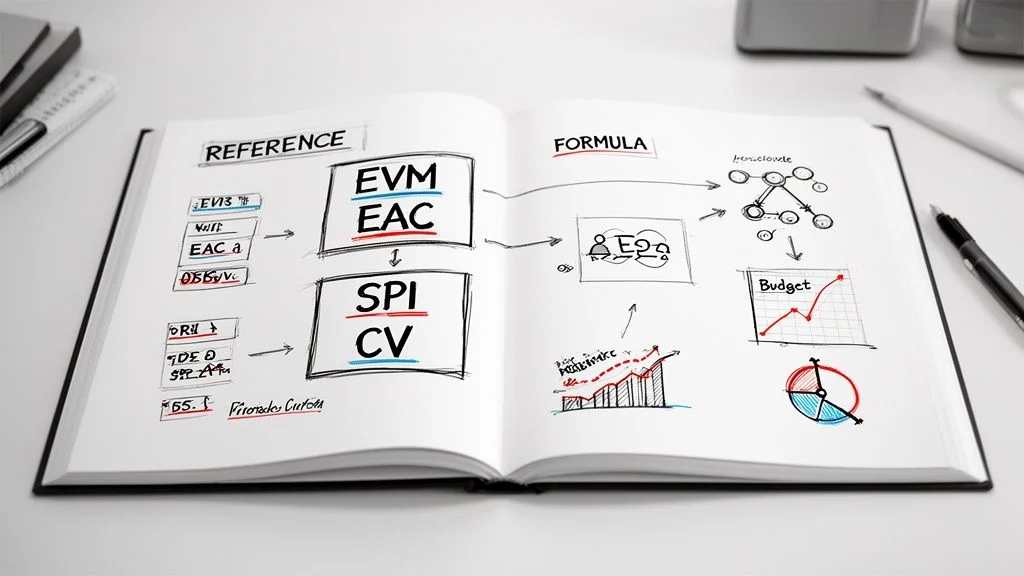
Mastering PMP Certification Formulas for Your 2026 Exam
If you're an IT professional eyeing the PMP exam, you've likely heard the buzz (or dread) about the formulas. Let's be unequivocally clear: a solid grasp of the underlying mathematics is not just helpful; it's absolutely fundamental for passing the PMP certification. While the exam has evolved to be more scenario-based, the ability to accurately interpret project data and make informed decisions hinges on understanding these core calculations. Ignoring them is not an option for success.
At MindMesh Academy, we believe in practical, applicable knowledge. This guide will equip you with a mastery of PMP formulas, ensuring you can not only recall them but, more importantly, apply them effectively in real-world and exam scenarios.
A Quick Reference Guide to Essential PMP Exam Formulas
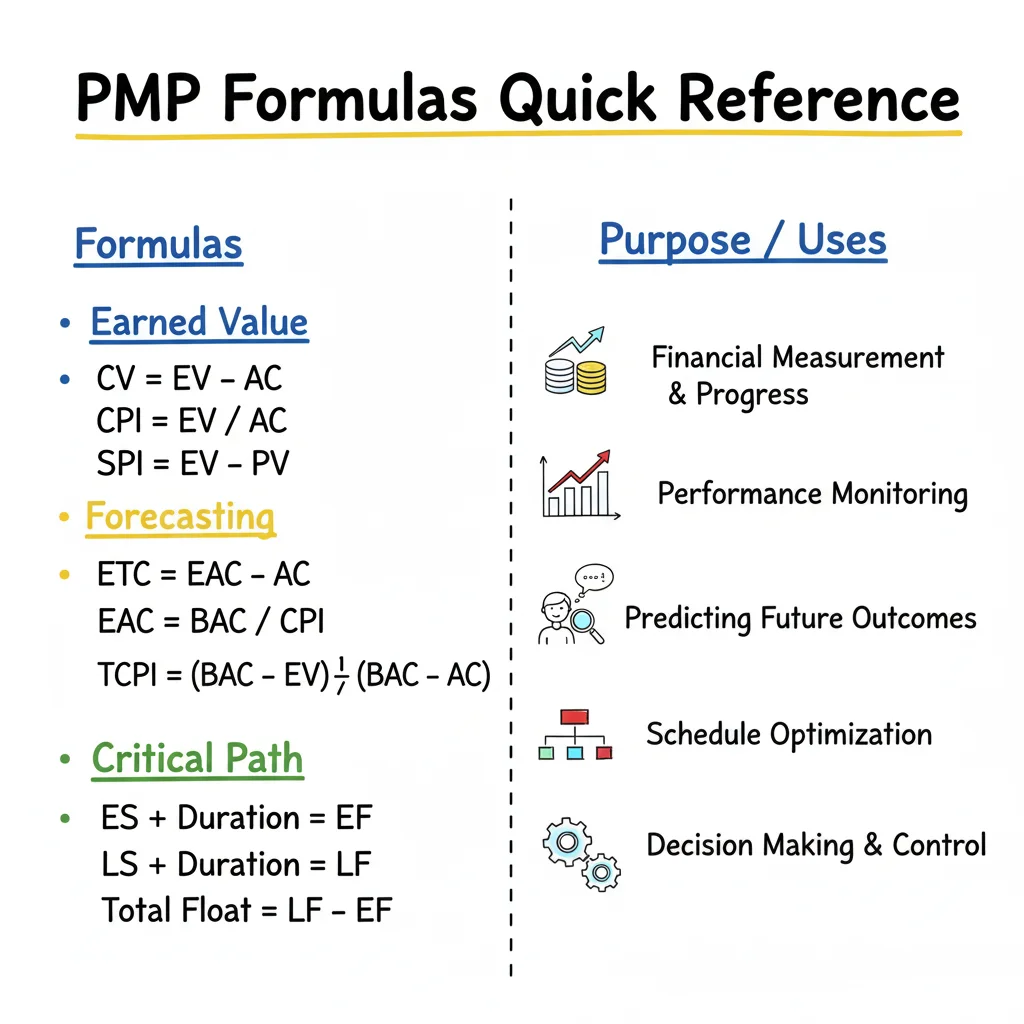 Caption: A comprehensive quick reference sheet for PMP certification formulas, categorized for easy study.
A common pitfall for many PMP candidates is simply memorizing formulas. The exam, however, is expertly designed to test whether you understand when to use a particular formula and why its result matters. It’s all about context and critical thinking. You'll be presented with a complex project situation, and your challenge will be to select the appropriate formula, perform the calculation, and then leverage that result to make a sound project decision. This skill is vital for PMP success and for your career as a project manager.
This guide serves as your definitive resource for every PMP formula you'll encounter. We'll move beyond mere definitions, diving into the operational context, practical examples, and common mistakes that frequently trip up even experienced professionals.
Core PMP Formula Categories at a Glance
To make your study efforts more strategic and manageable, it's beneficial to group the formulas into distinct categories. Understanding the primary purpose of each category and its typical weighting on the PMP exam allows you to prioritize your learning and focus your energy efficiently.
Here’s a concise overview to help you navigate the upcoming sections:
| Formula Category | Primary Purpose | Exam Importance |
|---|---|---|
| Earned Value Management (EVM) | To objectively measure project performance against baselines (cost, schedule, scope) and provide an integrated project status. | High |
| Forecasting (ETC, EAC) | To predict future project performance and estimate the final costs and completion dates based on current project data and trends. | High |
| Critical Path & Schedule | To determine the shortest possible project duration, identify critical activities, and understand schedule flexibility (float). | Medium |
| Procurement & Risk | To calculate specific contract price points (e.g., seller's risk threshold) and quantify the potential financial impact of risks and opportunities. | Medium |
| Communication & Estimation | To quantify communication complexity within a team and refine accuracy in time/cost estimates for tasks. | Low |
This table acts as your roadmap. In the following sections, we will delve deep into each category, dissecting every formula with step-by-step examples designed to solidify your understanding and practical application skills.
Understanding Earned Value Management (EVM) Formulas
For IT professionals pursuing the PMP certification, few topics are as critical, or as frequently tested, as Earned Value Management (EVM) formulas. Think of EVM as the project manager's advanced diagnostic dashboard. It cuts through subjective status reports by integrating your project's scope, schedule, and costs into one objective, quantifiable picture. This powerful tool helps you manage complex projects, whether it's a large-scale software deployment, an infrastructure upgrade, or a cloud migration initiative.
Mastering EVM means moving beyond guesswork to making truly data-driven decisions. At any stage of your project, it provides clear, undeniable answers to the two most critical questions:
- Are we truly on schedule to meet our deadlines?
- Are we sticking to the budget, or are we overspending?
To unlock these answers, you must first firmly grasp the three core data points that serve as the foundation for every EVM calculation: Planned Value (PV), Earned Value (EV), and Actual Cost (AC).
The Three Pillars of EVM Data
Before you can calculate variances, performance indexes, or future forecasts, you need these foundational inputs. They represent what you planned, what you actually achieved, and what that achievement cost you.
- Planned Value (PV): This is the authorized budget allocated for the work planned to be completed by a specific point in time. It represents your baseline, answering the question, "According to our plan, what value should we have earned by now?"
- Analogy: If you're building an AWS cloud environment with 10 modules over 10 weeks, the PV at week 5 would be the budgeted cost of 5 completed modules.
- Earned Value (EV): This is the monetary value of the work actually completed, measured against the budget baseline. It addresses, "How much value have we truly delivered from the work we've finished?"
- Analogy: In the AWS example, if you're at week 5 but only 4 modules are truly done and accepted, your EV is the budgeted cost of those 4 modules.
- Actual Cost (AC): This is the total money spent to accomplish the work for which you've measured the EV. Simply put, it asks, "How much have we paid out of pocket so far?"
- Analogy: This is the cumulative expense incurred for developing those 4 AWS modules.
Once you have these three critical numbers, you gain the power to objectively analyze your project's health.
Calculating Cost Variance and Schedule Variance
Variances are your initial diagnostic tools. They quantify the deviation between your plan and your reality, expressed in monetary terms. A positive variance is a sign of favorable performance, while a negative number signals a problem that requires immediate attention.
The formulas themselves are quite straightforward:
- Cost Variance (CV) = EV - AC
- Schedule Variance (SV) = EV - PV
Here's a memory aid that has proven effective for many PMP candidates: both formulas begin with EV. If you commit this to memory, the rest falls into place. Cost Variance focuses on money, comparing the value you've earned (EV) against what you've actually spent (AC). Schedule Variance, on the other hand, is about time, comparing the value you've earned (EV) against the value you planned to earn by this point (PV).
Interpreting Variance Results:
- CV > 0: You are currently under budget. This is a favorable outcome.
- CV < 0: You are currently over budget. This is an unfavorable problem that needs addressing.
- SV > 0: You are currently ahead of schedule. This is also a favorable situation.
- SV < 0: You are currently behind schedule. This is an unfavorable situation requiring investigation.
Example: Calculating Variances in a Software Project
Let's apply these concepts to a typical IT project scenario. Imagine you're managing a new mobile application development project with a total Budget at Completion (BAC) of $100,000, planned over 10 weeks. We are now at the end of week 5.
- Calculate PV: Your plan dictated that you should be halfway done. So, PV = 50% of $100,000 = $50,000. This is the budgeted value of work you should have completed by week 5.
- Determine EV: After reviewing user story completion and testing, you find that only 40% of the total project work is actually finished and accepted. So, EV = 40% of $100,000 = $40,000.
- Find AC: Checking the project's financial ledger, you see that $48,000 has been spent to date.
Now, let's plug these numbers into our variance formulas:
- Cost Variance (CV) = $40,000 (EV) - $48,000 (AC) = -$8,000
- Schedule Variance (SV) = $40,000 (EV) - $50,000 (PV) = -$10,000
Reflection Prompt: In an instant, you know this project is facing significant challenges. You're $8,000 over budget and behind schedule by work valued at $10,000. What immediate actions would you, as the project manager, consider based on these alarming figures?
Analyzing Performance with CPI and SPI
While variances provide a dollar figure for deviations, they can sometimes lack context. An $8,000 overage on a $100,000 project is a major concern, but on a $10 million enterprise-wide Azure migration, it might be a minor anomaly. This is precisely why we rely on performance indexes—they measure your efficiency as a ratio, providing crucial context.
The formulas for the Cost Performance Index (CPI) and Schedule Performance Index (SPI) are:
- Cost Performance Index (CPI) = EV / AC
- Schedule Performance Index (SPI) = EV / PV
These indexes are incredibly powerful because they quantify your rate of performance. For both, a value greater than 1.0 indicates efficient performance (good!), while a value less than 1.0 signals inefficiency (bad!).
Interpreting Index Results:
- CPI > 1.0: You are earning more value than you are spending. Your project is under budget.
- CPI < 1.0: You are spending more than the value you are creating. Your project is over budget.
- SPI > 1.0: You are getting work done faster than planned. Your project is ahead of schedule.
- SPI < 1.0: You are progressing slower than planned. Your project is behind schedule.
Example: Calculating Performance Indexes
Let's revisit the data from our mobile application project:
- EV = $40,000
- AC = $48,000
- PV = $50,000
Now, let's calculate the efficiency indexes:
- Cost Performance Index (CPI) = $40,000 / $48,000 = 0.83
- Schedule Performance Index (SPI) = $40,000 / $50,000 = 0.80
A CPI of 0.83 means that for every dollar spent, you are only generating 83 cents worth of work. This clearly indicates a significant cost inefficiency. Similarly, an SPI of 0.80 reveals that you are only accomplishing 80% of the work you had scheduled for this period. These numbers paint a stark, objective picture of a project with serious performance issues demanding immediate corrective action. To delve deeper into these foundational concepts, explore our detailed guide on the fundamentals of EVM on MindMesh Academy.
Becoming comfortable with these EVM metrics is non-negotiable for the PMP exam. The PMP test is challenging by design, with first-time pass rates historically estimated between 60% and 70%. This statistic isn't meant to deter you, but to underscore that PMI tests your ability to apply knowledge in realistic scenarios, not just recall it. The significant difference in pass rates between bootcamp attendees and self-studiers often highlights the critical importance of mastering applied concepts like EVM. Getting these formulas ingrained is a direct and powerful way to boost your chances of PMP success.
Applying Forecasting Formulas Like ETC and EAC
*Caption: A video explanation of Estimate at Completion (EAC) calculations, a key PMP forecasting formula.*Once you've utilized EVM to establish a clear understanding of your project's current status, the next crucial step is to look proactively into the future. This is precisely where forecasting formulas come into play. These predictive PMP certification formulas take your current performance data, such as CPI and SPI, and use them to answer the most common stakeholder question: "Where are we ultimately headed, financially and chronologically?"
These calculations are what distinguish a reactive project manager from a truly proactive one. It’s insufficient to merely know you're over budget; you must be able to predict the new projected final cost and determine the estimated resources needed to successfully finish the remaining work. For the PMP exam, mastering these forecasting formulas is absolutely essential. You will consistently encounter scenarios requiring you to calculate the most likely financial outcome of your project.
Estimate to Complete (ETC): The Work Remaining
Let's begin with the Estimate to Complete (ETC). In practical terms, this formula tells you how much more money you will likely need to spend to finish the rest of the project from the current point onward. It's your forward-looking cost forecast from today until the project's ultimate completion.
The most straightforward way to calculate ETC is:
- Estimate to Complete (ETC) = EAC - AC
The logic here is sound: simply take your new, projected total final cost (Estimate at Completion, or EAC) and subtract the cumulative money you've already spent (Actual Cost, or AC). The difference represents what you still need to spend to complete the project. We'll delve into the various EAC formulas next, as you often need that figure first to calculate ETC.
Estimate at Completion (EAC): The Four Scenarios
This is a cornerstone of PMP forecasting. The Estimate at Completion (EAC) is your new, reality-based prediction for the project's total cost at its conclusion. While your original budget (Budget at Completion, or BAC) was your best estimate at the outset, the EAC is a dynamic metric that adapts based on the project's actual performance and any changes in assumptions.
The PMP exam is renowned for testing your ability to select the correct EAC formula for a specific scenario. You must understand and be prepared for four primary scenarios.
1. EAC When Original Estimates Were Flawed (but current variance is atypical) You'll use this formula when you recognize that your initial budget was fundamentally inaccurate, but you are confident that the remaining work can be completed at the original planned rate of efficiency. This implies the variance encountered so far was a one-time event.
- Formula: EAC = AC + (BAC - EV)
- When to Use: Choose this when you've encountered a unique, non-recurring issue that won't impact future performance. You are essentially accepting the costs incurred so far (AC) and adding the original budgeted cost for the work that is still left to be done (BAC - EV).
- PMP Exam Clue: Look for phrases like "the variance to date is atypical" or "we expect future performance to be at the planned rate."
2. EAC When Current Performance Will Continue (most common) This is arguably the most common and heavily tested EAC formula. It operates on the assumption that the cost efficiency (or inefficiency) demonstrated up to the present moment will likely persist for the remainder of the project.
- Formula: EAC = BAC / CPI
- When to Use: This is your default choice when you believe that the cost variances experienced so far are typical and represent a sustainable trend. It effectively re-baselines your entire budget by adjusting it based on your proven Cost Performance Index (CPI).
- PMP Exam Clue: Key phrases include "assume current variances will continue," "the CPI is expected to continue for the remainder of the project," or "future performance will be like past performance."
3. EAC When Both Cost and Schedule Performance Matter This formula introduces a layer of complexity, suitable for situations where both your schedule and your budget performance are expected to collectively influence the final cost.
- Formula: EAC = AC + [(BAC - EV) / (CPI × SPI)]
- When to Use: This formula is particularly relevant when you're both behind schedule (SPI < 1.0) and over budget (CPI < 1.0). The logic here is that being behind schedule might necessitate accelerating work, potentially incurring additional costs (e.g., overtime, expedited delivery), leading to a combined impact on the final EAC.
- PMP Exam Clue: Watch for scenarios where both time and cost issues are intertwined and expected to influence the total cost, or phrases like "performance considering both cost and schedule factors."
4. EAC When You Have a New Estimate (from the ground up) Sometimes, past performance and the original plan become entirely irrelevant due to a major event. A significant risk event, a substantial scope change, or an unforeseen external factor might necessitate abandoning old forecasts and creating a fresh, new estimate.
- Formula: EAC = AC + New ETC
- When to Use: Deploy this formula after a game-changing event has occurred, forcing the project team to perform a brand-new, bottom-up estimate for all the remaining work. Your new total project cost is simply the sum of what you've already spent plus this freshly calculated estimate to complete.
- PMP Exam Clue: Look for "new bottom-up estimate for remaining work" or "original plan no longer valid due to major change."
PMP Exam Strategy Tip: The wording in exam questions is your most important clue. Train yourself to identify these specific phrases. For example, if a question states, "the team expects performance to continue as it has been," that's your strong signal to use the EAC = BAC / CPI formula. If it mentions "the original plan was fundamentally flawed, but future work will be as planned," then EAC = AC + (BAC - EV) is likely the correct choice. Practice discerning these nuances to confidently select the right formula.
This flowchart visually summarizes how to quickly assess your project's health based on those core EVM values, guiding your decision for forecasting.
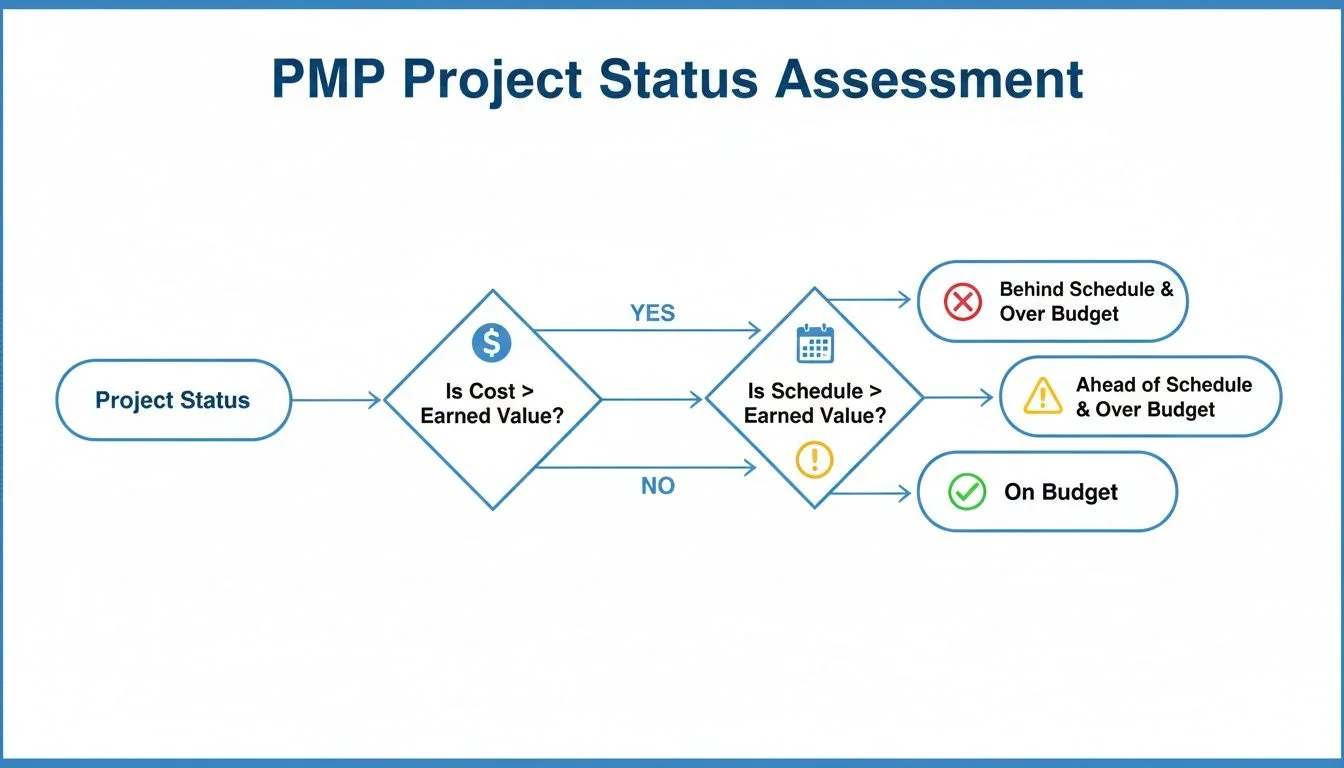 Caption: A flowchart illustrating how to quickly assess project health using Earned Value (EV), Actual Cost (AC), and Planned Value (PV).
As depicted, if your actual costs surpass your earned value, you are currently over budget. Similarly, if you've earned less value than what you planned for a given period, you're inevitably behind schedule. These are precisely the situations where accurate forecasting becomes absolutely critical for proactive project management.
Mastering Critical Path and Schedule Formulas
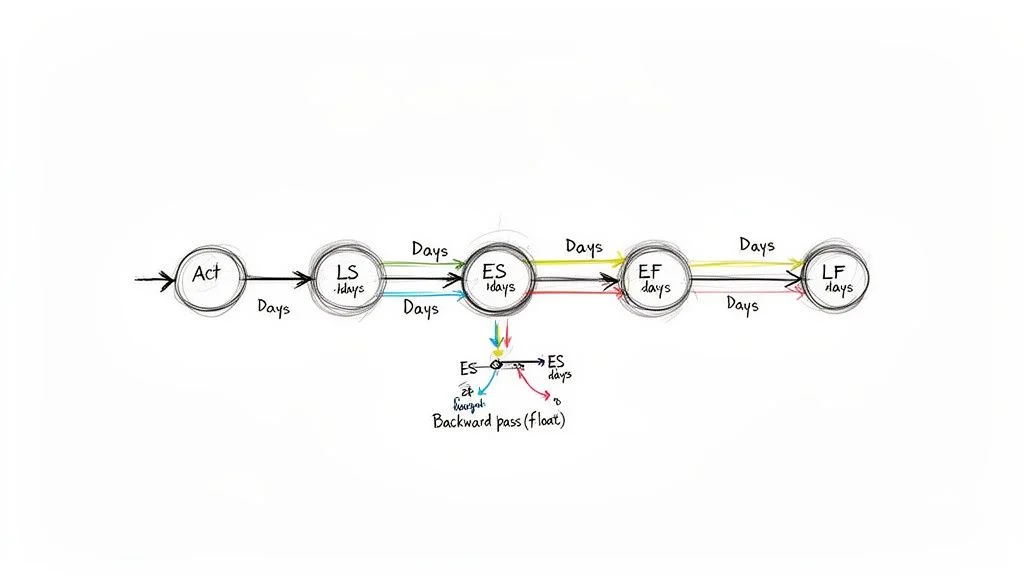 Caption: A visual representation of a project schedule network, detailing the calculation of Early Start, Early Finish, Late Start, and Late Finish for tasks.
While budget management and cost control often dominate discussions, a project that is late can be just as detrimental—if not more so—than one that's overspent. For any serious IT project manager, whether in software development, infrastructure deployment, or system integration, a robust understanding of schedule network analysis and the related PMP certification formulas is absolutely essential. These calculations are how you determine your project’s shortest possible duration and, more critically, identify the tasks that allow absolutely no room for delay.
At the core of this knowledge area is the Critical Path Method (CPM). Envision it as the longest continuous sequence of activities in your project, where any delay to a task on this path directly delays the entire project completion date. It dictates the absolute minimum time your project will take. If a single task on the critical path is delayed by even one day, your entire project's finish date will slip by one day, impacting client commitments, resource availability, and potentially incurring penalties.
Calculating ES, EF, LS, and LF
So, how do you pinpoint this critical path? It all begins with calculating four key dates for every single task within your project's network diagram. This is typically achieved through two distinct passes: a forward pass and a backward pass.
The Forward Pass (Determining the Earliest Dates) You initiate this pass at your project’s official start date and systematically work your way forward through the entire schedule network. The objective is to ascertain the absolute earliest moment each activity can potentially begin and conclude.
- Early Start (ES): The earliest possible moment a task can commence. For the project's very first activity, this is typically Day 1 (or the project start date). For all subsequent tasks, the ES is determined by the Early Finish of its immediate predecessor activity.
- Early Finish (EF): The earliest possible moment an activity can be completed.
- Formula: EF = ES + Duration
The Backward Pass (Determining the Latest Dates) Once you've reached the very end of the project with your forward pass, you then reverse direction and work backward through the schedule network. During this pass, you're calculating the latest possible moment a task can start or finish without causing any delay to the project’s overall completion deadline.
- Late Finish (LF): The absolute latest a task can be completed without pushing out the project end date. For the final activity in the project, its LF is usually the same as its EF (the desired project completion date). For every task preceding it, the LF is the Late Start of the task that immediately follows it.
- Late Start (LS): The latest possible moment a task can begin before it causes a delay to the project's scheduled completion.
- Formula: LS = LF - Duration
Uncovering Schedule Flexibility with Float
With these four critical values (ES, EF, LS, and LF) calculated for every single task, you are now equipped to determine the Total Float, also frequently referred to as Slack. Float is invaluable—it represents the amount of time a specific activity can be delayed from its Early Start without impacting the project's overall final delivery date.
Calculating Total Float is straightforward, and you have two equivalent methods to arrive at the same answer:
- Total Float = LS - ES
- Total Float = LF - EF
Any task exhibiting a Total Float greater than zero provides some degree of scheduling flexibility and breathing room. However, a task with zero Total Float possesses absolutely no flexibility at all. These are the critical activities that collectively form your project’s critical path.
Key Takeaway for PMP Certification & Real-World Projects: The critical path is defined as the sequence of activities where the Total Float equals zero. These are the tasks that demand your constant and vigilant attention. Any unforeseen hiccup or delay in these activities will directly translate into a delay for your project’s overall completion date, making them your highest priority for proactive risk management, resource allocation, and continuous monitoring. Knowing how to accurately calculate float isn't merely an academic exercise for the exam; it is a fundamental skill for effectively managing project schedules in any real-world IT environment.
Formulas for Procurement, Communication, and Risk
While the extensive calculations of Earned Value Management (EVM) and schedule analysis often take center stage in PMP exam preparation, it’s crucial to remember that the exam also features several other essential formulas. These calculations, appearing within the Procurement, Communication, and Risk Management knowledge areas, are the kind of questions that can significantly impact your final score.
Though they might not appear with the same frequency as EVM questions, you can almost certainly expect at least one question from each of these categories. Mastering these diverse formulas ensures you are fully prepared for anything the exam might present, allowing you to confidently secure those valuable points.
Calculating the Point of Total Assumption (PTA)
Let's begin with a concept that often poses a challenge for many PMP candidates: the Point of Total Assumption (PTA). This specific calculation is exclusively relevant to Fixed Price Incentive Fee (FPIF) contracts. The PTA marks the precise cost threshold where the seller begins to absorb 100% of any further cost overruns. Once the project's actual costs exceed the PTA, the price for the buyer is capped at the ceiling price, and all subsequent financial risk for additional costs falls squarely on the seller's shoulders.
The primary purpose of the PTA formula is to identify the exact project cost point at which the seller's profit begins to erode with every additional dollar spent.
- Formula: PTA = [(Ceiling Price - Target Price) / Buyer's Share Ratio] + Target Cost
Let’s quickly define what these variables represent in a real-world contracting scenario:
- Target Cost: The initial, agreed-upon estimated cost for the work to be performed.
- Target Fee: The seller's planned profit if the project is completed at the Target Cost.
- Target Price: The price the buyer agrees to pay if the project costs are exactly on target (Target Cost + Target Fee).
- Ceiling Price: The absolute maximum amount the buyer will ever pay under the contract, regardless of actual costs incurred by the seller.
- Buyer's Share Ratio: The buyer's predetermined percentage of any cost savings (if under target) or cost overruns (if over target, up to the PTA). For instance, in an 80/20 split, the buyer’s share ratio is 80%, or 0.8.
A Practical PTA Example for a Software Contract
Imagine you are managing the procurement for a custom software development project with the following FPIF contract structure:
- Target Cost: $200,000
- Target Fee (seller's planned profit): $20,000
- Target Price: $200,000 (Target Cost) + $20,000 (Target Fee) = $220,000
- Ceiling Price: $240,000
- Share Ratio: 80/20 (Buyer/Seller, meaning the buyer pays 80% of overruns up to PTA, seller pays 20%)
Let’s plug those numbers into the PTA formula step-by-step:
- PTA = [($240,000 - $220,000) / 0.80] + $200,000
- PTA = [$20,000 / 0.80] + $200,000
- PTA = $25,000 + $200,000
- PTA = $225,000
So, what does this $225,000 figure signify? It's the critical threshold. The moment the project's actual costs surpass $225,000, the seller becomes solely responsible for 100% of every additional dollar spent. Their profit margin will continue to shrink with every dollar burned past this point until it potentially turns into a loss, while the buyer's cost is capped at the ceiling price. Understanding PTA is crucial for evaluating contract risks and negotiating effectively.
The Communication Channels Formula
Now, let's shift focus from contracts to the dynamics of human interaction within a project. As you integrate more individuals into your project team, the complexity of communication doesn't merely grow linearly—it explodes exponentially. The communication channels formula is an elegantly simple yet powerful tool that illustrates precisely why establishing a robust and clear communication plan is far more than a "nice-to-have."
This formula calculates every single potential line of communication that can exist between all team members and key stakeholders.
- Formula: N(N-1) / 2
- Variable: N = the number of people (team members + key stakeholders) involved in the project.
This is not just a theoretical concept; it serves as a powerful visual aid for project managers. The addition of just one more person to a team doesn't simply add one more communication channel; it adds multiple new channels, each of which needs to be managed, monitored, and understood.
Real-World Application: Consider a small Agile development team of 5 people. They have 10 potential communication channels to manage (5 * (5-1) / 2). Now, imagine that team grows to 10 people with the inclusion of new stakeholders. They don't have double the channels; they have 45 (10 * (10-1) / 2). This massive jump perfectly illustrates why dedicated communication planning, especially for distributed or large-scale IT projects, is critical from day one to avoid misunderstandings, delays, and friction.
Calculating Expected Monetary Value (EMV)
Quantitative Risk Analysis is a formidable superpower in project management, and the Expected Monetary Value (EMV) formula stands as its most vital tool. EMV provides a structured method to assign a concrete dollar figure to an uncertain risk or opportunity event. This quantification is precisely what you need to make intelligent, data-driven decisions when faced with project uncertainties.
You calculate the EMV by simply multiplying a risk's probability of occurrence by its potential financial impact.
- Formula: EMV = Probability x Impact
- Probability: The likelihood that the risk will occur, expressed as a decimal (e.g., 20% becomes 0.20).
- Impact: The financial consequence if the risk eventizes, stated in dollars. Crucially, for threats, this will be a negative monetary value (a cost). For opportunities, it will be a positive monetary value (a gain).
EMV in Action: Analyzing a Project Risk
Let's consider a common risk scenario in an IT project: there's a chance a crucial third-party API integration might experience compatibility issues, leading to rework.
- You estimate there's a 30% (0.30) chance of this compatibility issue occurring.
- If it does happen, the financial impact will be an estimated $50,000 cost to the project for developer overtime and retesting.
Here’s how you calculate the EMV:
- EMV = 0.30 x -$50,000 = -$15,000
This -$15,000 represents the risk's "weighted" average financial value. It's not what you'll actually spend if the risk occurs, but it provides a standardized way to compare and prioritize different risks. For example, if you have another project risk with an EMV of -$25,000, you now objectively know which one carries a higher average financial consequence and therefore warrants more of your attention and contingency planning. This simple yet powerful mathematical approach transforms vague worries into actionable data for your risk register and stakeholder reports.
The PMP certification has firmly established itself as a global benchmark, with over 1.5 million certified professionals worldwide. The substantial concentration of PMP holders in technology-centric regions like China (36.62%) and the United States (26.53%) underscores the universal value of these formalized project management skills. As you prepare for your own exam, mastering these diverse formulas is an integral part of meeting that high international standard. You can explore more about the global PMP landscape and its impact on Plaky.com.
Your PMP Formula Cheat Sheet and Study Plan
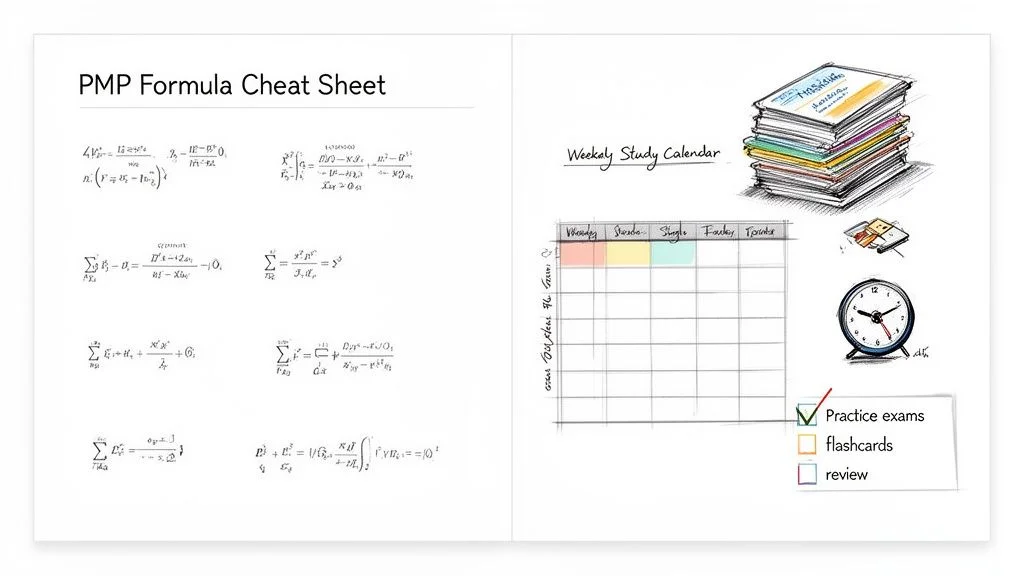 Caption: A visual guide to creating your PMP formula cheat sheet and integrating it into a structured study calendar.
While comprehending the intricate network of PMP certification formulas is a significant achievement, the true challenge lies in recalling and accurately applying them under the intense pressure of the exam. To bridge the gap between theoretical understanding and practical application, we at MindMesh Academy have developed a downloadable PMP Formula Cheat Sheet. This concise, two-page PDF summarizes every essential formula discussed in this guide, making it an indispensable resource for your final review sessions and crucial "brain-dump" practice runs on exam day.
Naturally, a cheat sheet's utility is directly proportional to your ability to wield it effectively. To genuinely master these formulas, you need a well-structured and disciplined study plan.
Building Your Formula Study Plan for PMP Success
The most effective study strategies I've witnessed consistently involve active learning rather than passive, rote memorization. A powerful starting point is to create personalized flashcards. For each formula, don't just scribble down the equation; crucially, add a quick note explaining when to apply it, what the variables represent, and what the result actually tells you about the project's health or status. As you integrate this into your broader study routine, it’s also beneficial to explore efficient techniques for how to take notes on a computer to keep your complex formula notes meticulously organized and easily reviewable.
Key to Sustained Success: From extensive experience coaching PMP candidates, consistent, focused practice invariably outperforms sporadic cramming. Dedicate a focused 20-30 minutes each day specifically to working through formula-based practice questions. This steady, daily reinforcement builds the essential mental muscle memory and rapid recall you will critically rely upon when the clock is ticking on exam day.
Ultimately, your goal should be to make the application of these calculations second nature. The only proven path to achieve this level of mastery is through extensive repetition with high-quality, realistic practice problems. You can find a complete, integrated learning path in our comprehensive PMP Certification Study Guide, which seamlessly weaves formula practice directly into your personalized study schedule.
Investing the time and effort into mastering these formulas truly yields significant dividends. Earning your PMP certification can increase your salary by an average of 16% to 23%—representing a substantial boost to your lifetime earnings and career trajectory. With robust demand for certified professionals across the IT sector, proficiency in these formulas is a direct conduit to advancing your career and securing your financial future. Discover more insightful project management salary statistics on ravetree.com.
Frequently Asked Questions About PMP Formulas
If you're an IT professional diligently preparing for the PMP exam, it's virtually guaranteed that you have questions and perhaps some anxiety surrounding the mathematical components. This is one of the most common areas of concern for test-takers, but we're here to provide clarity and boost your confidence. Let's address the questions we hear most often so you can approach exam day with a clear understanding.
A predominant question is always, "Exactly how many formula-based questions will I encounter?" While PMI does not provide an official, fixed count, consistent feedback from recent PMP test-takers points to approximately 10-15% of the exam dedicated to these types of questions. Out of 180 total questions, this translates to roughly 18-27 questions where you'll need to either perform a calculation directly or interpret the results of one to select the best project management action.
Do I Really Need to Memorize Every Single PMP Formula?
The concise answer is: no, not every single one in isolation. A more nuanced and effective answer is that you should vehemently prioritize understanding when and why to use a particular formula over mere rote memorization. You absolutely must have the core Earned Value Management (EVM), critical path, and forecasting formulas (EAC, ETC) committed to memory and deeply understood.
However, the PMP exam is fundamentally context-driven. It will rarely (if ever) simply ask you to recite a formula. Instead, it will present a complex project scenario and expect you to discern which project management tool—which formula—to pull from your toolkit. Knowing the equation for EAC is largely useless if you cannot correctly identify which of the four distinct EAC versions applies to the specific situation described in the question. That critical judgment is the true skill being tested.
What’s the Most Effective Way to Practice the PMP Math?
There is truly no substitute for hands-on, active practice by working through a substantial volume of high-quality, exam-style practice questions. This is the single most effective approach to developing the two crucial skills you need:
- Develops Muscle Memory: Repeatedly performing calculations builds speed and accuracy, making the process faster and more automatic under pressure.
- Trains Scenario Recognition: It trains your brain to quickly identify the specific keywords, phrases, and data points within a question that clearly indicate which formula is appropriate and what action to take based on the results.
When reviewing your practice sessions, focus on simulators and study materials that provide detailed, step-by-step breakdowns for each answer, rather than just presenting a final number. Understanding the "why" behind the correct calculation and choice is just as vital as arriving at the mathematically correct answer. If you're seeking additional strategies to refine your study habits, delve into our guide on proven study tips to pass the PMP exam on MindMesh Academy.
Final Takeaway: The PMP exam is fundamentally not a math test; it is a rigorous assessment of your professional judgment as a project manager. The formulas are merely sophisticated tools that provide objective insight into a project's health and trajectory. Focus relentlessly on mastering how to interpret the results of these calculations and, more importantly, how to apply them to make sound project decisions. Embrace this perspective, and you will be well on your way to not only passing the exam but also becoming a more capable, data-driven project leader.
Ready to transform your formula knowledge into certified exam success? MindMesh Academy offers adaptive learning paths and extensive practice question banks specifically designed to build your confidence and mastery across all PMP knowledge areas. Explore our comprehensive PMP exam prep resources at PMP Practice Exams and accelerate your journey to PMP certification today.

Written by
Alvin Varughese
Founder, MindMesh Academy
Alvin Varughese is the founder of MindMesh Academy and holds 15 professional certifications including AWS Solutions Architect Professional, Azure DevOps Engineer Expert, and ITIL 4. He's held senior engineering and architecture roles at Humana (Fortune 50) and GE Appliances. He built MindMesh Academy to share the study methods and first-principles approach that helped him pass each exam.