
Master Spaced Repetition for Studying
Master Spaced Repetition for IT Certification Success
Have you ever crammed tirelessly for a crucial IT certification exam, only to find the complex details you "learned" evaporating days later? It's a common and frustrating cycle for many IT professionals, highlighting a critical gap in traditional study methods. The true challenge isn't just absorbing information; it's embedding it into your long-term memory where it's accessible when you need it most.
At MindMesh Academy, we understand the stakes involved in your professional development. That’s why we advocate for spaced repetition for studying—a scientifically-backed method that works with your brain's natural memory consolidation processes, not against them. This technique is a game-changer for anyone aiming to conquer dense technical content and secure those vital certifications.
The Secret to Retaining Every Concept You Study

Trying to commit intricate network topologies or extensive cloud service definitions to memory through brute-force memorization can feel like trying to fill a leaky bucket. You invest significant effort, but the knowledge seems to slip away. The issue isn't a lack of dedication; it's often the inefficiency of the method. Spaced repetition offers a simple, yet profoundly effective, strategic shift.
Consider building muscle in the gym. You wouldn't expect to achieve lasting strength by attempting to lift the heaviest weights for hours on a single day. Sustainable growth is forged through consistent, spaced-out workouts that challenge the muscle just enough to stimulate adaptation. Your memory functions on a remarkably similar principle.
How Spaced Repetition Harmonizes with Your Brain's Memory
At its core, spaced repetition for studying involves reviewing information at progressively longer intervals. Instead of attempting to master an AWS IAM policy or a PMP knowledge area ten times in one evening, you strategically revisit it—perhaps after one day, then three days, then a week, and so on.
This deliberate scheduling directly combats the "forgetting curve," the natural process by which our brains shed information over time. Each time you actively recall a concept just before you're about to forget it, you fortify the underlying neural connections. This makes that memory stronger, more resilient, and more likely to transition into permanent storage.
By intentionally spacing out your reviews, you send a clear signal to your brain: "This information—whether it's an Azure resource group configuration or an ITIL incident management step—is important. Move it from temporary holding into long-term storage."
This intelligent approach transforms studying from a frantic, short-term sprint into an efficient, long-term system for building genuine expertise. It's not about logging more study hours; it's about studying smarter. You time your review sessions for peak impact, effectively breaking the frustrating cycle of learning and forgetting that plagues many certification candidates.
The advantages extend far beyond merely passing an exam. When you effectively employ spaced repetition for studying, you're not just memorizing; you're working towards true conceptual mastery.
- Superior Long-Term Retention: Information is robustly encoded into your long-term memory, ensuring it's available when you need it—weeks, months, or even years after your exam.
- Enhanced Efficiency: You eliminate wasted time re-learning material you've already forgotten, redirecting your energy towards strengthening existing knowledge gaps and new concepts.
- Deeper Conceptual Understanding: The act of active recall compels you to connect disparate ideas and concepts, fostering a much richer and more integrated understanding than passive re-reading ever could.
For IT professionals tackling rigorous certifications like AWS Solutions Architect, Azure Administrator, PMP, or CompTIA CySA+, these principles are not just beneficial—they are indispensable. To explore how this fits into a broader, science-backed study plan, delve into our guide on advanced study techniques and memory boosters. By understanding how your brain is optimized to learn, you can finally stop forgetting and start remembering what truly matters for your career progression.
Reflection Prompt: Recall a particularly challenging concept from a recent certification study guide. How might a structured spaced repetition schedule have helped you solidify that knowledge, preventing it from fading before the exam?
Why Your Brain Forgets and How Spacing Fixes It
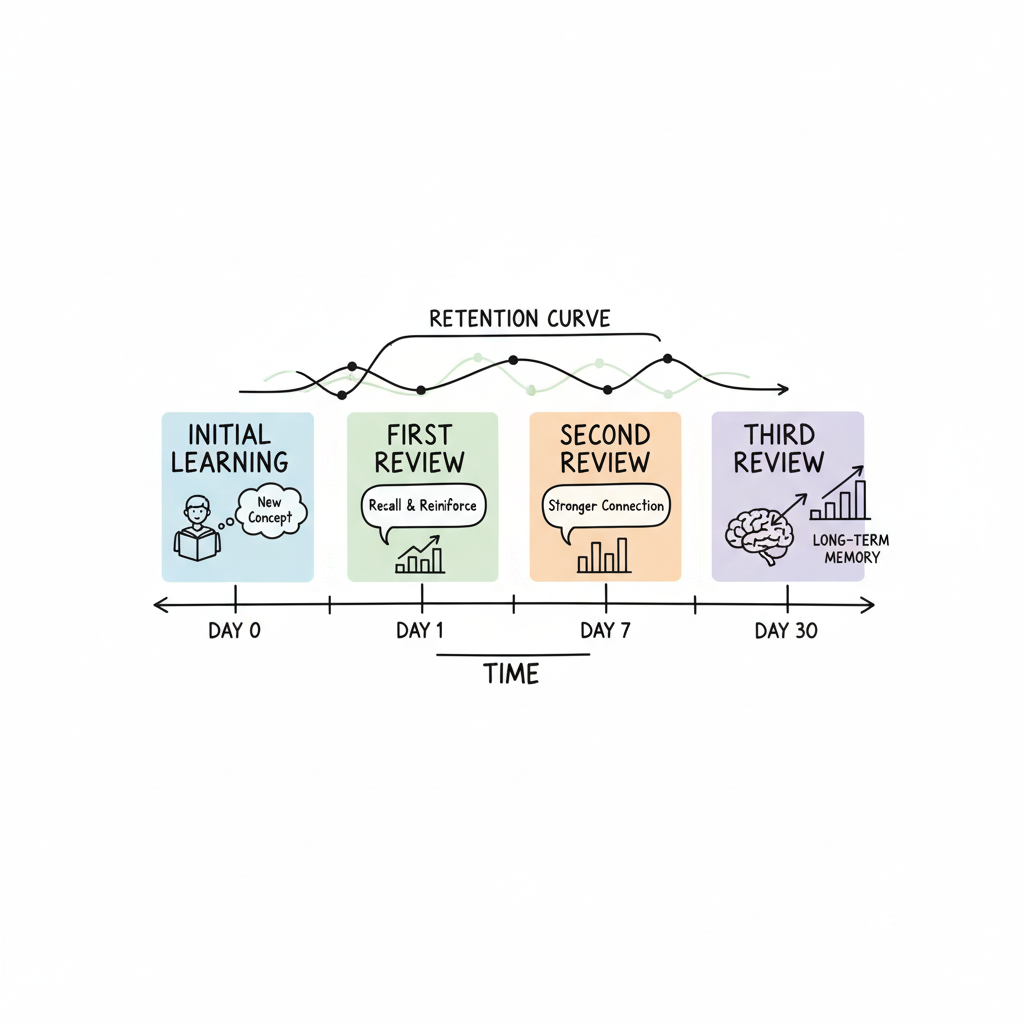
To fully appreciate the power of spaced repetition for studying, we must first understand its counterpart: forgetting. Our brains are remarkably efficient, constantly filtering out information deemed unimportant. This isn't a design flaw; it's an adaptive feature that prevents cognitive overload from irrelevant data.
However, when preparing for a critical IT certification exam, your brain doesn't inherently distinguish between a complex network security protocol and your grocery list from last week. Without deliberate reinforcement, both are equally susceptible to being discarded. This natural decay process was famously quantified in the 1880s by psychologist Hermann Ebbinghaus.
The Forgetting Curve in Action for IT Professionals
Ebbinghaus's groundbreaking research introduced the Forgetting Curve, a visual representation of how rapidly we lose new information without reinforcement. The initial drop-off is remarkably steep. In fact, you can forget a staggering 50-80% of newly learned material within the first 24 hours if it's not revisited.
This phenomenon precisely explains why "cramming" for an exam feels so unproductive in the long run. You spend intense hours stuffing information into your short-term memory, creating what often feels like an "illusion of knowing." But because you haven't signaled to your brain that this information is crucial for long-term retention—like the intricacies of a disaster recovery plan or the nuances of object-oriented programming—the forgetting curve takes hold, and the knowledge quickly dissipates.
Spaced repetition serves as the ultimate counter-strategy. Imagine building a robust knowledge base for an IT certification as forging a trail through a dense, unexplored forest.
- Cramming: This is akin to hacking your way through the undergrowth once. It's an exhausting effort, and the faint path you create quickly becomes overgrown and disappears.
- Spaced Repetition: This is more like walking that same path every few days. Each strategic revisit clears the trail a little more, making it easier and more permanent, until it becomes a well-trodden, established route in your cognitive landscape.
Every review session strategically interrupts the forgetting process, signaling to your brain, "Pay attention, this concept—whether it's a Kubernetes deployment strategy or a CI/CD pipeline stage—is important. Keep it!"
The core principle is elegantly simple: reviewing information at the precise moment you are about to forget it makes that memory significantly stronger and more durable.
Strengthening Memories with Strategic Reviews
The true ingenuity lies in the timing. Reviewing material too soon can be a wasted effort, as the memory is still vivid. However, waiting too long means you've already forgotten it, forcing you to re-learn from scratch. The sweet spot for spaced repetition for studying is that optimal interval that provides your brain with just enough of a challenge to lock the memory in even tighter.
This technique goes beyond mere rote memorization; it fundamentally deepens your understanding. Fascinating interdisciplinary research highlights that combining spaced repetition with slight variations in content can significantly boost memory consolidation. While repeating the exact same concept aids recall, introducing variety—such as different examples, scenarios, or contexts (e.g., applying an API call in different programming languages or using a cloud service in varying architectural patterns)—helps you internalize the nuances and details within a broader topic. An effective study system for IT certifications, therefore, should skillfully blend both strategic repetition and contextual variation. You can dive deeper into these findings in a recent neuroscience research report.
Once you grasp these fundamental cognitive principles, it becomes unequivocally clear why strategically timed study sessions are the linchpin to building enduring knowledge. You are, in essence, hitting the reset button on the forgetting curve with each review, progressively flattening its decline until the critical information is securely embedded in your long-term memory. This is the pathway from simply memorizing to truly mastering a subject.
How to Build Your Spaced Repetition System for IT Certs
Understanding the theory of spaced repetition for studying is valuable, but its real power is unleashed when you put it into practice. Constructing an effective system isn't as complex as it might seem. The key is to find a method that aligns with your individual study preferences, the specific technical topics you're tackling, and your personal learning style.
You can implement spaced repetition today using one of two primary approaches: a hands-on, manual system or a sophisticated digital tool. Both achieve the goal, but they cater to different types of learners and study environments. Let's explore how you can get started with each, keeping IT certification preparation in mind.
The Manual Approach: The Leitner System
If you appreciate the tactile experience of pen and paper and the satisfaction of physically organizing study materials, the Leitner System is an excellent choice. Developed in the 1970s by German science journalist Sebastian Leitner, it's an ingenious method for automating spaced repetition using only flashcards and a few boxes or compartments. It's deceptively simple, yet remarkably powerful.
Visualize it like this: you have a series of boxes (e.g., Box 1, Box 2, Box 3), each representing a different review interval.
- Start in Box 1: Every new flashcard you create—perhaps defining an AWS EC2 instance type or a fundamental network protocol like TCP/IP—begins here. You'll review the cards in Box 1 every single day.
- Promote or Demote: When you review a card, your recall performance dictates its next destination. Get it right? You "promote" it to the next box (e.g., from Box 1 to Box 2). Get it wrong? It's "demoted" all the way back to Box 1, regardless of its previous location.
- Space Out Reviews: Each box adheres to its own review schedule. Box 1 is for daily review. Box 2 might be reviewed every three days, and Box 3 perhaps every five or seven days.
This physical sorting mechanism naturally compels you to dedicate more time to the concepts you find challenging (those that repeatedly return to Box 1) and less time to the material you've already mastered.
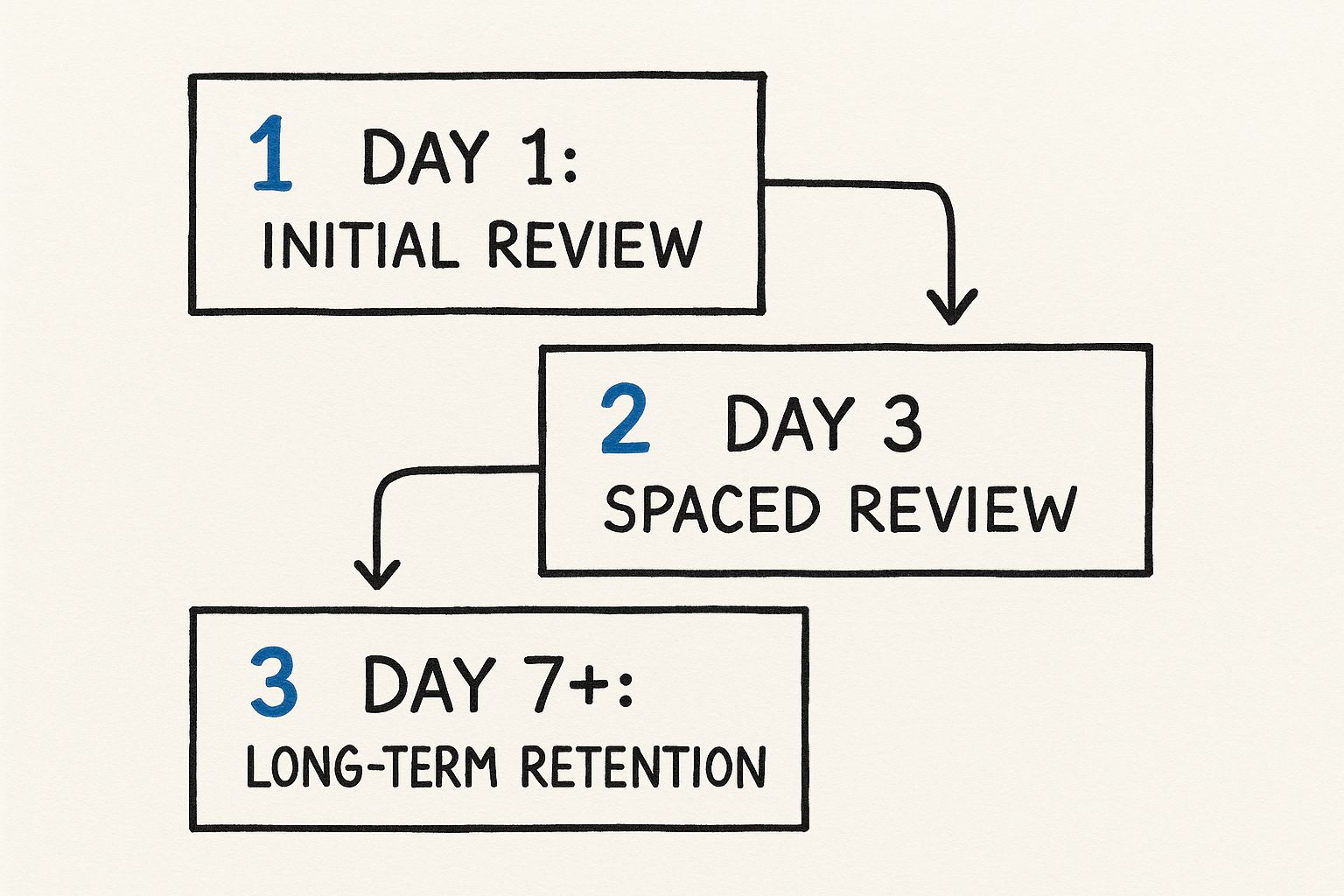
The flow here visually demonstrates how reviewing at precisely the right moments significantly aids in locking information into your long-term memory. For instance, if you're learning about the ITIL 4 Guiding Principles, a card on "Focus on Value" might start in Box 1, and only move up as you consistently recall its implications.
The Digital Approach: Apps and Software
For IT professionals who prefer an automated, on-the-go study solution, digital spaced repetition software (SRS) is the ideal answer. Applications like Anki and Quizlet, or integrated learning platforms such as MindMesh Academy, meticulously handle all the scheduling and sorting complexities for you. Your sole focus remains on the learning itself.
These tools leverage sophisticated algorithms to determine the optimal moment to present each flashcard for review. After attempting to recall an answer, you rate your difficulty (e.g., "easy," "medium," "hard"). The software then utilizes this feedback to precisely adjust the next review date for that specific piece of information.
Digital systems are incredibly efficient for IT certification prep. They construct a personalized review schedule for every single concept you're learning—from complex security policies to intricate cloud architecture patterns—adapting dynamically to your individual memory performance.
This inherent adaptability is why a vast number of IT professionals rely on digital SRS tools, especially when confronted with the immense volume of information required for certifications like the CCNA, CompTIA A+, or various Microsoft Azure exams.
Crafting High-Impact Flashcards for IT Concepts
Regardless of whether you choose a manual or digital system, your spaced repetition strategy is only as effective as the quality of your flashcards. A truly effective flashcard doesn't merely present a fact; it compels your brain to actively retrieve information from memory. This process is known as active recall.
Here are essential tips for creating flashcards that dramatically improve retention for technical subjects:
- One Idea, One Card: Avoid overloading a single card. Each flashcard should test one specific question, one key term, or one core concept. For example, instead of "Describe AWS S3," ask "What is the primary purpose of an AWS S3 bucket?"
- Use Your Own Words: When you rephrase a definition, explain a process, or describe a configuration in your own terms, you are actively processing the information. This cognitive effort is crucial for long-term memory encoding.
- Frame it as a Question or a Prompt: Instead of stating "ITIL 4 - Service Value System," transform it into a question: "What are the six components of the ITIL 4 Service Value System?" Or, for a practical IT scenario, "Given a virtual machine, describe the steps to provision a new network interface in Azure." This small but significant change fundamentally shifts from passive recognition to active recall.
Of course, powerful flashcards begin with exceptional notes. For a comprehensive guide on building that foundational knowledge for your technical studies, explore our guide on effective note-taking methods for tech certs.
Choosing Your Spaced Repetition Method
So, manual or digital for your IT certification journey? The truth is, neither method is inherently superior. The most effective system is the one you will consistently integrate into your study routine. To assist you in determining the best fit, here's a brief comparison:
Choosing Your Spaced Repetition Method
| Feature | Manual System (e.g., Leitner Box) | Digital System (e.g., Anki, MindMesh) |
|---|---|---|
| Setup Cost | Very low—primarily the cost of index cards and a few physical containers. | Often free for basic versions, with some apps offering premium features or integrations. |
| Portability | Can be cumbersome. Carrying multiple boxes of physical cards is not ideal for on-the-go study. | Highly portable. Your entire deck of thousands of flashcards is accessible on your smartphone, tablet, or laptop. |
| Scheduling | Requires self-management. You must manually track and adhere to review schedules for each box. | Fully automated. Intelligent algorithms meticulously manage all review scheduling based on your performance. |
| Card Creation | The physical act of writing can reinforce memory for some learners. | Extremely fast card creation, with rich media support (images, audio, code blocks), ideal for complex technical content. |
| Best For | Kinesthetic learners who benefit from a hands-on, tangible process. Suitable for smaller, focused sets of information. | Learners prioritizing maximum efficiency, personalization, and on-the-go study for extensive technical curricula. |
Ultimately, the objective is to cultivate a sustainable study habit. The best way to identify your optimal method is to experiment. Begin with the approach that resonates most with you, and don't hesitate to switch if it doesn't meet your needs. Your consistent commitment is what transforms the theory of spaced repetition for studying into tangible, lasting technical knowledge and certification success.
Applying Spaced Repetition to Any IT Subject
One of the persistent myths about spaced repetition for studying is that it's solely effective for simple memorization, such as vocabulary terms or historical dates. While it excels in these areas, its true power lies in its adaptability. With the right approach, this technique can be leveraged to master highly complex ideas across virtually any IT domain—from cloud architecture to cybersecurity, project management, and software development.
The key is to transcend basic "term-and-definition" flashcards. You must design prompts that actively force your brain to engage in deeper cognitive work—to recall intricate processes, synthesize interconnected ideas, and construct logical arguments or solutions from foundational knowledge. When implemented this way, spaced repetition evolves from a mere memory aid into a potent engine for profound, lasting technical understanding.
Mastering Languages Beyond Vocabulary (e.g., Programming, Scripting)
While the original article references human languages, the principle extends directly to learning programming languages, scripting, or API syntax. Simply memorizing "function" or "if-else" isn't enough. The challenge lies in understanding grammar (syntax), usage patterns, and correct application. Spaced repetition is an ideal tool for solidifying these practical skills.
Instead of a card stating "Python - def," create prompts that require actual application:
- Front: "How would you define a Python function named
calculate_totalthat accepts two arguments,priceandquantity?" - Back: ```python
def calculate_total(price, quantity):
return price * quantity
(This not only tests the `def` keyword but also parameter passing, basic arithmetic, and function structure.)
You can also use fill-in-the-blank prompts to practice specific syntax or API calls within a code snippet. This active application builds practical fluency, moving you beyond just a list of memorized commands to genuine coding proficiency.
Conquering STEM Subjects and Core IT Concepts
For IT professionals immersed in science, technology, engineering, and mathematics (STEM) fields, you understand the challenge of navigating complex formulas, multi-step procedures, and extensive classification systems. Spaced repetition for studying helps bring clarity to this cognitive overload.
- For Formulas: Don't just list the formula for subnet masks or AWS pricing. Create a card with a practical problem that necessitates the application of that specific formula. This forces you not only to remember the equation but, critically, to recognize when and how to apply it in a real-world IT scenario.
- For Processes: Take a complex IT process—such as deploying an Azure Virtual Machine, configuring a secure VPN tunnel, troubleshooting a network issue, or following an ITIL change management procedure—and decompose it into sequential steps. Create cards that ask, "What is the very next step after selecting the OS image for a new Azure VM?" or "Describe the main function of the 'Planning' stage in the PMP project management lifecycle."
- For Classifications: Visuals are invaluable here. For a cybersecurity certification, use a picture of a network topology and prompt yourself to identify different attack vectors or defense mechanisms. For cloud certifications, use diagrams of different storage types (block, object, file) and ask for their optimal use cases.
The efficacy of this method is particularly evident in fields dense with information, such as medical education, which shares parallels with complex IT certifications. One study observed medical students utilizing a spaced repetition app for clinical knowledge experienced a significant boost in test scores, moving from a mean of 27.93 to 30.8. The control group, lacking the app, showed no improvement. This powerfully demonstrates how effective spaced repetition for studying is for retaining vast amounts of intricate, technical information.
Self-reflection: Consider a multi-step deployment process (e.g., deploying a web application to a Kubernetes cluster or setting up a complex Active Directory configuration). How could you break down each stage into active recall flashcards to ensure complete mastery?
Excelling in IT Governance, Project Management, and Methodologies
IT fields like project management, governance, compliance, and agile methodologies often revolve around frameworks, theories, and the interconnectedness of concepts, rather than just isolated facts. Your spaced repetition system must be designed to reflect this deeper level of understanding.
In IT governance or project management, spaced repetition isn't merely about memorizing a definition; it's about internalizing the implications of a control, the rationale behind a process, or the cause-and-effect relationships within a project phase.
Craft your prompts to stimulate this higher-order thinking:
- Project Management (PMP, Agile): "What are the five Process Groups in the PMP framework, and how do they interact?" or "Explain the core differences between Scrum and Kanban methodologies."
- IT Governance/Security: "What are the key principles of GDPR, and what impact do they have on data handling within an organization?" or "Describe the main components of a robust cybersecurity incident response plan."
- Cloud Best Practices: "Compare and contrast the cost optimization strategies for AWS vs. Azure resources."
Questions like these force you to synthesize information, articulate relationships, and apply concepts, rather than simply regurgitating definitions. This is precisely the type of critical thinking required for everything from a project review to a professional certification exam. In fact, these same principles apply directly to prepping for exams like the PMP, where understanding intricate processes, ethical considerations, and scenario-based problem-solving is paramount. You can find more focused strategies in our guide on passing the PMP exam.
By meticulously shaping your flashcards to the specific cognitive demands of what you're learning, you transform spaced repetition for studying from a simple memory hack into a sophisticated strategy for cultivating genuine IT expertise.
Common Spaced Repetition Mistakes to Avoid for IT Professionals
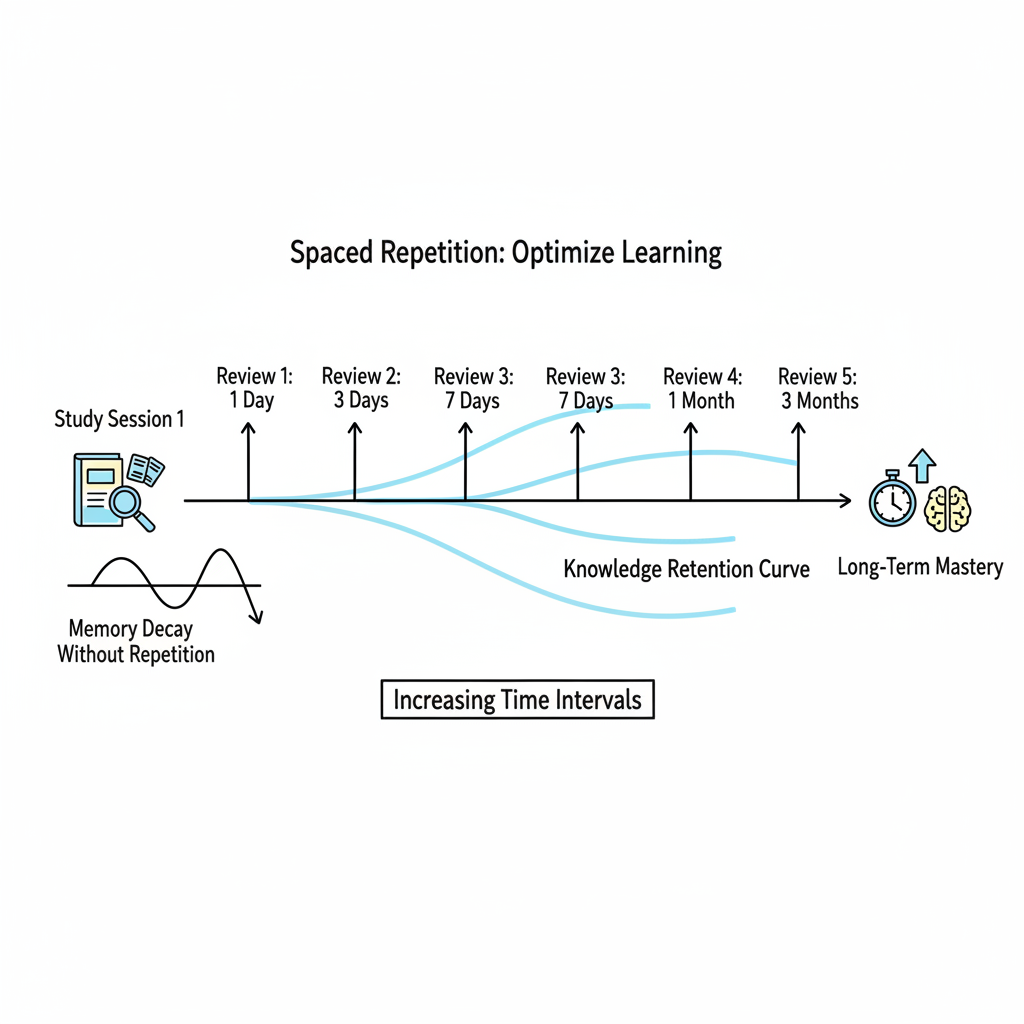
Spaced repetition is an incredibly powerful study tool, but like any sophisticated instrument, its effectiveness hinges on proper usage. Several common missteps can easily derail your efforts, so understanding these potential pitfalls from the outset can significantly contribute to your success, especially when preparing for demanding IT certifications.
One of the most frequent errors is creating poorly designed flashcards. It's incredibly tempting to simply copy and paste an entire paragraph or a lengthy technical definition onto a card. However, this approach is counterproductive. It encourages passive recognition of the answer rather than actively recalling it from memory. A good rule of thumb for IT concepts: if your card addresses more than one core idea or requires more than a concise, focused answer, it's likely too complex.
Then there's the dreaded "review avalanche." This occurs when you skip several days of reviews, returning to a massive, intimidating backlog of overdue cards. The sheer feeling of being overwhelmed is often enough to make individuals abandon the system entirely. Consistent, smaller daily efforts are key to avoiding this.
Memorizing vs. Understanding for Certification Success
Perhaps the most insidious pitfall, especially for IT professionals, is the subtle trap of memorizing facts without ever truly comprehending them. You might reach a point where you can perfectly recite a definition for a cloud service or an API call, but you're utterly incapable of applying that concept in a practical scenario or troubleshooting a related issue. This fosters a false sense of confidence that inevitably crumbles when faced with the scenario-based questions prevalent in many IT certification exams (e.g., AWS Solutions Architect, Microsoft Azure AZ-series, CompTIA Security+).
To skillfully navigate this, always take a deliberate moment to connect new technical information to your existing knowledge base before you even consider creating a flashcard. Ask yourself, "How does this firewall rule integrate into the overall network security architecture?" or "Could I explain this specific DevOps principle to a non-technical colleague in my own words?"
True learning for IT professionals isn't just about remembering discrete facts; it's about building a robust, interconnected web of technical knowledge. Spaced repetition for studying fortifies the strands of that web, but you must first weave them through genuine comprehension and contextualization.
Practical Fixes for Common Spaced Repetition Problems
Staying on track with spaced repetition for studying is often simpler than it appears. It primarily involves establishing a consistent routine from day one and maintaining intentionality in your study approach.
- Set Realistic Daily Limits: Don't overload yourself. Consistently learning 10-15 new cards per day and diligently keeping up with your scheduled reviews is far more effective and sustainable than adding 50 new cards and experiencing burnout within a week.
- Keep Flashcards Atomic (Single Concept): Adhere strictly to the "minimum information principle." Each card should test you on one, and only one, distinct piece of information. For example, a card shouldn't ask for both the purpose of a firewall and how to configure it; these should be separate cards.
- Adapt Your Approach for Different IT Subjects: While spaced repetition for studying is excellent for locking in knowledge, it's not a universal panacea. Meta-analytical reviews show it significantly boosts verbal and motor skills in over 80% of cases, but its application can be less straightforward for subjects like complex mathematics or hands-on coding. For these, you need to adapt your cards to test processes, problem-solving steps, and conceptual understanding, not just isolated facts. For instance, a math card might ask for the steps to solve an algorithm, rather than just the final answer. You can explore more about these findings at gwern.net.
Got Questions About Spaced Repetition for Your IT Studies?
Embarking on any new study methodology naturally brings forth questions, and that curiosity is a positive sign. As you begin to integrate spaced repetition for studying into your IT certification preparation, it's entirely normal to wonder if you're implementing it "correctly."
Let's address some of the most common questions IT professionals have. Getting these clarifications now will empower you to build a robust and effective study habit from the outset.
How Long Should My First Review Interval Be for New Technical Material?
There isn't a single, universally perfect number, but an excellent rule of thumb for new technical concepts is to conduct your first review 1-2 days after initially learning the material. This inaugural review is absolutely critical—it serves as your most potent defense against that initial, steep drop-off predicted by the Forgetting Curve.
After this initial phase, if you're using a digital spaced repetition system, the algorithms will intelligently manage the subsequent intervals for you. If you're utilizing a manual system like the Leitner box, a common strategy is to roughly double the interval each time you successfully recall the answer. Your review schedule might progress from: 1 day, then 2 days later, then 4, then 8, and so on. The core objective is always to prompt your memory just as the information is on the verge of fading.
Can I Use Spaced Repetition for Complex IT Concepts, Not Just Facts?
Absolutely. While spaced repetition for studying earned its reputation for memorizing discrete items like vocabulary or dates, its true strength lies in solidifying complex IT concepts. The strategic key is to fundamentally alter how you formulate your review prompts and flashcards.
Move well beyond simple "term-and-definition" cards. Instead, construct prompts that compel you to think critically, synthesize information, and engage with the technical material on a deeper cognitive level.
- Challenge yourself to explain a complex cloud service architecture (e.g., a serverless application with API Gateway, Lambda, and DynamoDB) in your own words.
- Force yourself to compare and contrast two different cybersecurity frameworks (e.g., NIST vs. ISO 27001).
- Require yourself to break down the sequential steps of a challenging technical process (e.g., deploying a highly available database cluster or configuring a complex VPN tunnel) entirely from memory.
This approach transforms a passive review session into an active learning exercise, which is precisely how you cultivate true understanding and retention of intricate IT concepts.
When you frame complex IT concepts as open-ended questions or scenario-based prompts, you're not merely recognizing a definition. You're practicing the crucial skills of retrieving, articulating, and applying complex technical ideas—a far more valuable skillset for any IT professional.
What Should I Do If I Miss a Day of Reviews?
Don't panic. In the demanding world of IT, life happens. Missing a day (or even a few) of your spaced repetition reviews will not irrevocably derail your entire progress. With spaced repetition for studying, consistency over absolute perfection is the guiding principle.
Most digital spaced repetition applications will simply reschedule your overdue cards for your next study session, prioritizing the most critical ones first. If you're using a manual system, simply pick up where you left off. The worst possible response is to feel overwhelmed and abandon the system entirely. Just get back to it the following day. A steady, sustainable habit—even just 15-20 minutes a day dedicated to your spaced repetition queue—is what consistently leads to long-term success and certification mastery.
Ready to stop forgetting and start mastering complex IT subjects? Mindmesh Academy seamlessly integrates these powerful, evidence-based learning principles into our adaptive study paths for IT certifications. Discover how our intelligent system can create a personalized review schedule tailored specifically for you, ensuring you're always studying the right technical material at the perfect, most impactful moment. Start your journey with Mindmesh Academy today!

Written by
Alvin Varughese
Founder, MindMesh Academy
Alvin Varughese is the founder of MindMesh Academy and holds 15 professional certifications including AWS Solutions Architect Professional, Azure DevOps Engineer Expert, and ITIL 4. He's held senior engineering and architecture roles at Humana (Fortune 50) and GE Appliances. He built MindMesh Academy to share the study methods and first-principles approach that helped him pass each exam.