
How to Upskill Employees for Business Growth
To upskill employees effectively, it all boils down to a simple, repeatable framework: Assess where your team stands, Develop their skills with targeted training, and Measure how that training moves the needle on business results. When you follow this approach, training stops being a cost center and becomes a genuine driver for growth, ensuring your people are ready for whatever comes next.
Why Upskilling Is a Core Business Strategy

It’s easy to sideline employee training as a secondary HR function—something you get to when you have the time or budget. But that’s a dangerous mistake. The biggest risk isn’t what you spend on training; it’s the cost of doing nothing at all. In a market where technology and customer needs are constantly in flux, a team with outdated skills is your biggest liability.
A proactive upskilling program is the best tool you have for building a resilient, adaptable team. It has a direct line to your profitability, improves employee retention, and creates a workforce that can pivot on a dime to grab new opportunities. Think of it as preventative maintenance for your most valuable asset—your people.
The Tangible Returns on People Investment
Investing in your employees pays real dividends. When you create clear pathways for them to grow their skills, you end up with a team that's more engaged, more capable, and more committed. This isn't just a feel-good theory; the numbers back it up.
Companies with formal employee training programs see a staggering 218% higher income per employee than those without. On top of that, well-trained teams are 17% more productive and drive 21% greater profitability. If you're curious, you can explore the full training statistics on eLearning Industry and see just how compelling the business case is.
The question isn't whether you can afford to upskill your employees. The real question is whether you can afford not to. Stagnation is far more expensive than education.
A Simple Framework For Success
So, where do you start? The key is to move away from random workshops and one-off courses and adopt a strategic framework. This entire guide is built around a straightforward process that works.
This table gives you a bird's-eye view of the three core pillars we'll be diving into.
The Core Framework for Employee Upskilling
| Phase | Objective | Key Activity |
|---|---|---|
| Assess | Identify critical skill gaps and future needs. | Conduct a thorough skills analysis aligned with business goals. |
| Develop | Implement targeted learning experiences. | Select and deploy effective training methods, from microlearning to coaching. |
| Measure | Quantify the program's business impact. | Track key metrics like productivity, retention, and ROI. |
By consistently following this Assess, Develop, and Measure model, you can be confident your upskilling initiatives are focused, effective, and directly tied to the success of your organization.
Pinpointing the Right Skills to Develop
A successful upskilling program starts with a clear-eyed view of where your team is now and where your business needs to be. Just throwing generic training at your employees is like trying to navigate without a map—it’s expensive, inefficient, and you’ll almost certainly end up lost. The real solution is a strategic skill gap analysis.
This process is about moving from guesswork to certainty. It ensures every dollar you put into training is aimed squarely at the right target. This isn’t about finding faults; it’s about uncovering growth opportunities that will genuinely move the needle for your organization.
For instance, a software company looking at its three-year product roadmap might see a huge, looming need for AI literacy and machine learning expertise. In the same way, a marketing agency could look back at project outcomes and realize its team is missing the advanced data analytics skills required to land bigger, more lucrative clients.
Align Future Skills With Business Goals
The first, most critical step is to look forward. Your company's strategic goals are the destination, and your upskilling plan is the roadmap to get there. Start by asking some tough questions that bridge the gap between your business objectives and your people.
- Where is the company headed in the next 1-3 years? Are you pushing into new markets, launching a different product line, or overhauling your tech stack?
- What new skills will be non-negotiable for achieving these goals? If you're automating certain workflows, you'll need people who can manage and optimize those automated systems.
- Which existing roles will feel the biggest impact from these shifts? Figure out which teams or departments will need the most help adapting to what's coming.
This forward-thinking approach means you're not just plugging today’s holes but actively preparing your workforce for tomorrow's challenges. It turns upskilling from a reactive fix into a proactive strategy for long-term growth. To get started on this, our training needs assessment template is a great resource for structuring your thoughts.
Uncover Insights From Performance Data
Your existing data is a goldmine. Performance reviews, project debriefs, and even customer feedback are packed with clues about where your team is shining and where they're struggling. Don't let that information just sit in a folder—put it to work.
Look for patterns. Do multiple performance reviews keep mentioning difficulties with project management or communicating with clients? Are customer satisfaction scores consistently dinged by a lack of deep technical knowledge from your support team? These recurring themes point directly to skills that need attention right now.
By analyzing the performance metrics you already have, you can spot systemic weaknesses. Addressing these through targeted training can lead to massive improvements in productivity, quality, and morale. It’s all about connecting the dots between individual performance and the company’s overall capability.
Talk To Your Managers On The Ground
Finally, no analysis is complete without talking to the people who lead your teams every single day. Your department managers have a ground-level view of their team's real-world capabilities, their workloads, and the daily hurdles they face. They know who the go-to experts are and who’s secretly struggling with a new piece of software.
Schedule some brief, focused conversations with them. Ask them directly: What skills would make the biggest difference to your team’s performance? What’s stopping them from hitting their goals? Their insights are absolutely crucial for confirming the trends you see in the data and ensuring your upskilling program solves real problems. This three-pronged approach gives you the complete picture you need to build a program that actually delivers.
Choosing Upskilling Methods That Actually Work
Once you've pinpointed the skills your team needs, the next big question is how to teach them. Let's be honest, there's no magic bullet here. The best approach is always a careful match between the training method, the skill itself, and your employees' day-to-day reality. A one-size-fits-all strategy is just a surefire way to waste everyone's time and leave your team feeling disengaged.
The real goal is to create a learning environment that feels less like a mandatory chore and more like a natural part of the job.
Think about it this way: a remote sales team needing quick updates on new product features would thrive with short, digestible microlearning modules they can pull up on their phones. But that same approach would completely fail an engineering team trying to adopt a complex new software framework. For them, an immersive, instructor-led workshop makes far more sense.
The infographic below really drives this point home, comparing different learning technologies and showing just how much completion, engagement, and immersion rates can vary.
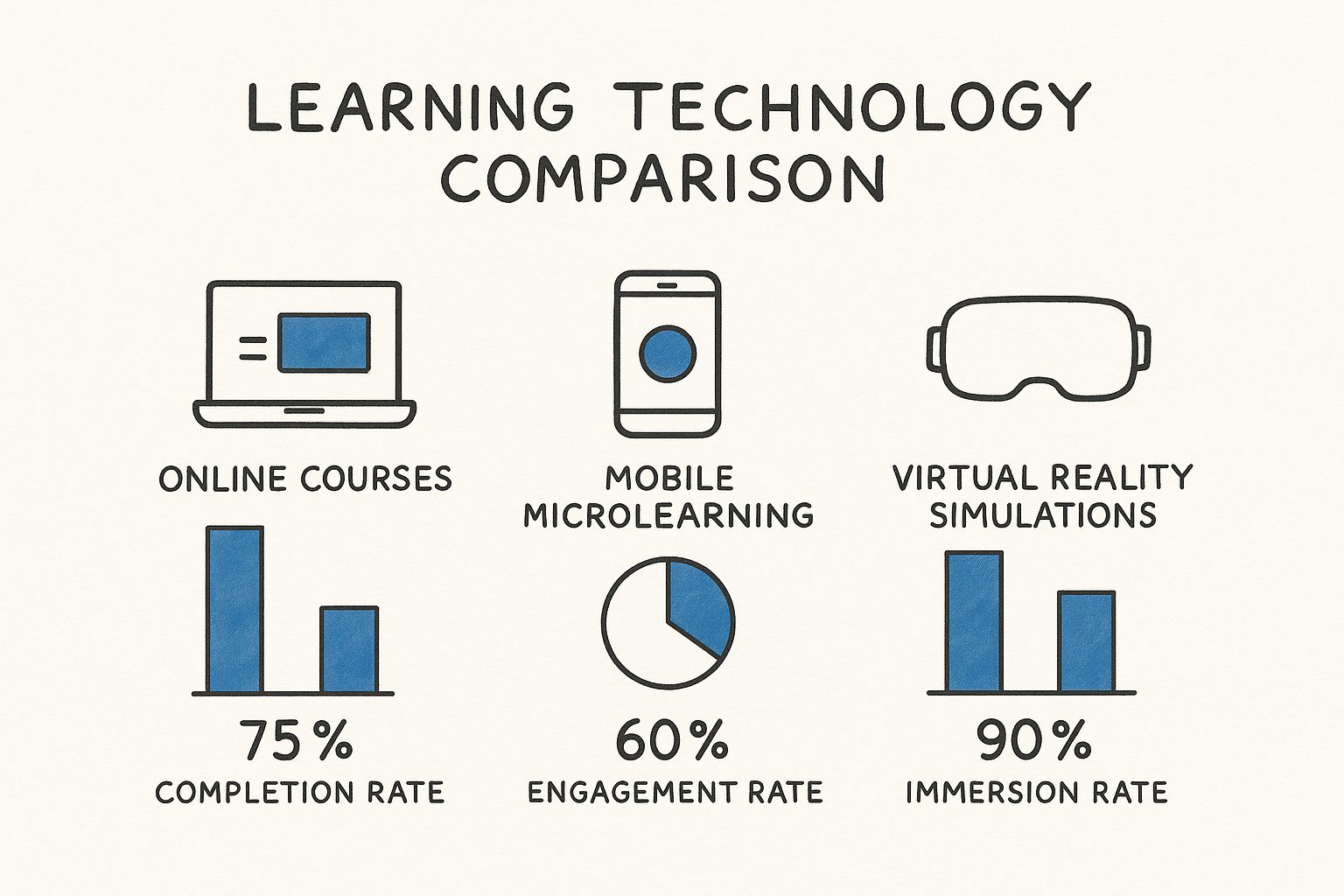
As you can see, while standard online courses are everywhere, specialized methods like virtual reality can achieve much higher immersion. This makes them perfect for practicing complex, hands-on skills where mistakes in the real world would be costly.
Blending Formal Training With On-The-Job Experience
It’s no secret that companies are investing heavily in their people—the global workplace training market has ballooned to $401 billion. But here's the kicker: the most impactful learning doesn't always happen in a classroom or on a Zoom call.
Research actually shows that about 70% of employee skills come directly from on-the-job experience. This highlights the incredible power of learning by doing. The most successful upskilling programs are the ones that weave learning directly into daily workflows.
Here are a few ways to make that happen:
- Project-Based Learning: Get employees involved in cross-functional projects that require them to flex new skill muscles in a real-world setting. There's no better way to gain practical, hands-on experience.
- Peer-to-Peer Coaching: This is a low-cost, high-impact gem. Pair a seasoned pro with a teammate who's looking to grow in a specific area. It's a fantastic way to transfer institutional knowledge and build stronger collaborative skills.
- Mentorship Programs: A more formal mentorship structure can provide guided career development, helping employees sharpen both hard and soft skills under the guidance of an experienced leader.
The most powerful learning happens when an employee can immediately apply a new concept to a real problem they are facing. Weaving training into the flow of work makes it relevant, sticky, and far more impactful than isolated courses.
Selecting The Right Learning Modality
Choosing the right format is absolutely critical for keeping people engaged and making sure the knowledge actually sticks. A dry, hour-long video lecture on a topic that screams for interaction is doomed from the start. Your toolkit needs to be diverse.
To help you decide, we've put together a quick comparison of a few popular methods.
Comparing Employee Upskilling Methods
Every training format has its own strengths. The key is to align the method with your specific learning objective and your team's context. This table breaks down some common options to help you choose the right tool for the job.
| Training Method | Best For | Key Benefit |
|---|---|---|
| Self-Paced Online Courses | Foundational knowledge, compliance training, self-motivated learners | Provides ultimate flexibility and allows employees to learn at their own pace. |
| Live Virtual Classrooms | Collaborative problem-solving, team-based skills, complex topics | Enables real-time interaction, Q&A, and group discussions. |
| Mentorship & Coaching | Leadership development, soft skills, nuanced role-specific expertise | Offers personalized guidance and transfers valuable institutional knowledge. |
| Simulations & Gamification | Technical skills, complex processes, risk-free practice | Creates a safe and engaging environment to practice and apply skills. |
| Microlearning | Quick updates, reinforcing concepts, just-in-time learning | Delivers short, focused bursts of information that fit into a busy day. |
Ultimately, you'll likely find that a blend of these approaches works best. You can explore more by checking out our guide on the best practices for online learning.
By thoughtfully combining these methods, you create a flexible and engaging program that meets your team where they are, making your upskilling efforts truly count.
Building a Culture That Champions Continuous Learning

Let's be honest. You can design the most brilliant upskilling program in the world, but it will fall flat if your company culture treats learning as a checkbox item. To get real results, you have to weave continuous development into the very fabric of how your company operates. This goes way beyond just offering a catalog of courses; it’s about creating an environment where curiosity is encouraged, and growth is a shared goal.
The whole thing starts at the top. When leaders actively participate in training sessions, talk about what they’re learning in team meetings, and are open about their own development journey, it sends a clear signal to everyone else. Executive buy-in turns training from a chore into a genuine strategic priority.
This cultural shift has never been more critical. The data is pretty sobering: only 24% of workers feel they have the skills they need to take the next step in their career. Even more concerning, a mere 17% feel their employers are putting enough resources into their growth. You can read more about these workforce development findings to grasp the urgency. Fostering a real learning culture is how you start to close that confidence gap.
Make Time and Space for Learning
Ask any employee what stops them from learning, and the answer is almost always the same: "I don't have time." If you're serious about upskilling, you have to tackle this head-on by formally carving out dedicated time for it. Don't just hope they'll find a spare hour.
- Schedule "Learning Hours": Block out time on the company calendar. Maybe it's a "Focus Friday" afternoon or a couple of hours every other week. This gives people permission to step away from daily tasks and invest in themselves.
- Provide the Right Tools: Make resources easy to find and use. A centralized hub is essential. If you're shopping for a platform, you can explore our learning management systems comparison to see what might fit.
- Set Clear Expectations: Managers need to be part of this. They should discuss learning goals during performance reviews and one-on-ones, making it clear that professional development is a core part of the job, not an extracurricular activity.
This structured approach takes the guilt out of "not working" and reframes learning as a productive and vital part of everyone's role. It's a powerful way to show your team you're truly invested in their future.
Celebrate and Reward Growth
What gets recognized gets repeated. Simple as that. When someone on your team finishes a tough certification course or finally masters a new piece of software, that win should be shouted from the rooftops. Publicly celebrating these achievements creates a powerful ripple effect, motivating others to start their own learning journeys.
The most powerful motivator? Tying skill acquisition directly to career progression. When people see a clear path from learning a new skill to getting a promotion, a raise, or a more interesting project, upskilling becomes the most obvious way to get ahead.
Think about building out skill-based career ladders. Instead of progression being tied only to years of service, tie it to mastering new competencies. For example, a junior data analyst might move up to a mid-level role not just after two years, but after they earn a new data visualization certification and successfully lead a reporting project.
This approach makes upskilling a tangible part of their career map, turning learning from something that happens once in a while into a consistent, daily habit.
Focusing On High-Impact Hard And Soft Skills
The question of what to teach often determines how successful your upskilling efforts will be. Rather than piling on generic courses, pinpoint the capabilities that will actually drive business outcomes. A forward-looking curriculum doesn’t just cover today’s to-dos; it also anticipates tomorrow’s demands.
You need a blend of targeted hard skills, like AI proficiency or cybersecurity know-how, and versatile soft skills, such as clear communication and teamwork. That balance ensures your workforce isn’t just technically capable but also effective collaborators when problems crop up.
The Rise Of Analytical And Creative Thinking
Employers increasingly expect more than coding chops or technical certs. The World Economic Forum’s Future of Jobs Report ranks analytical thinking as the top core skill, cited by 70% of companies. Professionals who can navigate complex data, detect patterns, and make decisions based on hard evidence are in high demand.
You can discover more insights in the full WEF report to understand these evolving demands. This trend underscores why the most successful upskilling programs are dual-focused. A logistics company, for example, masters route optimization software (hard skill) but also runs proactive client communication drills and problem-solving exercises (soft skills) to handle inevitable disruptions.
Finding The Right Mix For Your Team
Skill priorities differ across teams. Some groups may need technical certifications, while others require stronger collaboration routines. The real gain comes from mixing these strands, not running them in isolation.
- Infuse Soft Skills Into Technical Modules: When rolling out a new analytics dashboard, add a workshop on crafting concise executive summaries.
- Highlight “Power Skills”: Build resilience, adaptability, and social influence so teams can weather uncertainty and guide others.
- Use Real-World Simulations: Set up challenges that demand both coding expertise and clear client communication, mirroring the obstacles employees face daily.
A data analyst who can build a perfect predictive model is valuable. But an analyst who can also clearly explain that model’s business implications to the executive team is indispensable. That’s the power of combining hard and soft skills.
Ultimately, the strongest upskilling roadmaps treat learners as whole professionals. By interweaving technical depth and interpersonal strengths, you create a workforce that’s ready to hit the ground running and adapt whenever the next curveball arrives.
Measuring the True ROI of Your Upskilling Program
Let's be honest, proving your upskilling program actually works means looking past the easy-to-track numbers. It’s tempting to point to high course completion rates as a sign of success, but those are just vanity metrics. They feel good, but they don't tell you if the training is actually moving the needle for the business.
To really justify the investment and make your program better over time, you have to measure what truly matters.
The real proof isn't found in a dashboard showing how many people clicked "complete." It’s found in better team performance, people sticking around longer, and fewer expensive mistakes. It's about connecting the dots between the skills your team just learned and a real, tangible business outcome.
Tying Training to Business KPIs
The most convincing way to show value is to draw a direct line from a training initiative to a key performance indicator (KPI). Instead of just clocking who showed up, zero in on the operational metrics that the learning was designed to improve. This is how you get the hard data to prove a clear return on investment.
Here’s what this looks like in the real world:
- Sales Training: Forget just tracking attendance. Instead, look at the trained group's average deal size, close rates, and sales cycle length over the following quarter. Did they improve compared to the pre-training baseline?
- Customer Service Upskilling: The goal isn't just finishing a de-escalation module. The real win is a measurable decrease in support ticket escalations or a tangible increase in customer satisfaction (CSAT) scores.
- Technical Training: When your developers learn a new framework, the success metric isn't a certificate. It's a reduction in production bugs or a faster feature deployment speed.
This simple shift changes the conversation from "people said they liked the training" to "the training delivered a measurable business result."
Your goal is to stop measuring activity and start measuring impact. When you can draw a straight line from a training module to a boost in revenue or a drop in costs, your upskilling program becomes an undeniable strategic asset.
Research consistently shows that investing in your people leads to higher productivity and better retention, but there's a strange disconnect in practice. A shockingly low number of companies—fewer than 4% of employers—provide upskilling to new hires within their first two years, despite the obvious benefits.
You can explore more insights about this training gap from ADP Research to see why closing it is so crucial. By focusing on true ROI, you build a powerful case for not just continuing, but expanding the investment in your team.
Got Questions About Upskilling? We’ve Got Answers.
Even the most well-thought-out upskilling strategy runs into questions. It’s only natural. Let's walk through a few of the most common hurdles I see leaders face when they're getting a new training initiative off the ground.
How Do I Get Budget Approval For Upskilling?
This one comes up all the time. The secret is to stop talking about training as a cost and start framing it as a strategic investment. Don't just hand over a list of expenses. Instead, build a solid business case that connects the dots between the training you're proposing and a tangible business outcome.
Think about what really matters to the C-suite: reducing employee turnover, boosting sales numbers, or making operations run smoother.
For instance, you could pitch it like this: "If we invest $10,000 in advanced project management training for our ops team, I'm confident we can cut project delays by 15%. Based on last year's numbers, that translates to a cost saving of around $50,000 in the next fiscal year alone." See? It’s no longer an expense; it’s a money-maker.
How Can We Get Employees To Actually Participate?
You can lead a horse to water, right? Buy-in is everything. Your team is swamped with their day-to-day work, so you need to give them a compelling reason to make time for learning. That reason has to answer their silent question: "What's in it for me?"
The trick is to show them that learning these new skills is the clearest, most direct path to a promotion, a better salary, or a chance to work on the cool projects everyone wants. When you tie development directly to career progression, you don't have to push them—they'll pull.
Make it as frictionless as possible. Officially block out time on their calendars for learning. Get their managers to champion the program. And when someone finishes a course or gets a new certification, celebrate it publicly! A little recognition goes a long, long way.
What Is The Best Way To Upskill A Remote Team?
Training a distributed team is a different ballgame. You can't just stick everyone in a conference room for a day. Relying on scheduled, live video calls is a recipe for headaches, especially with people scattered across different time zones.
The key is a flexible, digital-first mindset. You need a program that blends on-demand learning with moments for real human connection.
Here are a few tactics that work wonders for remote teams:
- Think in bite-sized pieces. Use microlearning—short videos, quick articles, or interactive quizzes they can knock out whenever they have a spare 15 minutes.
- Make virtual sessions count. Use live workshops for interactive problem-solving and collaboration, not for one-way lectures they could have just watched a recording of.
- Foster community. Set up dedicated Slack channels or virtual "learning circles" where remote colleagues can kick around ideas, ask questions, and learn from each other.

Written by
Alvin Varughese
Founder, MindMesh Academy
Alvin Varughese is the founder of MindMesh Academy and holds 15 professional certifications including AWS Solutions Architect Professional, Azure DevOps Engineer Expert, and ITIL 4. He's held senior engineering and architecture roles at Humana (Fortune 50) and GE Appliances. He built MindMesh Academy to share the study methods and first-principles approach that helped him pass each exam.