
How Long to Study for CCNA: Your Ultimate Guide
Optimizing Your CCNA Study Timeline: A Comprehensive Guide for IT Professionals
Embarking on the journey to earn your Cisco Certified Network Associate (CCNA) certification is a significant step for any IT professional. The foundational knowledge and practical skills gained are invaluable, whether you're starting your career or looking to specialize further in networking. A frequent and crucial question we hear at MindMesh Academy is, "How long does it truly take to achieve CCNA certification?"
The most honest answer is that it's highly individual, much like preparing for other major certifications such as AWS Solutions Architect or PMI's PMP. However, for most aspiring network professionals, a realistic timeframe typically spans three to six months of dedicated study.
Your personal timeline will largely hinge on your existing IT knowledge and prior networking experience. A complete newcomer will naturally require more time to grasp core concepts, while an experienced professional might accelerate their preparation. The key is to objectively assess your starting point and commit to a sustainable study pace.
Deconstructing Your CCNA Study Timeline
Successfully navigating your CCNA certification path begins with a clear understanding of your personal study timeline. Resist the urge to compare your progress directly with others; your journey is unique, shaped by your current expertise and the time you can realistically dedicate each week.
Understanding the Time Commitment for Certification Exams
Industry experts and successful CCNA candidates generally recommend allocating between 100 to 200 hours of focused study time. This isn't an arbitrary figure; it reflects the extensive breadth and depth of topics covered in the official CCNA exam blueprint, which includes everything from network fundamentals and IP connectivity to security basics and automation.
The CCNA exam itself presents a formidable challenge in terms of time management. Candidates typically face a significant number of questions within a limited duration.
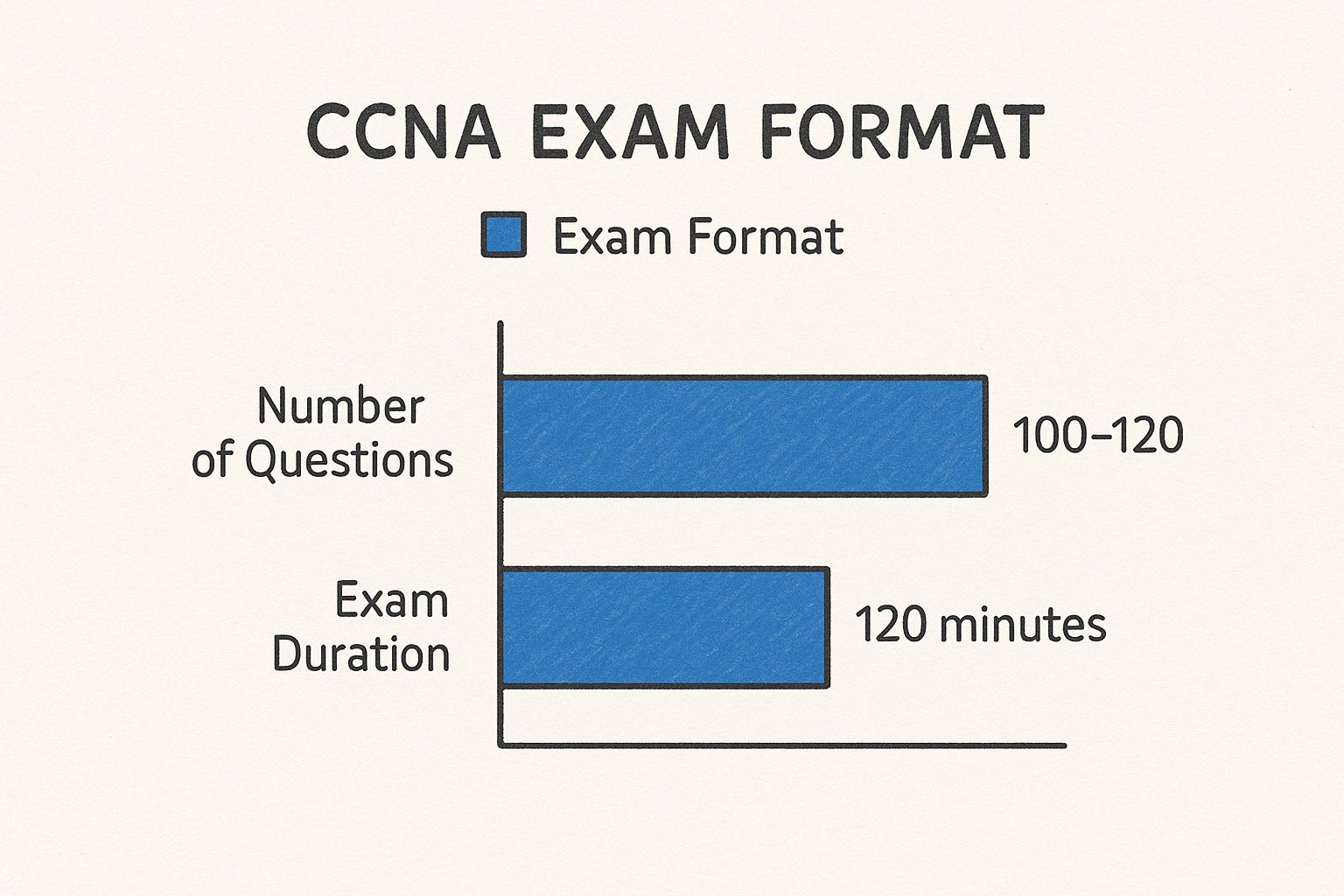 Caption: Effective time management is crucial during the CCNA exam, where you'll typically have about one minute per question. This underscores the importance of deep understanding and quick recall.
This tight constraint highlights why a thorough understanding of the material is paramount. You simply won't have the luxury of second-guessing answers. To help you contextualize this commitment, let's explore estimated study times based on different levels of experience.
Estimated CCNA Study Time by Experience Level
The following table offers a guideline for total study hours and the typical duration needed to prepare for the CCNA exam, categorized by your current networking knowledge. These estimates can also serve as a general framework for other technical certifications like CompTIA Network+ or Azure Fundamentals.
| Experience Level | Recommended Study Hours | Typical Timeframe |
|---|---|---|
| Beginner (No IT Experience) | 200-240+ Hours | 5-6 Months |
| Some IT Background | 150-200 Hours | 4-5 Months |
| Networking Professional | 80-120 Hours | 2-3 Months |
These figures are a starting point. Your personal dedication, chosen study methods, and the quality of your learning resources will significantly influence your actual timeline. Consistency in your study routine is the most critical factor.
Architecting Your Personalized CCNA Study Plan
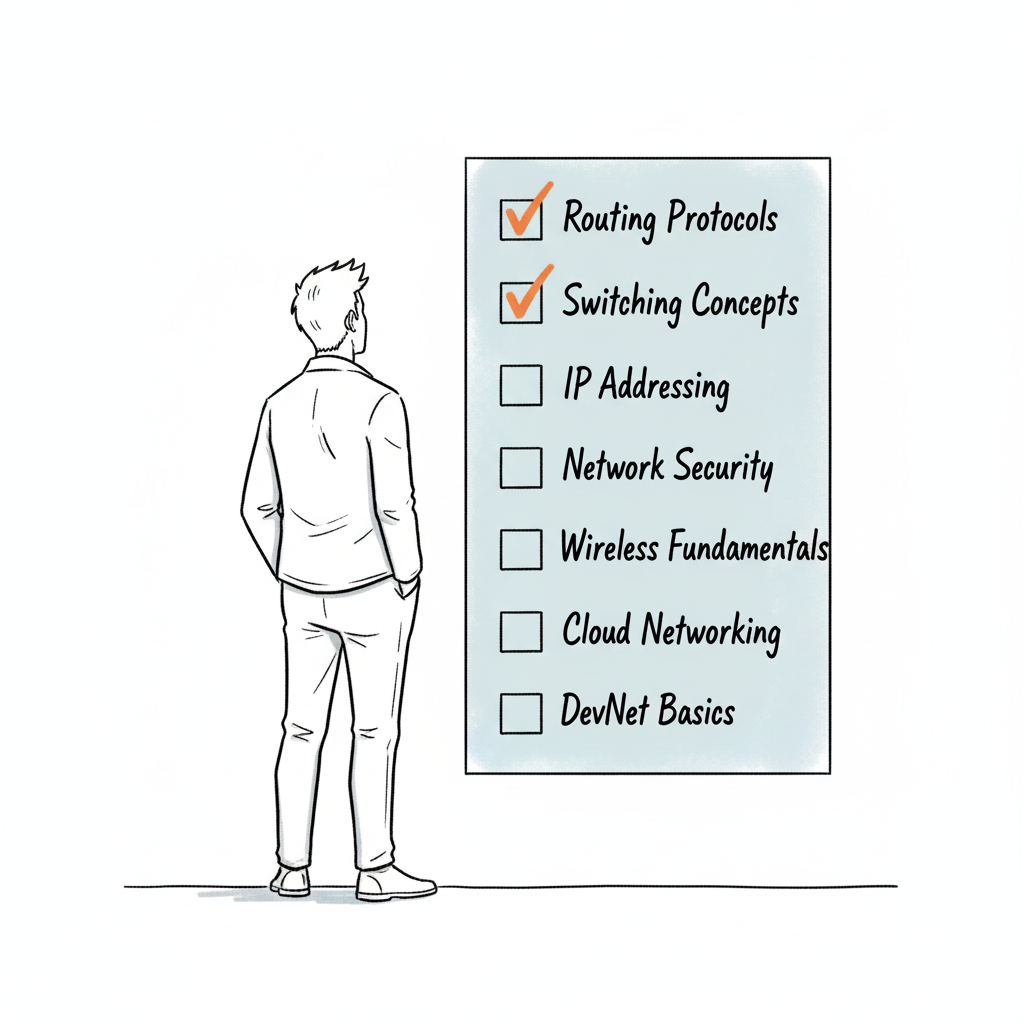 Caption: Tailoring your CCNA study plan to fit your individual life and commitments is essential for sustainable progress and avoiding burnout.
Generic study plans often fall short. Your CCNA preparation must be seamlessly integrated into your life – accounting for work, family, and other commitments. The key to success is finding a pace that allows for steady progress without leading to burnout, a principle applicable to any demanding IT certification.
Reflection Prompt: Before you even consider a schedule, honestly assess: How many hours can you genuinely commit to studying each week, consistently? It's far more effective to maintain a realistic eight hours weekly than to aim for an aspirational twenty, only to abandon the effort in a month.
Consider the contrast: a complete beginner in networking who can dedicate 10 hours per week might plan for a 6-month journey. In comparison, a systems administrator familiar with IP addressing who can invest 15 hours weekly could be exam-ready in just 2 to 3 months.
Structuring Your Study Schedule Effectively
Once you've determined your realistic weekly hour count, it’s time to get granular. Avoid vague calendar blocks labeled "study time." A truly actionable plan specifies what you'll study and how. For example:
- Weekdays: Allocate one hour in the morning to deep-dive into theoretical concepts, followed by another hour in the evening for hands-on lab exercises.
- Weekends: Dedicate a longer, focused 3-4 hour block for tackling comprehensive practice exams and meticulously reviewing your weaker areas.
This structured approach transforms abstract goals into concrete, daily actions. Research across various IT certifications, including the CCNA, reveals that while over 50% of professionals become exam-ready within 6 weeks to 5 months, approximately a third require more time. Only a select 15% manage to pass in under 6 weeks.
Remember, the ultimate objective isn't merely to pass a test; it's to cultivate the robust skills that will define your career. Rushing often leads to superficial memorization without true comprehension, which offers little practical benefit when troubleshooting a real-world network outage or tackling complex tasks in an AWS or Azure environment.
Prioritizing Smart Learning Techniques
How you learn is just as crucial as how long you study. "Cramming" is particularly ineffective for a technical certification like the CCNA, which demands deep understanding and practical application. True mastery stems from consistent, spaced-out review and active engagement. This is where methodologies like spaced repetition and active recall become invaluable for solidifying complex topics such as subnetting, routing protocols (like OSPF), and switching concepts for the long term.
By integrating smarter study habits into your routine, you ensure every hour invested yields maximum returns—both on exam day and throughout your future career as an IT professional.
Factors That Truly Influence Your CCNA Study Timeline
 Caption: Your study timeline for certifications like the CCNA is heavily influenced by your existing knowledge, the quality of your resources, and your daily discipline.
Have you ever wondered why some individuals conquer the CCNA in 90 days, while others require a full year? It's less about innate genius and more about the interplay of personal variables and how effectively they are managed.
Your educational and professional background, the quality of your chosen study materials, and your daily discipline are the primary determinants that will either accelerate or decelerate your progress. Identifying and addressing these factors is the foundational step in transforming a vague aspiration into a concrete plan for achieving certification.
Your Starting Point: Existing Knowledge and Professional Experience
This is arguably the most significant piece of the puzzle. Are you currently working in IT, perhaps interacting with network equipment daily? Or are you approaching this entirely from scratch? The difference in preparation time is substantial.
Someone holding a CompTIA Network+ or with a year of help desk experience already possesses a working vocabulary of IP addressing, network topologies, and the OSI model. Much of the introductory CCNA material will serve as a review, providing a considerable head start. Similarly, a professional with existing AWS or Azure cloud experience might find certain network security or automation concepts easier to grasp.
Conversely, if you're entirely new to the IT field, you'll need to meticulously build that foundational knowledge from the ground up. This is perfectly achievable, but requires a realistic allocation of additional time. Based on extensive community discussions, newcomers should realistically anticipate studying for 6 to 12 months. An experienced professional, by contrast, might be exam-ready in just 3 to 4 months. For more insights from the community, explore discussions on CCNA preparation timelines.
Your Resources: Study Materials and Essential Hands-On Lab Time
The quality and structure of your chosen resources can profoundly impact your timeline. Attempting to piece together all your knowledge from a fragmented collection of random, potentially outdated online videos is a recipe for frustration, leading to significant gaps in understanding. A high-quality, structured course from a reputable provider offers a clear, linear path through the curriculum, ensuring you cover every topic on the exam blueprint.
However, theoretical knowledge alone is insufficient. Hands-on practice is not merely recommended; it is non-negotiable for the CCNA and many other practical IT certifications.
Reading extensively about OSPF routing protocols is one thing. Actually configuring OSPF from a blank command line, troubleshooting adjacencies, and verifying routes in a lab environment is an entirely different, and critical, learning experience. The CCNA exam primarily assesses what you can do and apply, not just what you can memorize.
You should aim to dedicate at least 40% of your total study time to practical exercises within a lab environment. Essential tools like Cisco Packet Tracer or GNS3 are indispensable for this. This is where abstract concepts solidify into tangible skills, building the muscle memory and problem-solving aptitude you'll depend on when the exam clock is ticking.
Maximizing Every Hour: Making Your CCNA Study Time Count
You now have a general idea of the total hours required. The true challenge, however, lies in ensuring that every single one of those hours effectively propels you closer to achieving a passing score.
Simply passively watching video lectures or reading a textbook is insufficient. You need a structured approach that actively engages your brain, fostering true learning and long-term retention, rather than just superficial consumption of information.
Mastering One Domain at a Time
A common pitfall is haphazardly jumping between topics. One day might be spent on subnetting, the next attempting to decode OSPF, and then a sudden switch to wireless security. This fragmented approach often leads to burnout, shallow understanding, and an inability to connect related concepts.
A far more effective strategy, particularly useful for structured exams like the CCNA, ITIL, or even the PMP, is to dedicate an entire study period (e.g., a week) to a single major domain. For instance, immerse yourself completely in Network Access for a full week. The following week, delve deeply into IP Connectivity. This methodical approach allows you to build a robust foundation in one area before progressing, enabling your brain to establish crucial connections between related concepts and fully integrate the knowledge.
The Imperative of Daily Hands-On Lab Practice
I cannot emphasize this enough: theoretical knowledge will only take you so far. The CCNA is fundamentally a practical exam, and genuine understanding manifests through direct interaction with the command line. Adopting a "lab every day" mindset is absolutely critical for success.
This doesn't necessitate marathon lab sessions. Even 30-45 minutes of focused practice within a network simulator like Cisco Packet Tracer or GNS3 will yield remarkable results. This consistent practice is what differentiates someone who can describe a VLAN from an IT professional who can competently configure and troubleshoot one under the real-world pressure of an exam timer or a production environment.
Consistency consistently outperforms intensity. A brief, daily lab session is significantly more valuable for long-term retention and skill development than an exhaustive eight-hour lab binge once a week. This steady, daily engagement builds the essential muscle memory required for the exam's performance-based questions and real-world scenarios.
A Sample Weekly Study Framework for Success
To illustrate how these elements can be integrated, here’s a sample weekly schedule often recommended for certification candidates. It's designed to create a balanced routine that incorporates theory, hands-on practice, and review, all while minimizing the risk of burnout.
Sample Weekly CCNA Study Schedule
This balanced weekly schedule systematically integrates diverse learning methods to optimize knowledge retention and develop practical skills.
| Day | Morning (1 Hour) | Evening (1.5 Hours) |
|---|---|---|
| Mon-Thurs | Watch video course / Read chapter on a specific topic | Complete hands-on lab related to the day's topic |
| Friday | Review all the week's notes and use flashcards | Take a practice quiz on the week's domain |
| Saturday | Work on a more complex, multi-topic lab project | Go back and review any weak areas from the quiz |
| Sunday | Rest & light review (flashcards, etc.) | Rest or plan out the upcoming study week |
This dynamic rhythm keeps your learning process engaging and prevents monotony. You'll constantly reinforce learned concepts through varied activities, building a robust understanding.
As your exam date approaches, you can strategically replace a weekend lab session with a full-length practice test. This is the most effective way to simulate the actual exam environment and accurately assess your readiness. Accessing high-quality practice test questions and resources is crucial for pinpointing any remaining knowledge gaps before the big day.
Common Obstacles That Derail CCNA Candidates
 Caption: Recognizing common study pitfalls, such as passive learning or analysis paralysis, is the first step toward building a successful and sustainable CCNA preparation strategy.
It's a familiar narrative in the IT certification world: an individual brimming with enthusiasm to earn their CCNA dives in, only to lose momentum entirely a few weeks later. What typically goes wrong? Understanding these common traps is your best defense against them, ensuring you maintain consistent progress.
The foremost and most insidious trap is analysis paralysis. This is frequently observed among aspiring professionals who spend weeks—sometimes months—endlessly comparing video courses, textbooks, and lab tools. Their quest for the "perfect" study resource becomes an endless cycle. The truth is, the "perfect" resource is often the one you start with and stick to. Consistent effort applied to a reputable resource will invariably yield better results than an indefinite search for an elusive "perfect" one.
The Critical Difference: Passive Learning vs. Active Engagement
Another significant momentum killer is succumbing to the allure of passive learning. It's deceptively easy to binge-watch hours of video tutorials and feel a sense of accomplishment. However, if you never actually open a command line, configure a router, or troubleshoot a switch, that perceived knowledge remains superficial. You might recognize a concept, but you won't be able to confidently apply it when the pressure is on—be it in an exam or a real-world scenario.
To truly embed the material into your long-term memory and skill set, you must engage actively:
- Instead of just watching someone build a network topology, construct it yourself from scratch in a virtual lab environment.
- Deliberately introduce faults and misconfigurations into your lab setup. Then, systematically apply troubleshooting methodologies to identify and rectify them.
- Attempt to explain a complex topic, such as OSPF areas or VLAN tagging, out loud, as if you were instructing a colleague. This active recall technique forces deeper processing.
This type of active engagement is what solidifies concepts, develops critical thinking, and builds the practical skills necessary for an IT professional.
The ultimate goal isn't solely to pass a certification exam; it's to develop into a competent network engineer, cloud architect, or cybersecurity specialist. While passive learning might help with multiple-choice quizzes, active labbing and hands-on practice are what truly prepare you for performance-based exam questions and the demands of an actual IT role.
Finally, a sporadic study schedule is a direct pathway to failure. Cramming for eight hours on a Sunday, only to neglect the material for the next five days, is counterproductive. This inconsistent approach disrupts your learning rhythm and hinders long-term retention. A focused 90 minutes of study every single day is exponentially more effective for cementing knowledge.
As you approach your exam day, your study strategy will need to adapt again, shifting focus to intensive review and mock exams.
Addressing Your Top CCNA Preparation Questions
As you begin to construct your personalized study calendar, several common questions frequently arise. Let's clarify these uncertainties to empower you to build a confident plan and focus on what truly matters for your CCNA preparation.
"Can I Really Achieve This While Working a Full-Time Job?"
Absolutely, you can. In fact, a vast majority of professionals pursuing their CCNA—or other certifications like AWS Certified Solutions Architect or ITIL 4 Foundation—are simultaneously managing a 40-hour work week. The true secret to their success isn't discovering massive blocks of free time; it's about unwavering consistency and strategic time utilization.
The key lies in establishing a study pace that is genuinely sustainable without leading to burnout. Aim for 1-2 focused hours on weekdays, and then dedicate a more extended 3-4 hour session on either Saturday or Sunday. This consistent approach can accumulate a solid 8-10 hours weekly, positioning you well within the 5-6 month timeline if you're new to networking. Don't underestimate the power of "micro-learning" moments either; utilizing flashcard apps or reviewing quick concepts during commutes or short breaks can significantly compound over time.
"How Crucial Is Hands-On Lab Time, Truly?"
Hands-on lab time is not just crucial; it is completely non-negotiable. The CCNA is not merely a vocabulary test of networking terms; it is a practical examination designed to assess your ability to perform the work of a network associate. You must develop proficiency and comfort with the command line interface (CLI), configuring routers and switches until the commands and their outputs become second nature. This principle extends to other certifications, where practical application is key, such as configuring cloud services for AWS or Azure, or setting up security controls for CompTIA Security+.
Consider this analogy: Reading countless cookbooks will not transform you into a chef. You must step into the kitchen and actively cook to master culinary skills. For network professionals, labbing is your essential "kitchen time."
A sound guideline is to allocate at least 30-40% of your entire study duration to hands-on practice within a lab environment. You don't need to invest in expensive physical hardware to begin. A robust, free tool like Cisco Packet Tracer provides an excellent virtual environment, offering everything you need to build the practical skills vital for not only passing the exam but also for succeeding in real-world networking roles.
"Self-Study vs. Bootcamp: Which Approach is Better?"
The choice between self-study and a bootcamp largely depends on your individual learning style, financial resources, and your capacity for self-accountability. For the vast majority of successful candidates we observe, self-study proves to be the most effective route. It offers unparalleled flexibility, is significantly more affordable, and allows you to thoroughly master complex topics at your own pace through a diverse mix of high-quality video courses, textbooks, and extensive lab practice.
Bootcamps, by contrast, are intensive, typically very expensive, and move at an extremely accelerated pace. They can be beneficial for experienced professionals who already possess a strong networking foundation and are under strict deadlines to achieve certification for their job. However, for most individuals, the self-study path cultivates a much deeper, more enduring foundation of knowledge and practical skills essential for a long-term career in networking.
Ready to build a strategic study plan that delivers tangible results? MindMesh Academy provides expertly curated materials and intelligent learning tools designed to help IT professionals master complex concepts and confidently pass their certification exams. Start optimizing your certification journey today at mindmeshacademy.com.
Ready to Get Certified?
Prepare with expert-curated study guides, practice exams, and spaced repetition flashcards at MindMesh Academy:

Written by
Alvin Varughese
Founder, MindMesh Academy
Alvin Varughese is the founder of MindMesh Academy and holds 15 professional certifications including AWS Solutions Architect Professional, Azure DevOps Engineer Expert, and ITIL 4. He's held senior engineering and architecture roles at Humana (Fortune 50) and GE Appliances. He built MindMesh Academy to share the study methods and first-principles approach that helped him pass each exam.