
Google Cloud Certification Path: Your Roadmap to a Cloud Career
Navigating your career in cloud computing requires a deliberate strategy. The optimal Google Cloud certification path isn't a one-size-fits-all solution; it's a personalized roadmap shaped by your individual career aspirations and current technical foundation. For many IT professionals targeting hands-on roles, the journey effectively begins with the Associate Cloud Engineer certification. This foundational technical credential then serves as a springboard for advanced, professional-level specializations such as the Professional Cloud Architect or Professional Data Engineer, ensuring a structured and effective skill development trajectory. At MindMesh Academy, we understand the importance of this strategic approach to professional growth.
Why a Google Cloud Certification Path Matters Now
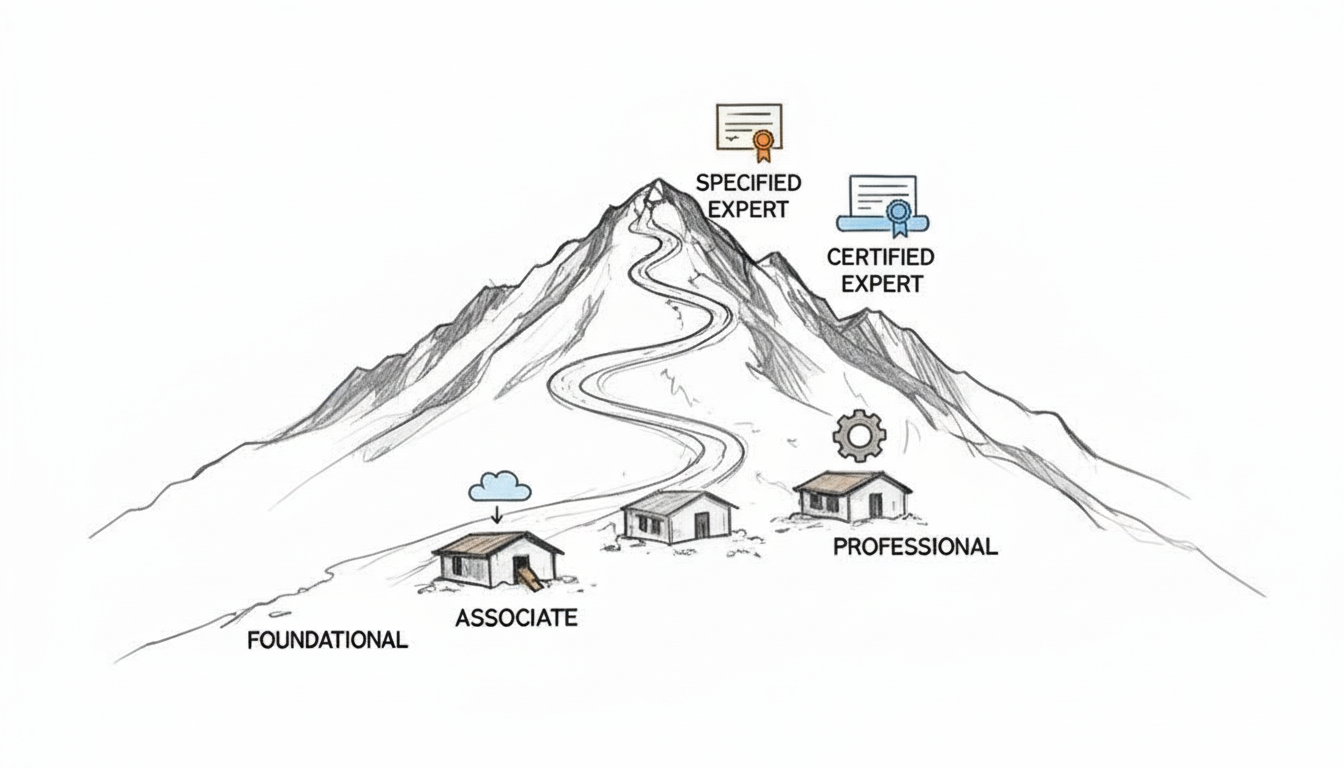
Venturing into the vast landscape of cloud computing without a clear strategy can feel akin to attempting to summit a challenging peak without a topographic map. A well-defined Google Cloud certification path serves precisely as that essential guide. It meticulously deconstructs what might seem like an overwhelming professional goal into a series of attainable milestones. In today's competitive IT landscape, these certifications have evolved beyond mere resume enhancers; they represent a tangible, high-impact investment in your professional longevity and expertise.
The market's hunger for individuals genuinely proficient in Google Cloud Platform (GCP) is experiencing exponential growth. This demand is particularly pronounced in cutting-edge domains like Artificial Intelligence (AI) and advanced data analytics, where GCP offers industry-leading capabilities. Organizations are actively seeking certified professionals who can expertly deploy, manage, and optimize these powerful cloud services, transforming certified individuals into highly sought-after assets.
Reflection Prompt: Consider your current career goals. How might a structured certification path help you bridge the gap between your present skills and your desired future role?
Charting Your Expedition
Envision your certification journey as a meticulously planned mountain expedition. Each certification you successfully acquire represents a new base camp established, providing you with validated skills and the confidence required to ascend to the next, more complex technical challenge. This inherently structured methodology ensures a robust foundation of knowledge and practical capabilities is firmly in place before you delve into intricate architectural designs or advanced deployments.
A defined certification path transcends mere technical skill acquisition; it systematically builds professional momentum. Each earned certification not only validates your growing expertise but also unequivocally signals to potential employers your serious commitment to mastering the Google Cloud Platform, a crucial element in learning how to future-proof your career.
The Tangible Rewards of a Clear Path
Adhering to a logical Google Cloud certification path yields concrete, measurable career advantages. This journey is not solely about knowledge acquisition; it's demonstrably about professional advancement and increased earning potential. Industry trends consistently show that IT professionals holding Google Cloud certifications frequently experience substantial salary increases and accelerated career progression. This is largely because certifications provide clear, verifiable, third-party validation of your practical capabilities – much like a PMP certification validates project management expertise or an AWS Solutions Architect certification confirms design proficiency.
Furthermore, a meticulously planned certification trajectory is a powerful defense against wasted effort. It strategically concentrates your study efforts, mitigating the risk of developing critical knowledge gaps. Rather than piecemeal learning about disparate services, you'll focus intensely on the competencies most pertinent to your desired role and the specific exam domains. This targeted approach rigorously prepares you for authentic, real-world cloud challenges, empowering you to become a highly effective and confident cloud professional from day one.
Understanding the Google Cloud Certification Levels
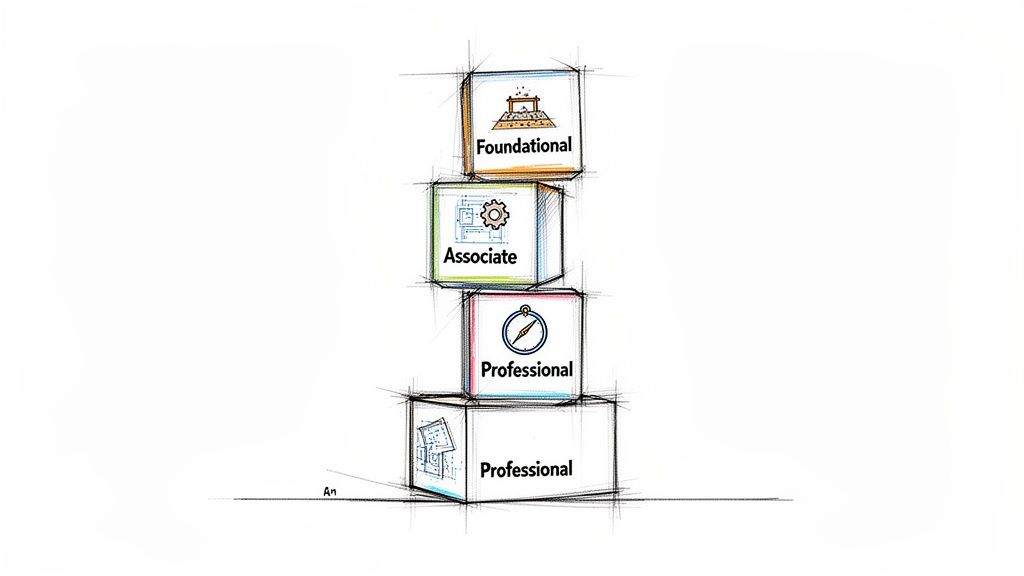
Google Cloud strategically structures its certification offerings into three distinct tiers, providing a clear framework for charting your professional growth. The most intuitive way to conceptualize the Google Cloud certification path is through the analogy of constructing a robust building. You wouldn't begin with the roof; instead, you'd meticulously lay a strong foundation, then erect a sturdy framework, and finally add specialized architectural elements. Google's progressive certification levels mirror this logical, intuitive construction process.
Each level – Foundational, Associate, and Professional – is designed to systematically build upon the preceding one. This progressive architecture is invaluable for cultivating a comprehensive, practical mastery of the platform, proactively preventing the formation of critical knowledge gaps. It’s explicitly engineered to equip you for real-world operational success and strategic problem-solving, far beyond merely passing an exam.
The Ground Floor: Foundational Level
Your expedition commences at the Foundational level with the Cloud Digital Leader certification. This credential represents the solid ground floor of your cloud expertise, meticulously designed for broad accessibility, even for individuals without a traditional technical background. It serves as an excellent fit for professionals in business development, sales, project management, or leadership roles who require a strategic understanding of cloud concepts. Much like the ITIL 4 Foundation validates an understanding of IT service management principles, the Cloud Digital Leader focuses on the strategic 'what' and 'why' of Google Cloud.
This certification intentionally steers clear of intricate coding or network configurations. Instead, its core curriculum centers on grasping Google Cloud's overarching business value, its transformative impact on organizations, and how it facilitates achieving strategic objectives. It is the perfect initial step for anyone aiming to confidently articulate cloud concepts and their implications in executive discussions.
The Foundational tier is more than a technical primer; it's a strategic entry point. It validates your ability to articulate cloud capabilities in terms of business objectives, a skill increasingly indispensable for leaders across all departments.
Given the global cloud computing market's projected surge from USD 676.29 billion in 2024 to an astonishing USD 2,291.59 billion by 2032, concrete validation of your skills is paramount. Certifications like the Cloud Digital Leader serve as verifiable proof of competence in understanding vital areas such as storage, machine learning applications, and analytics within the Google Cloud Platform (GCP).
The Structural Frame: Associate Level
With your foundational knowledge secured, the next logical progression is to the Associate level, akin to erecting the essential structural frame of your cloud expertise. The Associate Cloud Engineer (ACE) certification stands as the cornerstone of this tier. It is specifically tailored for practitioners who require robust, hands-on skills to actively deploy, monitor, and manage applications and infrastructure on Google Cloud.
This is precisely where theoretical understanding transitions into practical application. The ACE exam meticulously validates your ability to configure a functional cloud environment, efficiently manage core resources, and maintain operational oversight. It is widely recognized as the primary on-ramp for aspiring cloud engineers, software developers, and system administrators who will engage directly with Google Cloud technology on a daily basis. Think of it as Google Cloud's equivalent to the AWS Certified Solutions Architect - Associate (SAA-C03) or the Azure Administrator Associate (AZ-104), focusing on the practical administration and deployment aspects of the platform.
Reflection Prompt: If you're already in a technical role, how might earning your ACE validate your existing skills and open doors to more cloud-specific responsibilities?
The Specialized Blueprint: Professional Level
The Professional level represents the culmination – the intricate, specialized blueprint guiding the entire structure of your cloud career. These advanced certifications serve as undeniable proof of deep, role-based expertise, demonstrating your capability to design, implement, and proficiently manage complex, large-scale cloud solutions from their inception to ongoing operation.
This tier encompasses Google Cloud's most advanced and highly sought-after certifications, including:
- Professional Cloud Architect: Focuses on designing robust, scalable, highly available, and secure cloud architectures. This role often involves strategic planning akin to what a PMP-certified project manager might oversee for a complex IT initiative.
- Professional Data Engineer: Centers on building, operating, and maintaining sophisticated data processing and machine learning systems.
- Professional Cloud Security Engineer: Specializes in designing and implementing a secure infrastructure, ensuring compliance and mitigating risks across Google Cloud environments—a critical function mirrored in cybersecurity certifications like CompTIA Security+ at a foundational level, but with deep cloud-specific application here.
These credentials hold immense value for employers as they unequivocally demonstrate true mastery and the ability to solve complex, real-world business challenges. Achieving a professional certification frequently catalyzes significant career acceleration and is a crucial differentiator for securing some of the top-paying IT certifications in 2025. This level signifies that you don't merely utilize Google Cloud; you possess the acumen to lead projects, innovate solutions, and tackle formidable business problems using the platform.
Google Cloud Certification Levels at a Glance
For enhanced clarity, the following table provides a concise overview of how these distinct Google Cloud certification levels are structured and differentiate from one another. This summary is invaluable for mapping your ideal Google Cloud certification path.
| Certification Level | Focus Area | Ideal Candidate | Exam Cost (USD) |
|---|---|---|---|
| Foundational | Core cloud concepts and Google Cloud's business value | Business professionals, managers, non-technical staff | $99 |
| Associate | Hands-on deployment, monitoring, and management | Aspiring cloud engineers, developers, administrators | $125 |
| Professional | Advanced design, implementation, and management skills | Experienced architects, data engineers, security experts | $200 |
Consider this table your essential quick-reference guide. It empowers you to precisely determine your optimal starting point, aligning with your current professional role and ambitious career trajectory within the Google Cloud ecosystem.
The Essential Starting Point: The Cloud Digital Leader
Every significant professional journey mandates a clear starting point. For anyone earnestly considering a future within the Google Cloud ecosystem, that inaugural step is the Cloud Digital Leader certification. This credential functions as your official entry pass into the expansive domain of cloud computing, offering a high-level, business-centric perspective.
The distinctive appeal of this certification lies in its broad accessibility. It was meticulously designed not exclusively for aspiring technical specialists but also for professionals in roles such as sales, marketing, product management, or senior leadership who need to actively participate in strategic cloud discussions. You are not required to be a software developer or network engineer to comprehend the immense business value proposition of cloud technology – and that fundamental understanding is the precise focus of this examination. Much like the CompTIA Cloud Essentials+ aims to provide a vendor-neutral understanding of cloud fundamentals, the Cloud Digital Leader delivers a Google Cloud-specific business perspective.
The Cloud Digital Leader primarily explores the why of Google Cloud, emphasizing its strategic impact rather than the intricate how-to technical details. It equips you with the essential vocabulary and contextual understanding necessary to engage intelligently in conversations about digital transformation, cloud adoption, and strategic business initiatives. It stands out as one of the most practical and valuable entry-level IT certifications available today.
Who Should Start Here
This certification serves as the quintessential launchpad for any professional needing to comprehend cloud computing from a business-first vantage point. It is an exceptional fit for:
- Project Managers who oversee or plan cloud migration, adoption, or development projects, enabling them to communicate effectively with technical teams and stakeholders.
- Sales and Marketing Professionals responsible for articulating the value and benefits of cloud solutions to clients or the market.
- Business Leaders and Analysts tasked with making strategic decisions regarding technology adoption, investment, and organizational transformation.
- Aspiring Cloud Practitioners from non-technical backgrounds who seek a structured, confidence-building entry point into the cloud domain.
Obtaining this credential concretely demonstrates your ability to link Google Cloud products and services to tangible, real-world business challenges and opportunities. It effectively bridges the communication chasm that frequently exists between highly technical teams and business decision-makers, ensuring a shared understanding and alignment on strategic cloud initiatives.
The Cloud Digital Leader transcends the memorization of a service catalog. Its true value lies in cultivating an understanding of how to leverage cloud technology as a strategic enabler for sustainable business growth and innovation.
Reflection Prompt: In your role, how often do you find communication barriers between technical and business teams? How could a common understanding of cloud concepts, like that provided by the Cloud Digital Leader, enhance collaboration?
A Practical Study Plan for the Cloud Digital Leader
Unlike more advanced certifications, the Cloud Digital Leader exam doesn't demand months of intensive study. For most dedicated individuals, a focused commitment of just two to four weeks is ample time to prepare thoroughly without feeling overwhelmed.
Here’s a meticulously designed, milestone-based study plan designed to guide your preparation:
- Week 1: Cloud Fundamentals & Business Value: Begin by solidifying your understanding of general cloud computing concepts and the strategic implications of 'digital transformation' for modern enterprises. Focus on the fundamental benefits of cloud adoption, such as enhanced cost efficiency, unparalleled scalability, and operational agility.
- Week 2: Core Google Cloud Services (Overview): Progress to familiarizing yourself with Google Cloud's fundamental services. Understand the high-level functions of offerings like Compute Engine (virtual machines), Cloud Storage (object storage), and BigQuery (data warehousing), without delving into deep technical configurations at this stage.
- Week 3: Innovation & Strategic Use Cases: Concentrate on how Google Cloud facilitates business innovation, particularly in areas like data analytics, machine learning, and artificial intelligence. Explore practical, real-world use cases and scenarios where GCP services deliver tangible business outcomes.
- Week 4: Security, Compliance, Cost & Exam Prep: Conclude your study by reviewing essential concepts related to cloud security, regulatory compliance, and cost management best practices within Google Cloud. Dedicate significant time this week to practice questions and mock exams to acclimate yourself to the exam format and reinforce confidence.
This streamlined, targeted approach renders the Cloud Digital Leader a highly manageable and impactful first step, perfectly positioning you for more advanced Google Cloud certifications and expanded career opportunities in the future.
Key Takeaway: The Cloud Digital Leader exam emphasizes conceptual understanding and business relevance. Focus on what services do and why they are valuable, rather than intricate how-to configurations.
Building Your Core Skills With The Associate Cloud Engineer
While the Foundational certification grounds you in the strategic why of Google Cloud, the Associate Cloud Engineer (ACE) is the pivotal point where you transition from conceptual understanding to tangible, hands-on application. This credential marks the effective beginning of almost all technical cloud roles, shifting focus from theoretical knowledge to practical, operational proficiency.
The ACE is specifically designed for the practitioners who are actively involved in deploying applications, diligently monitoring infrastructure, and managing enterprise-level cloud solutions. Successfully passing this exam unequivocally demonstrates your capability to move beyond mere discussion about the cloud – it validates your practical skills in configuring, launching, troubleshooting, and maintaining Google Cloud environments.
From Concepts to Command Line
To further the analogy, consider the Cloud Digital Leader as teaching you the rules of the road and how to interpret traffic signs. The Associate Cloud Engineer then places you firmly behind the wheel, instructing you on how to operate the vehicle, navigate various road conditions, and reach your destination efficiently. This distinction highlights the critical shift to practical deployment and operational skills.
This is consistently the most prevalent entry point for technically inclined professionals because it imparts baseline competencies applicable across a wide spectrum of hands-on cloud roles, including:
- Cloud Engineers: Directly responsible for managing, deploying, and maintaining core cloud infrastructure components.
- Developers: Needing to effectively deploy, configure, and troubleshoot their applications within a cloud environment.
- System Administrators: Transitioning their on-premises infrastructure management expertise to cloud platforms.
The ACE exam is not a theoretical exercise in rote memorization. It is a highly practical assessment of your ability to establish and configure a functional cloud environment, ensure its correct operation, and implement foundational access controls. It unequivocally validates the core 'muscle memory' required for routine Google Cloud administration and deployment tasks. For instance, you might be asked to deploy a Dockerized application to Compute Engine, configure a basic VPC network, or manage IAM roles for a new project team—all scenarios directly testing practical application.
Reflection Prompt: How confident are you with command-line interfaces and cloud consoles? What steps can you take to gain more hands-on experience, even before beginning formal study for the ACE?
Experience and Preparation
While Google Cloud does not impose formal prerequisites for the ACE exam, it strongly advises candidates to possess at least six months of hands-on experience directly interacting with Google Cloud. This recommendation should be taken very seriously. The examination is meticulously designed to assess your ability to apply knowledge to practical problem-solving scenarios, a skill that cannot be developed through documentation review alone. Genuine proficiency requires significant time spent navigating the GCP console and executing commands via the gcloud command-line interface. Resources like Qwiklabs or MindMesh Academy's integrated labs provide excellent sandboxes for this crucial hands-on practice.
This practical experience is precisely what elevates the value of ACE-certified professionals. It confirms their capability to effectively manage cloud projects, provision and operate diverse resources such as virtual machines and container clusters, and implement foundational security controls. Employers prioritize this demonstrable, practical skill set.
Your 3-Month ACE Study Blueprint
Successfully conquering the ACE exam without succumbing to overwhelm hinges on a well-structured study plan. A three-month timeline typically provides the ideal balance, allowing ample time to deeply internalize concepts and gain the indispensable hands-on practice.
Here’s a meticulously designed, milestone-based approach we recommend:
Month 1: Foundational Services and IAM
- Weeks 1-2: Core Infrastructure & Compute Engine. Dedicate this period to mastering Google Cloud's fundamental infrastructure components. Your primary focus should be on proficiently setting up and managing projects, understanding billing best practices, and becoming exceptionally comfortable with Compute Engine. Practice deploying, managing, and troubleshooting various VM instances until these operations become second nature, utilizing
gcloud compute instances createand similar commands. - Weeks 3-4: Identity and Access Management (IAM). This domain constitutes a significant portion of the ACE exam. Practice assigning appropriate roles to different users (e.g.,
gcloud projects add-iam-policy-binding) and service accounts. Crucially, differentiate between primitive, predefined, and custom roles, and understand the principle of least privilege in a practical context.
Month 2: Storage, Databases, and Containers
- Weeks 5-6: Storage Solutions. Dive deep into Google Cloud's diverse storage options. You must not only know what each option does but, more importantly, when to strategically employ each one. Gain hands-on expertise with Cloud Storage for object data, Persistent Disks for VM storage, and understand file storage solutions like Cloud Filestore, practicing with
gsutilcommands. - Weeks 7-8: Containerization with GKE. Container orchestration is a non-negotiable skill for contemporary cloud roles. Your focus here should be on Google Kubernetes Engine (GKE). Learn how to create a cluster, deploy a simple containerized application (e.g., using
kubectl deploy), and grasp the fundamentals of GKE networking and scaling.
Month 3: Networking, Monitoring, and Exam Prep
- Weeks 9-10: Cloud Networking. Become proficient in Google Cloud networking concepts. Get comfortable configuring Virtual Private Clouds (VPCs), subnets, firewall rules (e.g.,
gcloud compute firewall-rules create), and Cloud DNS. Your objective is to practice connecting and securing your cloud resources robustly and efficiently. - Weeks 11-12: Cloud Operations & Exam Simulation. Shift your attention to monitoring and logging with the Cloud Operations suite (formerly Stackdriver). Practice setting up alerts, querying logs in Cloud Logging, and constructing informative dashboards in Cloud Monitoring to observe application performance. Conclude the final week by rigorously attacking official practice exams. These are the most effective tools for identifying your remaining knowledge gaps and familiarizing yourself with the actual exam's format and question style.
By adhering to a structured plan like this, you will achieve more than just factual recall – you will cultivate genuine, practical skills that are indispensable for success on exam day and throughout your subsequent cloud career.
Key Takeaway: Consistent, hands-on practice with the GCP console and
gcloudCLI is paramount for the ACE. Every conceptual topic should be immediately followed by practical application in a free-tier environment.
Charting Your Course: From Associate to Professional
Once you have firmly established your core cloud engineering competencies with the ACE, the next crucial phase involves specialization. This stage is where your overarching career aspirations profoundly influence your Google Cloud certification path. The era of a one-size-fits-all trajectory concludes; you now possess the agency to select a direction that aligns directly with your target high-demand technical role.
Conceive of the Associate Cloud Engineer (ACE) certification as a bustling major airport hub. With that foundational credential secured, you're granted clearance to embark on a direct flight to a highly specialized destination. Whether your passion lies in architecting resilient, large-scale systems, expertly managing intricate datasets, or fortifying digital defenses, there exists a Professional-level certification meticulously crafted to guide you. Each of these credentials rigorously validates a distinct, highly valuable skill set that organizations are actively seeking in today's market.
Reflection Prompt: Based on your interests and career vision, which of the professional specializations (Architect, Data, DevOps, Security, Network) resonates most strongly with you, and why?
The Cloud Architect Path: Designing Resilient Systems
The trajectory toward becoming a Professional Cloud Architect stands as one of the most sought-after and professionally gratifying Google Cloud certification paths. This role functions as the master planner within the cloud ecosystem, bearing the critical responsibility for designing, developing, and overseeing the deployment of robust, secure, and highly scalable solutions on Google Cloud Platform (GCP). It transcends mere knowledge of individual service functions; it demands a sophisticated understanding of how to intricately integrate these services to address complex, multifaceted business challenges. This parallels the role of a Solutions Architect in AWS (e.g., after the AWS Solutions Architect - Associate, one might pursue the Professional level) or an Azure Solutions Architect Expert (AZ-305).
This particular path directly leverages and expands upon the foundational expertise cultivated through the ACE:
- Foundation with ACE: You first solidify your fundamental skills in deploying and managing cloud resources.
- Ascension to Professional Cloud Architect: This becomes your primary objective. The corresponding exam rigorously tests your ability to design architectures prioritizing security and compliance, to analyze and optimize intricate technical processes, and to ensure the fault tolerance and resilience of the solutions you engineer.
This systematic progression—from a solid operational base to an advanced architectural specialization—serves as the quintessential blueprint for success in numerous senior technical roles.
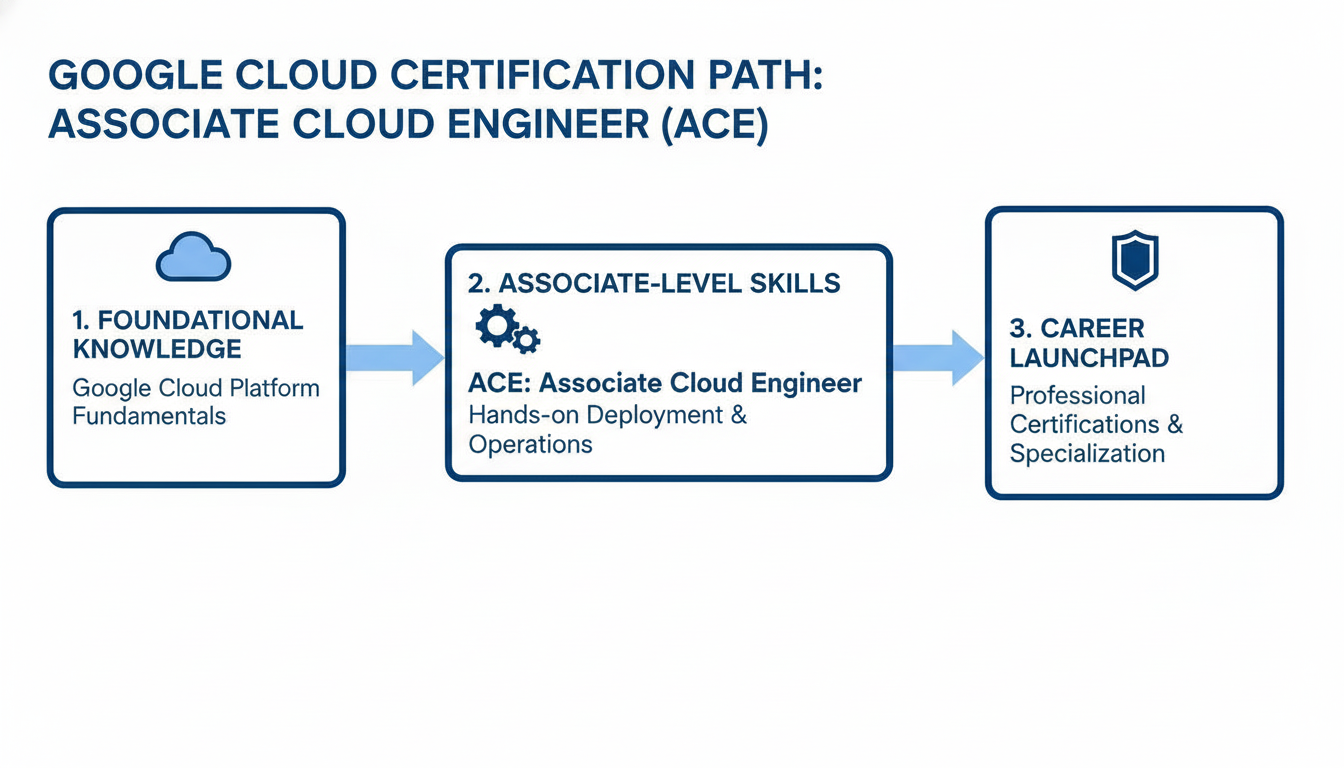 Caption: The ACE certification acts as a crucial stepping stone, validating core hands-on skills before advancing to specialized professional roles within Google Cloud.
This diagram visually encapsulates the logical flow: beginning with general Google Cloud knowledge, progressing to demonstrate hands-on operational skills at the Associate level with the ACE, and subsequently utilizing that as the launchpad for any chosen professional specialization.
The Data Engineer Path: Building Intelligent Pipelines
For those professionals captivated by the power of data, the Professional Data Engineer path offers an exceptionally rewarding career trajectory. Data engineers are the indispensable architects of the modern data landscape, responsible for conceptualizing, designing, and constructing the sophisticated systems that facilitate the collection, transformation, and analysis of data at massive scales. They forge the critical data pipelines that fuel everything from essential business intelligence dashboards to advanced machine learning models and real-time analytics.
This specialization necessitates a profound, practical command of key Google Cloud services such as BigQuery (for analytical data warehousing), Dataflow (for stream and batch data processing), and Pub/Sub (for real-time messaging).
- Core Focus: Your overarching objective in this specialization is the Professional Data Engineer certification.
- Key Skills: You will be expected to demonstrate expert ability in designing resilient and scalable data processing systems, operationalizing complex machine learning models (from training to deployment and monitoring), and rigorously ensuring the highest standards of data quality, governance, and security.
This is a profoundly critical role for any organization aiming to leverage data for intelligent, informed decision-making, positioning it as an incredibly valuable and future-proof career track within the IT profession.
The DevOps Engineer Path: Automating and Optimizing
For IT professionals who thrive on automation, operational efficiency, and seamlessly bridging the divide between software development and IT operations, the Professional Cloud DevOps Engineer path offers an ideal specialization. A skilled DevOps professional meticulously focuses on constructing and maintaining robust Continuous Integration/Continuous Delivery (CI/CD) pipelines, managing infrastructure as code (IaC), and rigorously ensuring the unwavering reliability and accelerated velocity of software delivery.
This role transcends a mere understanding of tools; it embodies a transformative mindset centered on deep collaboration, pervasive automation, and relentless continuous improvement. The Professional Cloud DevOps Engineer certification specifically validates your advanced capability to apply Site Reliability Engineering (SRE) principles—a methodology pioneered by Google—to systematically enhance service performance, stability, and scalability. This is analogous to how an Agile certification validates a structured approach to project execution, but applied to the entire software delivery lifecycle.
The tangible impact of this specialization is profound. Google's internal data reveals that a remarkable 85% of Google Cloud learners indicate their certifications provided the requisite skills to secure highly in-demand roles across leading markets. As highlighted in various career acceleration guides, these credentials are not merely symbolic badges; they serve as potent catalysts for significant career advancement and professional recognition.
The Security and Network Engineer Paths: Securing the Cloud
Within the dynamic realm of cloud computing, security and networking are inextricably linked, forming two indispensable pillars for establishing a stable, resilient, and secure environment. Recognizing this critical interdependence, Google provides distinct professional certification paths for each specialized discipline.
- Professional Cloud Security Engineer: This rigorous path is meticulously designed for professionals charged with designing, implementing, and maintaining a robust, secure infrastructure on Google Cloud. Mastery in this domain requires deep expertise in identity and access management (IAM), the strategic configuration of layered network security defenses (e.g., firewall policies, VPC Service Controls), and the adept management of operations within a hardened, compliance-driven security framework. This certification is a cloud-specific equivalent to a deeply specialized cybersecurity credential, like a CISSP or CySA+, but focused entirely on GCP.
- Professional Cloud Network Engineer: This certification is singularly focused on the advanced design, implementation, and meticulous management of network architectures within GCP. It validates profound expertise in configuring complex Virtual Private Clouds (VPCs), establishing seamless hybrid connectivity solutions (e.g., Cloud VPN, Cloud Interconnect), optimizing various network services (e.g., load balancing, Cloud DNS), and rigorously securing intricate network topologies. This is for the individual who might pursue a CCNA or CCNP in traditional networking, but applied to the hyperscale cloud.
Your strategic choice between these two advanced specializations should be guided by your inherent passion and career focus. Do you gravitate more towards defining overarching security policies, mitigating advanced threats, and ensuring regulatory compliance? Or does the intricate architecture and performance optimization of network infrastructure itself ignite your interest? Regardless of your selection, both paths lead to highly impactful, high-stakes, and exceptionally rewarding roles in the cloud industry.
Role-Based Google Cloud Certification Paths and Salaries
To provide a clearer visualization of the professional trajectories enabled by each specialization, the following table delineates these key roles. It outlines the recommended professional certification, the core competencies you will validate, and the average salary ranges typically observed in North America for these highly skilled positions.
| Career Role | Recommended Professional Certification | Core Skills Validated | Average North American Salary |
|---|---|---|---|
| Cloud Architect | Professional Cloud Architect | Designing for scalability, security, and reliability; optimizing technical and business processes. | $175,000 – $210,000 |
| Data Engineer | Professional Data Engineer | Building data pipelines; operationalizing ML models; ensuring data quality and security. | $160,000 – $195,000 |
| DevOps Engineer | Professional Cloud DevOps Engineer | Implementing CI/CD pipelines; applying SRE principles; managing service incidents. | $155,000 – $190,000 |
| Security Engineer | Professional Cloud Security Engineer | Configuring access controls; defining security policies; managing incident response. | $165,000 – $205,000 |
| Network Engineer | Professional Cloud Network Engineer | Designing VPC networks; implementing hybrid connectivity; configuring network services. | $150,000 – $185,000 |
This comprehensive side-by-side comparison unequivocally illustrates that each specialized Google Cloud certification path leads to a distinct, highly compensated, and impactful role within the IT industry. By introspectively considering your genuine interests and long-term career aspirations, you can strategically select the professional certification that will not only validate your advanced expertise but also unlock extraordinary opportunities and substantial earning potential.
Reflection Prompt: Review the core skills listed for each professional role. Which set of skills aligns best with your existing strengths and desired areas of growth?
Creating Your Strategic Study and Exam Plan
Identifying your ideal Google Cloud certification path is a critical first step, but successfully earning that credential demands a meticulously constructed strategic plan. A robust study methodology is the decisive factor that differentiates aspiration from accomplishment. It serves to prevent burnout, significantly enhances knowledge retention, and instills the confidence needed to approach the exam feeling thoroughly prepared, rather than anxious. This preparation process is not about superficial last-minute cramming; it's about cultivating genuine, enduring skills that will serve you well beyond exam day.
We cannot overstate this: the most effective preparation strategy for any Google Cloud certification involves extensive hands-on practice. Theoretical comprehension is valuable, but it provides only a partial understanding. You must become profoundly comfortable navigating the Google Cloud console, executing gcloud commands in the terminal, and adeptly diagnosing and resolving operational issues. This is precisely where the GCP Free Tier becomes an indispensable asset and your ultimate personal training ground.
Building Your Personal Lab Environment
Google offers a remarkably generous Free Tier, granting you access to a suite of services usable monthly at no cost, provided you adhere to the specified usage limits. Consider this your completely risk-free sandbox—an ideal environment to diligently practice and internalize the practical skills requisite for any Google Cloud certification path. This hands-on experience is especially crucial for scenario-based exam questions that simulate real-world problem-solving.
Getting started with your personal lab is straightforward and highly recommended:
- Sign Up for a Free Trial/Credits: If you're a newcomer to GCP, leverage the free trial which often includes a significant credit allocation. This is invaluable for experimenting with larger or more complex services that might exceed the "always-free" tier limits.
- Concentrate on Core Services: Systematically utilize your lab to perform tasks directly relevant to your chosen certification's exam objectives. Practice deploying virtual machines with Compute Engine, establishing container clusters within Google Kubernetes Engine (GKE), and configuring Virtual Private Clouds (VPCs).
- Intentionally Introduce Failures (and Fix Them): Embrace the opportunity to "break things" on purpose. Do not simply follow tutorials verbatim. Deliberately misconfigure a firewall rule, assign an incorrect IAM permission, or deploy a faulty application. The process of diagnosing, troubleshooting, and rectifying these issues will build invaluable problem-solving skills and deepen your understanding far more effectively than flawless execution.
This immersive, hands-on engagement fosters the critical "muscle memory" that most Google Cloud certification exams are designed to test, ensuring you're prepared for practical challenges, not just theoretical questions.
Reflection Prompt: What is one specific GCP service you find challenging? How could you use the Free Tier this week to experiment with it and deepen your understanding?
Leveraging Official Resources and Practice Exams
While immersive lab experiences are paramount for skill development, it is equally crucial to anchor that practical knowledge firmly within official documentation and structured practice methodologies. Google provides a wealth of high-quality study materials—including comprehensive official documentation, detailed study guides, and free training modules on platforms like Google Cloud Skills Boost—which should form the bedrock of your study plan.
Your study plan should ideally function as a continuous feedback loop, echoing principles of adaptive learning. First, absorb a new concept from the official documentation. Second, immediately apply and experiment with that concept in your GCP Free Tier lab environment. Finally, utilize high-quality practice exams to pinpoint any lingering areas of uncertainty or 'fuzziness' in your understanding, then reiterate the cycle.
The art lies in discovering a sustainable rhythm that optimizes your learning. Strategically allocate dedicated blocks of time each week for specific activities: perhaps two days for theoretical review and documentation study, two days for intensive hands-on lab work, and one day solely focused on rigorous practice questions to solidify your comprehension. This milestone-based, iterative approach ensures consistent, measurable progress, preventing the common pitfall of feeling overwhelmed or stagnated.
Creating a Realistic Schedule
The advanced professional specializations in Google Cloud genuinely demand a significant investment in expertise and dedicated study. For instance, the Skillsoft 2023-2024 IT Skills and Salary Report indicates that Professional Cloud Network Engineers command an average global salary of $163,198, while security specialists in North America can exceed $201,687. Such substantial compensation packages are not easily attained. They directly reflect the profound depth of skill and experience validated by these credentials, underscoring why a realistic and sustainable study timeline is absolutely paramount.
A well-paced schedule is crucial for preventing burnout and maintaining consistent motivation. It ensures that your journey along the Google Cloud certification path is both effective and enjoyable, rather than a frantic race against the clock. Remember, the goal is not just to pass an exam, but to acquire mastery that serves your long-term career. For more detailed insights into these compensation figures, you can explore information about Google Cloud certification salaries on Coursera.org.
Reflection Prompt: Given your personal and professional commitments, how many hours per week can you realistically dedicate to focused study and hands-on practice without compromising other responsibilities? Be honest with yourself!
Your Google Cloud Path Questions Answered
As you meticulously plot your personalized Google Cloud certification path, a few common and practical questions are almost certain to arise. Addressing these queries proactively is fundamental to effectively planning your time, optimizing your effort, and ensuring a confident start to your certification journey. We'll now tackle some of the most frequently asked questions we encounter. Let's clarify any ambiguities surrounding prerequisites, certification validity periods, and the broader career implications of your credentials.
Do I Have to Take the Foundational Exam First?
No, Google Cloud does not enforce a rigid hierarchical order for its certifications. If your existing experience and knowledge make you confident enough to directly pursue an Associate or even a Professional-level exam, you are certainly permitted to do so.
However, there's a compelling reason why a significant majority of successful candidates commence their journey with either the Cloud Digital Leader or the Associate Cloud Engineer. This strategic approach is akin to constructing a robust educational foundation. It ensures you acquire the fundamental concepts and practical skills necessary to build upon, significantly enhancing your prospects of successfully navigating the more challenging and specialized professional exams further down your Google Cloud certification path. It is less about a formal prerequisite and more about establishing an optimal learning trajectory for sustained success. Skipping foundational knowledge can lead to gaps that hinder progress at advanced levels.
Reflection Prompt: Honestly assess your current cloud knowledge. Would starting with an Associate or Professional exam genuinely leverage existing expertise, or might it expose critical gaps that a Foundational cert could address?
How Long Are Google Cloud Certifications Valid?
The majority of Associate and Professional Google Cloud certifications remain valid for a period of two years from the date of issuance. To maintain your certified status and ensure your credentials reflect the most current platform capabilities, you are required to successfully pass the latest version of the respective exam prior to your current certification's expiration date.
Fortunately, you won't need to meticulously track your calendar. Google proactively sends out email reminders well in advance as your certification expiration date approaches, providing ample notification to prepare for your recertification process. This continuous validation ensures that your expertise remains relevant in a rapidly evolving cloud landscape.
Which GCP Certification Leads to the Highest Salary?
While various factors – including your depth of experience, geographic location, specific job responsibilities, and market demand – collectively influence your compensation, the Professional-level Google Cloud certifications are consistently associated with the highest salary brackets.
Notably, the Professional Cloud Architect and Professional Cloud Security Engineer certifications frequently correlate with the most substantial salaries. It is common to observe senior-level professionals in North America holding these credentials earning significantly over $200,000 annually. The rationale is clear: these certifications unequivocally validate deep, practical expertise in areas that are critically valued by businesses – architectural design for scale and resilience, and robust cybersecurity posture – directly impacting an organization's bottom line and operational integrity.
Key Takeaway: The highest-paying Google Cloud certifications demand not just technical skill, but the ability to translate that skill into strategic business value, complex problem-solving, and risk mitigation.
Ready to build a study plan that sticks? MindMesh Academy uses proven methods like spaced repetition and adaptive learning paths to help you master concepts, not just memorize them. Visualize your progress and conquer your Google Cloud certification path at Explore IT Certification Practice Exams.

Written by
Alvin Varughese
Founder, MindMesh Academy
Alvin Varughese is the founder of MindMesh Academy and holds 15 professional certifications including AWS Solutions Architect Professional, Azure DevOps Engineer Expert, and ITIL 4. He's held senior engineering and architecture roles at Humana (Fortune 50) and GE Appliances. He built MindMesh Academy to share the study methods and first-principles approach that helped him pass each exam.