Free CompTIA Study Guide for IT Success – Download Now
Securing foundational IT certifications like those offered by CompTIA is a strategic move for any IT professional aiming for career growth. While premium study materials certainly have their place, achieving certification success is absolutely possible using high-quality, free resources—provided you know how to effectively combine them. This comprehensive guide from MindMesh Academy is designed to help you navigate the wealth of free materials available for CompTIA's cornerstone A+, Network+, and Security+ exams. Let's optimize your study approach and accelerate your path to certification, starting today.
Charting Your Course: The CompTIA Certification Journey
The landscape of CompTIA certifications might seem vast, but consider this article your detailed roadmap. CompTIA credentials, particularly the "Trifecta"—A+, Network+, and Security+—form the bedrock of a robust and versatile IT career. These certifications validate core competencies that are universally sought after by employers across the IT spectrum, from help desk to cybersecurity.
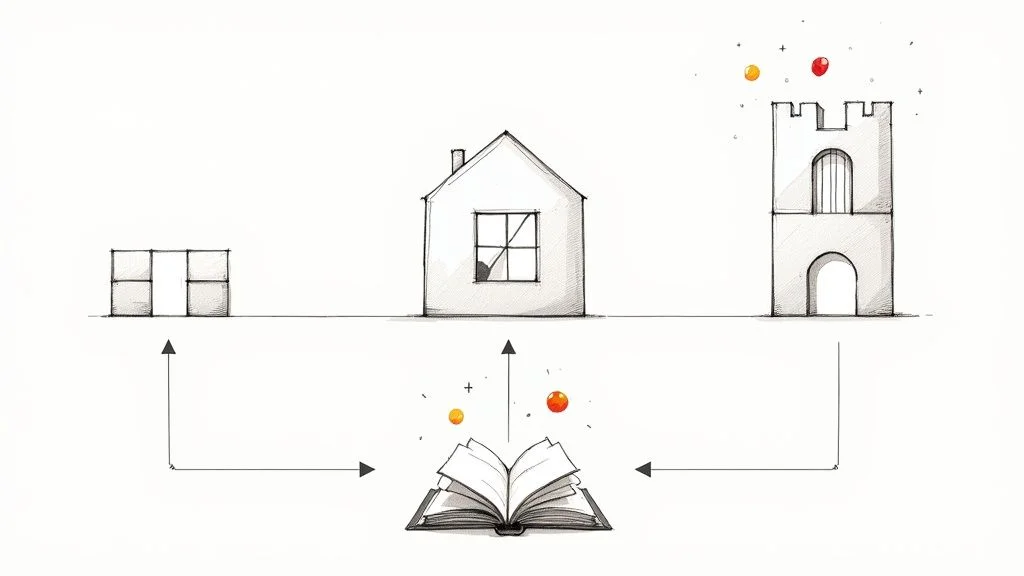
To illustrate, envision building a resilient and functional structure. The CompTIA A+ certification provides the essential concrete foundation, ensuring stability and fundamental operational understanding. CompTIA Network+ then erects the structural framework, complete with the intricate plumbing and electrical systems, allowing different components to communicate effectively. Finally, CompTIA Security+ integrates the critical security measures—the locks, surveillance systems, and alarm protocols—to safeguard the entire edifice. Each certification systematically builds upon the last, culminating in a well-rounded skillset that is invaluable in today's demanding IT environments.
Deciphering the Core Domains of CompTIA
To successfully conquer these exams, IT professionals must develop a deep understanding of several fundamental IT domains. While each certification delves into specialized areas, they are all underpinned by common conceptual threads. The visual below offers a concise overview of the primary focus areas you will encounter across the major CompTIA certifications.
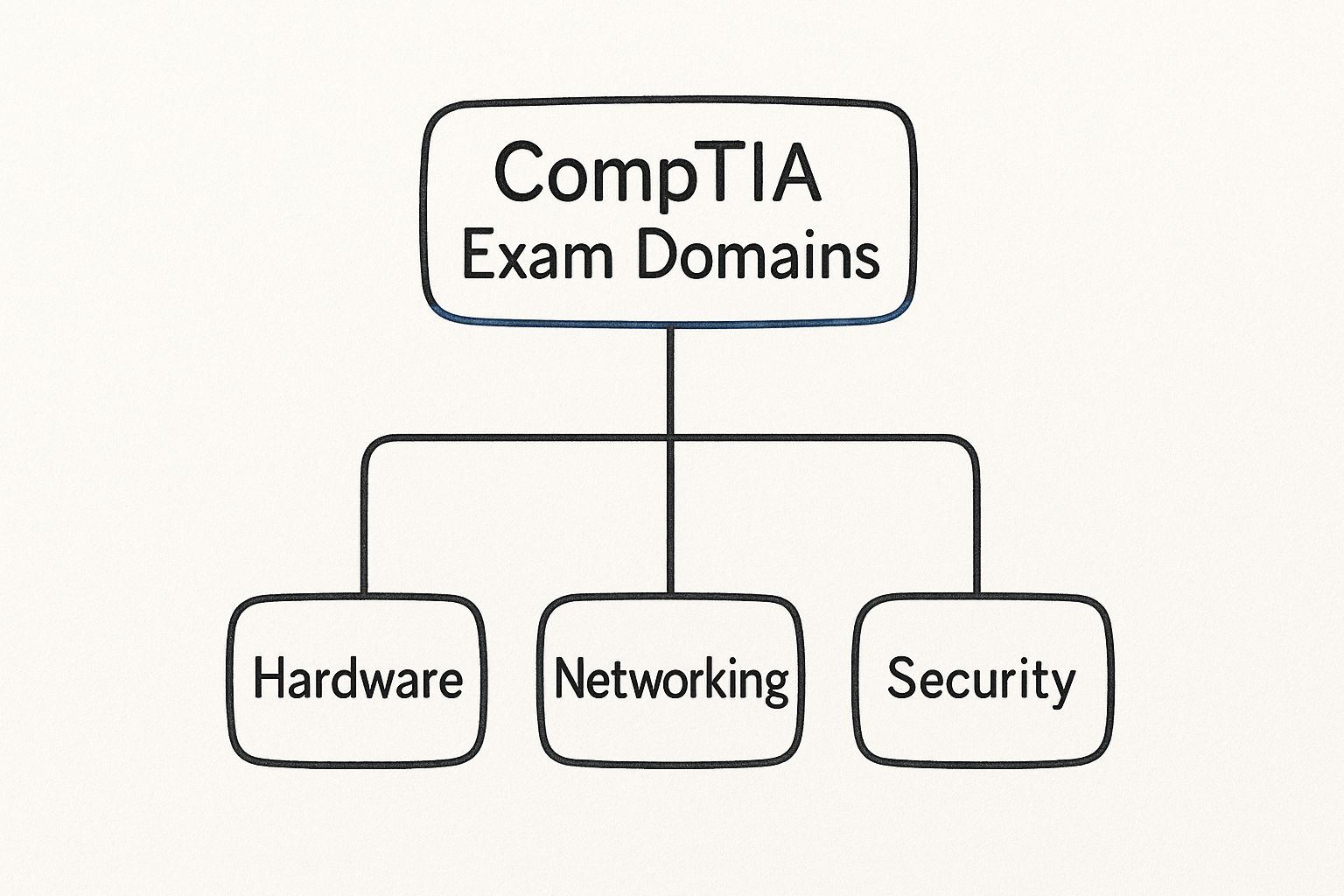
As this illustration from CompTIA suggests, every significant CompTIA certification is constructed from these core pillars. This interconnectedness underscores the importance of a strong, layered understanding—the knowledge you gain from A+ will directly enhance your grasp of concepts in Network+ and Security+. It's a progressive learning journey where each step reinforces the next.
Why Prioritize the CompTIA A+ Certification?
For IT professionals either entering the field or seeking to validate fundamental skills, the CompTIA A+ certification stands as the quintessential starting point. It's the industry-recognized credential that confirms proficiency in the hands-on, practical knowledge indispensable for virtually every technical support and endpoint management role.
Even as of 2025, A+ remains one of the most highly demanded certifications globally. This is particularly evident in regions like North America, where a significant 59% of IT professionals holding at least one CompTIA certification possess an A+. Why such widespread adoption? Employers recognize that A+ certified candidates possess validated troubleshooting and support skills, which translates into reduced training overhead and enhanced operational reliability from day one. For those interested in deeper insights, CompTIA provides a comprehensive breakdown of the top CompTIA certifications for career advancement on their official website.
The A+ certification transcends mere resume enhancement; it serves as a tangible validation of your ability to diagnose, repair, and maintain the essential hardware and software infrastructure that underpins modern businesses.
Achieving A+ certification provides a robust knowledge base, preparing you to confidently engage with the more complex topics covered in Network+ and Security+. It truly is the foundational, most critical step in establishing a professional IT career. To kickstart your preparation, we've compiled a quick-reference table featuring some of the most effective free resources currently available.
Essential Free Study Resources for the CompTIA Trifecta
Here’s an expertly curated guide to some of the finest free study materials for CompTIA's foundational certifications. These resources are widely lauded and have successfully guided thousands of professionals toward exam success.
| Certification | Highly Recommended Free Video Series | Top Free Practice Questions Source | Key Topics Covered |
|---|---|---|---|
| A+ | Professor Messer's A+ Series | ExamCompass A+ Practice Tests | Hardware, Mobile Devices, Networking, Troubleshooting, Operating Systems |
| Network+ | Professor Messer's Network+ Series | Crucial Exams Network+ Questions | Networking Concepts, Infrastructure, Network Operations, Security, Troubleshooting |
| Security+ | Professor Messer's Security+ Series | GetCertified4Less Practice Questions | Threats & Vulnerabilities, Architecture & Design, Implementation, Operations |
Integrate these resources as your primary study tools. Combining a thorough video course with extensive practice questions is consistently one of the most effective preparation strategies for passing CompTIA exams.
Navigating the CompTIA A+ Core 1 and Core 2 Exams
The CompTIA A+ certification acts as your entry visa into the dynamic IT world, but it's crucial to understand it's not a single monolithic assessment. Instead, it's segmented into two distinct examinations: Core 1 (220-1101) and Core 2 (220-1102).
Consider them as two essential facets of comprehensive IT support. Core 1 focuses on the tangible infrastructure—the hardware components you can physically interact with and maintain. Core 2, conversely, delves into the logical layer—the software, operating systems, security protocols, and operational procedures that enable that hardware to function effectively.
Successful certification requires passing both exams, though the order of completion is flexible. Most candidates find it advantageous to begin with Core 1, establishing a robust hardware foundation before progressing to the software and systems that operate upon it.
Mastering Core 1: The Hardware Core
The Core 1 exam is where you engage directly with the physical elements of IT. This domain encompasses mobile devices, fundamental networking components, virtualization concepts, and introductory cloud computing principles. It's about understanding the intricate interplay of computer hardware and, critically, how to troubleshoot and resolve issues when these components malfunction.
Let's use a common analogy to solidify these concepts: imagine a computer system as a high-performance vehicle.
- The CPU (Central Processing Unit) functions as the engine. It's the powerhouse, executing computations and driving all primary operations, much like an engine propels the car.
- RAM (Random Access Memory) can be likened to the immediately accessible space in the front passenger seat. This is where active data and programs are temporarily held for rapid access. It's lightning-fast but volatile—information is cleared once the system powers down, similar to tidying up the passenger seat after a journey.
- Storage (e.g., SSD or HDD) represents the trunk. This is for persistent, long-term data retention—your operating system, applications, and documents. It securely stores information until it's needed, at which point it's moved into RAM for active processing.
Understanding the synergistic operation of these components is paramount. A state-of-the-art engine (CPU) is hobbled if there's insufficient immediate workspace (RAM) for current tasks. For a more exhaustive exploration of these hardware topics, this comprehensive CompTIA A+ Core 1 study guide offers a detailed breakdown of every exam objective.
Key Takeaway for IT Professionals: Core 1 emphasizes more than just memorizing component names. It's about comprehending the functional role of each part and their interdependencies within a system. This holistic understanding is fundamental for accurately diagnosing and effectively resolving real-world hardware issues.
Conquering Core 2: The Operational Brain
Once you've mastered the hardware layer, Core 2 shifts focus to the software and operational intelligence that brings those physical components to life. This exam evaluates your knowledge of operating systems, best practices for security, software troubleshooting methodologies, and the routine procedural tasks expected of an IT professional.
Revisiting our car analogy:
- The Operating System (e.g., Windows, macOS, Linux) serves as the driver. It skillfully manages all the car's systems (the hardware), and provides the intuitive interface through which you (the user) control and interact with the vehicle.
- Software Applications are the specific activities or functions performed within the car. A GPS app handles navigation, while a media player app provides entertainment. These all operate through the car's systems, but it's the driver (the OS) that orchestrates their execution.
- Security Practices are analogous to adhering to traffic laws and utilizing the car's safety features. This includes activating antimalware solutions (locking your doors), configuring firewalls (wearing your seatbelt), and implementing robust user authentication (never handing your keys to a stranger).
Proficiency in both Core 1 and Core 2 makes you a truly well-rounded technician—one who understands both the physical machine and how to operate it securely and efficiently within an organizational context.

As depicted in CompTIA's own materials, A+ certified professionals are proven problem solvers. They are expected to support the core technologies prevalent today, encompassing security, cloud integration, data management, and beyond. This broad skillset makes them indispensable in diverse IT environments.
Preparing for Real-World Troubleshooting with PBQs
The A+ exams are particularly renowned for their Performance-Based Questions (PBQs). Unlike standard multiple-choice questions, PBQs immerse you in simulated IT environments, requiring you to actively solve a problem or configure a system.
For example, you won't merely be asked to define the "Blue Screen of Death" (BSOD). You might be presented with a virtual machine experiencing a BSOD and tasked with identifying the root cause and proposing a solution within the simulated interface.
Consider yourself a digital forensic investigator arriving at a problematic system. What is your methodical approach?
- Gather Evidence: What specific error codes or messages are displayed? A quick and targeted search of these codes often yields critical leads.
- Interview Stakeholders: What actions did the user perform immediately prior to the incident? Did they install new software, connect a peripheral, or update a driver? User input can provide invaluable context.
- Examine the Scene: On a Windows system, you would consult the Event Viewer. This comprehensive log often contains critical error messages that directly pinpoint the source of the issue.
- Hypothesize and Test: Based on your collected evidence, you might formulate theories: a failing RAM module, a corrupted driver, or an overheating component. You then systematically test each hypothesis, one at a time, until the precise solution is identified and implemented.
This methodical, diagnostic approach is precisely what the A+ exams evaluate. It embodies the core competency of every exceptional IT technician—the ability to apply theoretical knowledge to practical troubleshooting scenarios.
Building Your Network+ N10-008 Expertise
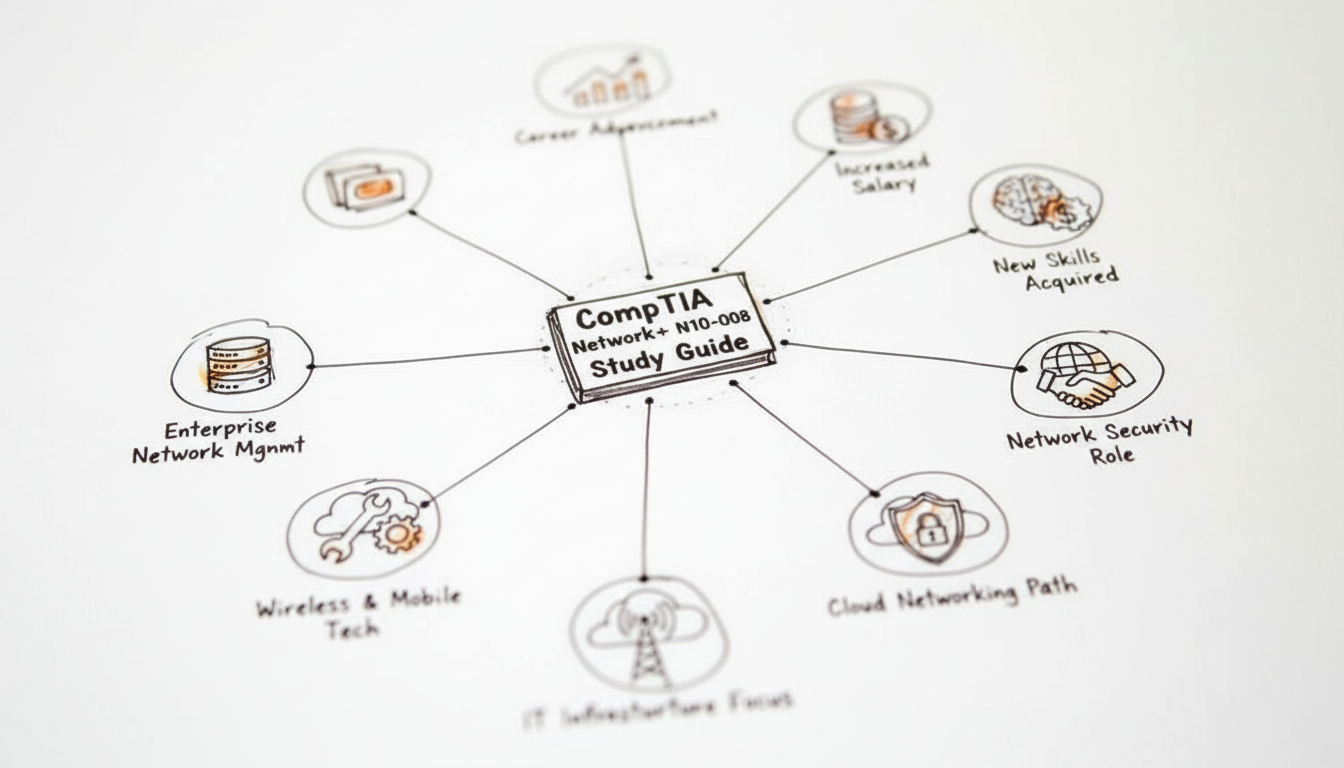
Transitioning from the device-centric world of A+ to Network+ can feel like learning a new language. While A+ focuses on individual systems, Network+ elevates your perspective to how all these systems interconnect and communicate. It's about the intricate dance of data across networks.
To simplify, imagine the internet as a vast, global logistics and delivery service. Every computer, smartphone, server, or IoT device possesses a unique address, much like a physical street address. When you transmit an email or access a webpage, your device is essentially packaging small parcels of data and dispatching them to another specific address somewhere across this global network.
The Network+ exam is designed to assess your comprehension of this entire delivery infrastructure—from the virtual pathways and high-speed data highways to the sophisticated routing centers that ensure data reaches its correct destination. We will demystify these core concepts, anchoring them in practical, real-world networking examples.
Demystifying the OSI and TCP/IP Models
To prevent this global data delivery service from devolving into chaos, stringent rules and protocols are essential. In networking, these foundational rules are encapsulated within frameworks known as the OSI (Open Systems Interconnection) model and the TCP/IP model. These models are elegantly designed to decompose the incredibly complex process of digital communication into a series of smaller, more manageable, and distinct layers.
Consider the OSI model as a seven-stage assembly line for preparing a package for international shipment:
- Layer 7 (Application): This is where you compose your message (your data), using an application like a web browser or email client.
- Layer 6 (Presentation): Data is formatted and encrypted/decrypted to ensure the recipient's application can correctly interpret it.
- Layer 5 (Session): A communication session is established, managed, and terminated between applications, much like a formal greeting before a conversation.
- Layer 4 (Transport): Data is segmented into smaller units, given sequence numbers, and reliability protocols (like TCP for guaranteed delivery or UDP for speed) are applied. This is choosing your shipping method.
- Layer 3 (Network): Logical addresses (IP addresses) are added, and the optimal path for data packets across the network is determined. This is writing the full destination address.
- Layer 2 (Data Link): Physical addresses (MAC addresses) are added, and data is prepared for transmission over specific network media (Ethernet, Wi-Fi). This is handing the package to the local courier.
- Layer 1 (Physical): The raw bits of data are converted into signals (electrical, optical, radio) and transmitted across the physical cable or airwaves. This is the truck physically moving the package.
The TCP/IP model offers a more consolidated, four-layer representation of this process, aligning more closely with practical internet protocols. For the Network+ exam, a thorough understanding of each layer's function in both models is absolutely critical. This isn't just theoretical knowledge; it's the fundamental framework for diagnosing connectivity issues, such as why a web application is unresponsive or a network printer is offline.
Essential Networking Tools and Topologies
Every proficient network technician requires a robust toolkit, both physical and conceptual. The Network+ exam covers the essential hardware components and the logical layouts that constitute a network's foundational structure. You will need to differentiate between devices like hubs, switches, and routers—the traffic controllers and data sorting facilities in our postal service analogy.
Beyond hardware, a strong grasp of network topologies, which are essentially the architectural blueprints for data flow, is crucial.
- Bus Topology: Imagine a single, shared trunk line to which all devices connect, like houses on a main road sharing a single power line. Simple to implement, but a single break can bring down the entire segment.
- Star Topology: The most prevalent modern configuration, where all devices connect to a central device (typically a switch). This is akin to houses in a cul-de-sac, all connected to a central junction. A failure at one device doesn't affect others, offering greater resilience.
- Ring Topology: Data travels sequentially from one device to the next in a circular fashion. Often found in older fiber optic networks or specific industrial control systems.
- Mesh Topology: Characterized by every device having a direct connection to every other device. While incredibly robust and fault-tolerant, it's also resource-intensive and complex to manage, resembling a dedicated private road connecting your home to every other building in a city.
Understanding these fundamental network layouts is paramount because they directly influence a network's performance, scalability, cost-effectiveness, and resilience. The strategic choice of topology is one of the initial and most impactful decisions in network design and implementation.
Mastering Subnetting and IP Addressing
Now we arrive at the digital addresses themselves. IP addressing is the standardized system by which devices locate and communicate with one another on a network. An IPv4 address, for instance, is a sequence of four octets, where portions of the address designate the "network" (like a street name) and the "host" (like a house number).
Subnetting is the sophisticated technique of dividing a single large network into smaller, more efficient, and logically segmented subnetworks. Why is this necessary? Consider a sprawling city with millions of residents but only one colossal street name—locating anyone would be an impossible task. Subnetting creates discrete "neighborhoods" (subnets), each with its own manageable block of addresses. This dramatically improves data traffic flow, enhances security by isolating traffic, and optimizes IP address utilization. For many IT professionals studying with any CompTIA study guide free of charge, subnetting is frequently identified as the single most challenging topic to fully master.
Here’s a practical cheat sheet to aid your initial practice with common subnet masks:
| CIDR Notation | Subnet Mask | Number of Usable Hosts |
|---|---|---|
| /24 | 255.255.255.0 | 254 |
| /25 | 255.255.255.128 | 126 |
| /26 | 255.255.255.192 | 62 |
| /27 | 255.255.255.224 | 30 |
Proficiency in subnetting is cultivated through consistent practice. We strongly recommend leveraging free online subnetting calculators and diligently working through practice questions until the concepts become intuitive. This topic is pervasive throughout the N10-008 exam, appearing in both traditional multiple-choice questions and hands-on simulation-based scenarios, making practical application indispensable.
Reflection Prompt: How might efficient subnetting benefit a large organization, like a university or a hospital, in terms of network performance and security?
Mastering the Security+ SY0-701 Exam
Embarking on the Security+ SY0-701 exam signifies a critical advancement in your IT career. If A+ established your understanding of individual computing components and Network+ connected them, Security+ tasks you with the formidable responsibility of defending the entire digital ecosystem you've constructed. You transition from a technician to a guardian of information assets.
To truly internalize these complex security concepts, it's beneficial to adopt an analogy of defending a robust fortress. Your firewall represents the deep moat and formidable stone walls, serving as the primary perimeter defense. Encryption acts as the unbreakable secret code used by your trusted messengers to ensure confidential communications. And access control policies? These are the vigilant guards positioned at every gate, meticulously verifying credentials before granting entry to any individual.
This conceptual framework transforms abstract security jargon into tangible, actionable knowledge. The goal isn't mere rote memorization of acronyms; it's about developing a profound understanding of the strategic principles underlying robust information protection. Let's delve into the key domains you must master, beginning with an exploration of potential adversaries.
Identifying Threats and Vulnerabilities
The foundational principle of any effective defense strategy is a comprehensive understanding of your adversaries. The Security+ exam rigorously tests your knowledge across the expansive landscape of digital threats and system weaknesses. A crucial distinction to internalize is the difference between a threat (e.g., a sophisticated cybercriminal organization targeting your data) and a vulnerability (e.g., unpatched software or a misconfigured server that the threat might exploit).
You must become proficient in recognizing various attack vectors and understanding the motivations of threat actors:
- Malware: Envision malware as a diverse array of digital saboteurs already infiltrating your systems. A virus might corrupt data files, much like contaminating a food supply, while ransomware could encrypt critical business data and demand a ransom, effectively locking down your digital treasury.
- Phishing: This is analogous to a cunning spy masquerading as a trusted ally, employing social engineering tactics to trick unsuspecting personnel into divulging sensitive information like login credentials to the main gateway.
- Denial-of-Service (DoS) Attacks: Picture a massive, orchestrated digital protest that overwhelms all access points to your digital infrastructure. Legitimate users are prevented from accessing services, and critical business operations are brought to a grinding halt due impacting availability.
A profound understanding of these tactics is your initial and most crucial step. Any credible CompTIA study guide free resource will be replete with real-world examples demonstrating how these attacks are executed and their potential impact.
A core tenet in modern cybersecurity is operating under the assumption that vulnerabilities always exist. The objective is not to engineer an infallible system—an impossible feat. Instead, it is to proactively identify these weaknesses, accurately assess the potential risk they pose, and judiciously implement intelligent controls to mitigate that risk to an acceptable level.
Cultivating this proactive and risk-aware mindset is not only essential for passing the SY0-701 exam but will be a cornerstone of your entire career in cybersecurity.
Implementing Secure Architectures and Designs
Knowing your enemy is critical, but you must also design and build a fortress capable of withstanding those attacks. This segment of the Security+ exam centers on secure architecture—you are the master builder, integrating defense mechanisms into the very fabric of your systems from the outset.
A fundamental concept here is layering your defenses, known as defense-in-depth. You never rely solely on a single protective barrier. Instead, you deploy multiple, overlapping security controls—firewalls, intrusion detection systems, strong authentication, data encryption, security awareness training—so that if one layer is breached, others are ready to contain the threat.
Key architectural concepts to master include:
- Secure Network Design: This involves segmenting networks into distinct zones (e.g., DMZ, internal networks) using VLANs and firewalls, much like creating separate, walled-off wards within your castle. If one section is compromised, the breach is contained and cannot propagate freely.
- Cloud Security: As organizations increasingly migrate assets to cloud environments (AWS, Azure, Google Cloud), understanding how to protect data and applications not physically housed within your on-premise infrastructure is vital. This includes grasping the shared responsibility model, which defines who is responsible for what in a cloud deployment.
- Cryptography: This is the sophisticated science of secure communication. You will explore various encryption types (e.g., symmetric like AES, asymmetric like RSA) and their application in protecting data both at rest (stored on disks) and in transit (sent across networks).
These are not merely academic skills. CompTIA certifications are integral to the global IT workforce, with credentials like Security+, Network+, and CySA+ directly correlating to high-growth job roles. Notably, Security+ is held by 62% of IT professionals with at least one CompTIA certification, underscoring its relevance in addressing contemporary threats. Further data on the impact of CompTIA certifications on the tech workforce is available on CompTIA's official website.
Managing Risk and Ensuring Compliance
Finally, being a security professional extends beyond actively fending off cyberattacks. A substantial portion of the role involves systematic risk management and ensuring your organization adheres to regulatory mandates—a domain broadly known as Governance, Risk, and Compliance (GRC).
The risk management process is a powerful, iterative framework:
- Identify Assets: What are your organization's most valuable information assets? This could be customer Personally Identifiable Information (PII), proprietary intellectual property, critical operational systems, or financial data.
- Identify Vulnerabilities: Where are the identifiable weaknesses in your systems, processes, and people that could be exploited? (e.g., unpatched servers, weak passwords, lack of employee training).
- Assess Risks: Determine the likelihood that a specific threat will exploit a identified vulnerability, and quantify the potential business impact if such an event occurs. A highly probable, high-impact risk demands immediate attention.
- Implement Controls: Deploy appropriate security measures and countermeasures (administrative, technical, physical) to reduce the identified risks to an acceptable level, balancing cost and effectiveness.
This domain also critically addresses compliance with various industry-specific and governmental regulations, such as GDPR (General Data Protection Regulation), HIPAA (Health Insurance Portability and Accountability Act), and PCI DSS (Payment Card Industry Data Security Standard). These act as external treaties or legal mandates requiring your organization to meet specific security standards. Non-compliance can lead to severe penalties, including substantial fines and significant reputational damage. Your role is to ensure that internal security practices are aligned with these external regulatory requirements, thereby fortifying both the organization's defenses and its trustworthiness.
Proven Study Methods for CompTIA Success
 Understanding the exam objectives is merely the initial stride. The true key to passing CompTIA certifications—and more importantly, retaining the knowledge for practical application—lies in employing effective study methodologies. Simply passively reading through a study guide or watching videos will not suffice for the depth of understanding required for these professional exams. To genuinely embed CompTIA concepts, you must actively engage your cognitive processes with proven learning techniques.
These active methods compel you to transcend mere recognition of terms, pushing you toward a profound comprehension of the material. This is precisely the level of mastery needed to excel on the performance-based questions (PBQs) that often challenge unprepared candidates. Let's explore two of the most potent techniques consistently yielding success for technical certifications.
Accelerate Learning with Active Recall
Have you ever diligently memorized a long list of networking ports and protocols, only for them to evaporate from your memory shortly thereafter? This common experience highlights the limitations of passive learning. This is precisely where Active Recall becomes an indispensable ally. Instead of merely re-reading your notes, this technique compels your brain to actively retrieve information from memory storage.
Think of it as building a mental muscle. Each instance you exert effort to recall information, you are strengthening the neural pathways associated with that knowledge. This method is straightforward to integrate into your study routine:
- Flashcards: Whether physical or digital (e.g., Anki, Quizlet), flashcards are ideal for drilling ports, protocols, acronyms, and command syntax.
- The Blank Page Method: After completing a study session on a topic, take a blank sheet of paper or open a new document and write down everything you can recall without consulting your notes. This immediately exposes gaps in your understanding.
- Self-Quizzing: As you progress through your study materials, pause frequently and formulate questions for yourself about the content you've just covered. Try to answer them aloud or in writing.
This active approach is a cornerstone of efficient learning, especially given the sheer volume of detailed information assessed in CompTIA exams. For guidance on structuring your notes to facilitate active recall, explore our guide on effective note-taking methods for tech certifications.
Reflection Prompt: How can you integrate active recall into your daily routine, even for brief periods, to maximize retention of complex technical details?
Master Concepts with the Feynman Technique
The Feynman Technique is less a study hack and more a powerful mental framework for achieving deep understanding in any subject. Named after the brilliant physicist Richard Feynman, its core premise is elegantly simple: if you cannot explain a concept clearly to someone with no prior knowledge (e.g., a child), you haven't truly grasped it yourself.
Here's how to apply it in four systematic steps for CompTIA preparation:
- Select a Concept: Choose a challenging topic from your study material, such as IPv6 addressing, RAID levels, or the principles of public key infrastructure.
- Teach It: Explain the concept aloud, as if you are teaching a complete beginner. Use simple, direct language, avoiding jargon where possible or immediately defining it.
- Identify Knowledge Gaps: During your explanation, notice where you hesitate, struggle for words, or resort to complex terminology. These points highlight areas where your understanding is weak. Revisit your study materials to reinforce these specific gaps.
- Simplify and Refine: Once you've shored up your understanding, attempt to explain the concept again, striving for even greater clarity and conciseness. Use analogies and metaphors to make it more accessible.
This method is invaluable for CompTIA preparation because it compels you to comprehend the "why" behind the "what." It transforms theoretical knowledge from a textbook into a practical, articulate skill—precisely what employers value in certified IT professionals.
The tangible benefits of CompTIA certifications are well-documented. Research consistently indicates that IT professionals holding CompTIA credentials experience enhanced job satisfaction and command higher salaries. For instance, the Global Knowledge IT Skills and Salary Report often highlights impressive average salaries for professionals with certifications like Linux+ (averaging around $103,198) and Security+ (approximately $99,609 in North America). These figures are not mere statistics; they powerfully reflect the significant value organizations place on these validated, certified skills. You can delve deeper into how CompTIA certifications elevate IT careers for comprehensive career insights.
Your CompTIA Prep Questions, Answered
As you immerse yourself in your CompTIA studies, it's natural for questions and uncertainties to arise. Consider this section a direct consultation with an expert, designed to clarify those common doubts and ensure you remain focused on your primary objective: excelling on your certification exams.
Let's address these frequently asked questions to empower your study journey.
Is It Feasible to Pass CompTIA Exams Exclusively with Free Resources?
Absolutely. For a disciplined and motivated IT professional, achieving CompTIA certification using only high-quality free materials is entirely achievable. The core strategy lies in intelligently combining and maximizing the utility of these diverse resources.
The key is to construct a comprehensive, multi-faceted study system. For example, you could diligently follow a full video course series from a respected educator like Professor Messer, then solidify your conceptual understanding and test your retention with practice questions from a reliable platform such as ExamCompass. This combination effectively covers both learning and assessment. Integrating the vibrant support and shared insights from online communities, like the r/CompTIA subreddit, further strengthens your study plan. While paid resources often offer convenience and structured content, they are not a prerequisite for success if you are resourceful and committed.
Which CompTIA Certification Should an IT Professional Pursue First?
For the vast majority of IT professionals, particularly those early in their careers or seeking to build a broad technical foundation, the CompTIA A+ is the unequivocal recommendation. It provides the essential, foundational knowledge spanning hardware, software, networking basics, and introductory security concepts—the universal language spoken by every IT professional.
Obtaining your A+ credential optimally positions you for critical entry-level and support roles, such as help desk technician or IT support specialist. Even if your long-term aspirations lean towards specialized domains like cloud architecture or advanced cybersecurity, beginning with A+ and then progressing to Network+ establishes an incredibly solid base. When you eventually tackle Security+, the more sophisticated concepts will integrate much more seamlessly because you will have a firm grasp of the underlying fundamentals.
The A+ certification is far more than an initial stepping stone; it is the fundamental bedrock upon which a stable, adaptable, and ultimately successful IT career is constructed. Master these core principles, and you will be exceptionally well-prepared for any subsequent challenges in the technology landscape.
Of course, mastering the technical material is only one part of the equation. If you find yourself grappling with exam-day pressure, remember that developing strategies to manage test anxiety is a skill that can be cultivated. For highly practical techniques and insights, refer to our guide on how to overcome exam anxiety and boost your confidence. These mental preparation tools can significantly impact your performance.
How Much Time Should I Allocate for CompTIA Exam Preparation?
This is a classic "it depends" question, and for valid reasons. The duration of study required is highly dependent on your existing technical knowledge, prior experience, and the amount of dedicated study time you can realistically commit each week.
Here’s a general framework for planning your study timeline:
- For IT newcomers or those with limited experience: Budget approximately 1 to 3 months of consistent, focused study for each of the core certifications (A+, Network+, Security+). This typically translates to a commitment of about 10-15 hours per week.
- For IT professionals with some existing experience: You can likely compress your study timeline. You might achieve readiness in as little as 3 to 4 weeks per exam, as your focus will primarily be on filling knowledge gaps and reinforcing existing understanding rather than learning everything from scratch.
Be realistic about your schedule and current proficiency. Utilize structured study plan templates, perhaps drawing inspiration from the methods discussed earlier in this guide, to create a personalized schedule that is both challenging and sustainable.
What Are the Best Sources for Free CompTIA Practice Exams?
Sourcing high-quality practice exams is absolutely non-negotiable for effective preparation. They are the essential benchmark for gauging your readiness and identifying areas requiring further attention. While a robust CompTIA study guide free of charge is an excellent foundation, you must test that acquired knowledge under simulated exam conditions.
Prioritize reputable and community-vetted sources. Websites such as ExamCompass are highly regarded for their extensive question banks, often allowing you to filter practice questions by specific exam objectives—an excellent feature for targeted remediation of weak areas. Many established training providers also offer free sample tests, which provide valuable exposure to the format and style of the actual examination. Furthermore, do not overlook the collective wisdom of online communities like the r/CompTIA subreddit, where users frequently share links to excellent, community-curated practice question databases and mock exams.
At MindMesh Academy, we are dedicated to the principle that effective study methods and expertly curated materials are pivotal to IT career advancement. We specialize in providing comprehensive, educational prep courses designed not merely to help you pass, but to empower you with the mastery and practical skills essential for a thriving IT career. Explore our certification programs and resources here. You can also find our learning journeys that guide you through the content you need to understand for the Core 1 Exam and Core 2 Exam on your way to achieving the CompTIA A+ certification.
Ready to Get Certified?
Prepare with expert-curated study guides, practice exams, and spaced repetition flashcards at MindMesh Academy:

Written by
Alvin Varughese
Founder, MindMesh Academy
Alvin Varughese is the founder of MindMesh Academy and holds 15 professional certifications including AWS Solutions Architect Professional, Azure DevOps Engineer Expert, and ITIL 4. He's held senior engineering and architecture roles at Humana (Fortune 50) and GE Appliances. He built MindMesh Academy to share the study methods and first-principles approach that helped him pass each exam.