8 Essential Examples of Project Charter Document for 2026
8 Essential Examples of Project Charter Documents for IT Professionals in 2026
Launching a critical IT project without a meticulously crafted project charter is akin to navigating a complex enterprise cloud migration without a clear architecture, budget, or stakeholder alignment. It’s the foundational document that formally authorizes a project, empowers the project manager, and aligns all key stakeholders on a singular, unified vision. While understanding its necessity is straightforward, developing an effective charter that truly drives success is often the real challenge for IT leaders and project managers. A poorly defined charter invariably leads to costly scope creep, budget overruns, and persistent stakeholder conflicts. Conversely, a well-structured charter serves as your project's North Star, guiding every decision from inception through to successful delivery.
This guide transcends theoretical discussions. We will meticulously deconstruct eight distinct examples of project charter document templates, each specifically designed for the common and complex scenarios IT professionals encounter. We'll explore everything from the universally recognized PMI-aligned frameworks to specialized charters for intricate hybrid cloud migrations and strategic ServiceNow implementations.
For each example, we'll provide:
- Strategic Analysis: A deep dive into what makes each section effective and why it matters for IT projects.
- Actionable Takeaways: Concrete strategies and tactics you can apply immediately to your own projects.
- Certification Relevance: How mastering these charters prepares you for key industry certifications (e.g., PMP, AWS, ITIL, Azure).
Whether you're rigorously studying for your PMP certification, preparing for an AWS Solutions Architect exam, or leading a major corporate IT initiative, these detailed examples will equip you to build charters that secure genuine buy-in, minimize risk, and ensure project clarity from day one. You'll learn to initiate your projects on the strongest possible footing, establishing a clear and predictable path to success.
1. PMI Standard Project Charter Template
Recognized as the gold standard in project management, the Project Management Institute (PMI) offers a project charter template that directly aligns with the rigorous principles outlined in the PMBOK® Guide. This is arguably the most fundamental among all examples of project charter document templates, serving as the official, foundational framework for initiating projects in a structured, repeatable, and globally accepted manner. It formally authorizes the project's existence and, critically, grants the project manager the authority to apply organizational resources to project activities.

Strategic Analysis for IT Professionals
The enduring strength of the PMI template lies in its comprehensiveness and universal acceptance, especially within established IT organizations and Project Management Offices (PMOs). It compels teams to thoroughly consider all critical project elements before any significant work begins, covering everything from the project's clear purpose and measurable objectives to high-level requirements, identified risks, and a detailed stakeholder list. For IT departments operating within a structured PMO, this template ensures a consistent starting point for all initiatives, significantly simplifying portfolio management, resource allocation, and overall governance.
Its structured nature is a powerful preventative measure against scope creep, establishing clear boundaries and defining success criteria from the outset. For IT professionals pursuing their PMP certification, mastering this document is not just theoretical knowledge; it's a core competency directly tested and crucial for real-world application. Comprehensive guidance on this can be found in resources like the Project Management Professional Study Guide.
Reflection Prompt: How might a well-defined project purpose in a PMI charter help mitigate common challenges in a multi-vendor IT integration project?
When to Use This Template
- Large-Scale Enterprise IT Projects: Ideal for significant undertakings like data center consolidations, major ERP system upgrades (e.g., SAP, Oracle), or multi-phase software rollouts where formal authorization and clear boundaries are critical.
- Government & Highly Regulated Initiatives: Its structured and formal nature perfectly meets the rigorous documentation, compliance, and approval requirements common in public sector projects or industries with strict regulatory oversight (e.g., finance, healthcare).
- PMP Certification Preparation: Actively using this template on real-world IT projects is invaluable practice for aspiring PMPs, as it directly reflects and reinforces PMBOK principles.
Actionable Takeaways
To effectively leverage the PMI template in an IT context, always connect project objectives directly to the organization's strategic IT goals and business value. This ensures executive buy-in and clearly articulates the project's worth. Schedule a formal charter approval meeting involving all key stakeholders, especially the sponsor, to foster a shared understanding and secure official sign-off. While the template is detailed, keep the content high-level and concise, typically between 2-5 pages. Remember, the charter isn't a detailed project plan; it's the authoritative document that sanctions the creation of that plan.
2. Agile Project Charter Template
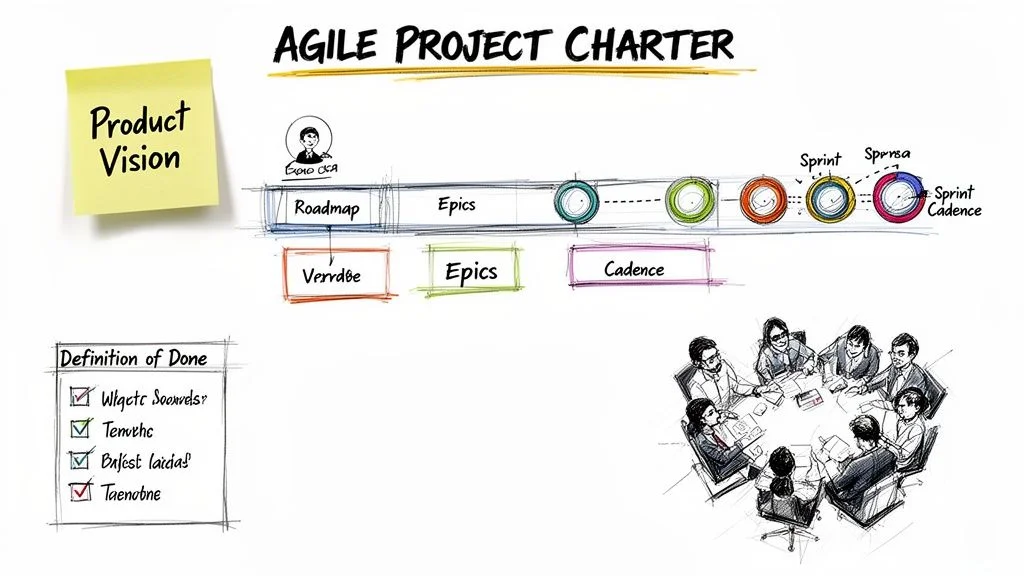
An agile project charter is a streamlined, flexible document specifically designed for iterative development methodologies prevalent in modern IT. Unlike traditional charters that may lock in a fixed scope, this version emphasizes a shared product vision, a high-level roadmap, and collaborative team goals. This is a crucial one among examples of project charter document for contemporary tech environments because it provides essential direction without stifling the adaptability that is core to agile principles. It sets the stage for empowered teams and continuous feedback, formally authorizing the team to begin work within a flexible, evolving framework.
Strategic Analysis for IT Professionals
The power of the agile charter stems from its focus on the "what" and "why" – the desired business outcomes and overarching product vision – rather than prescribing a rigid "how." It establishes project boundaries and success metrics at a high level, enabling the Scrum team or other agile teams to discover the best technical solutions through iterative sprints and continuous feedback cycles. This approach is fundamental for IT projects where requirements are expected to evolve, such as developing a new mobile application, refining a SaaS product, or initiating a cloud-native application development. Popularized by agile frameworks like Scrum and SAFe, this template prioritizes a clear product vision and explicitly identifies the Product Owner, granting them the authority to manage and prioritize the product backlog.
By keeping the document concise, often one to two pages, it becomes a living reference point for the team, fostering collaboration rather than serving as a bureaucratic hurdle. This aligns perfectly with the principles of the Agile Manifesto, which values working software and customer collaboration over extensive documentation. It's a foundational skill for IT professionals pursuing credentials like the Certified Scrum Product Owner (CSPO) or other agile certifications.
Reflection Prompt: How does an agile charter's focus on "what" and "why" allow for better adaptation to unforeseen technical challenges during software development?
When to Use This Template
- Software and App Development: Perfect for projects where user feedback will directly shape the final product, such as developing a new mobile banking application or an internal developer portal.
- Cloud Migration Projects (Iterative): When moving applications to services like AWS or Azure, an agile approach allows teams to adapt to unforeseen technical challenges, optimize cloud resources iteratively, and respond to changing business needs.
- Digital Transformation Initiatives: Useful for large-scale IT changes where the exact path forward is not fully known and requires an exploratory, iterative process, enabling learning and adjustment.
Actionable Takeaways
To effectively create an agile charter, focus on defining the product vision and desired business outcomes, not a granular list of features. Establish the key agile roles from the start, especially the Product Owner, and clearly state their responsibilities and authority over the backlog. Instead of fixed requirements, capture high-level needs using epics or user stories to inform the initial product backlog. Finally, conduct a charter review with the entire Scrum team and key stakeholders to build a shared understanding and ensure everyone is aligned on the goals before the first sprint planning ceremony. The charter should be seen as a guiding artifact that can evolve as the product backlog matures and empirical learning occurs.
3. IT Infrastructure Project Charter Template
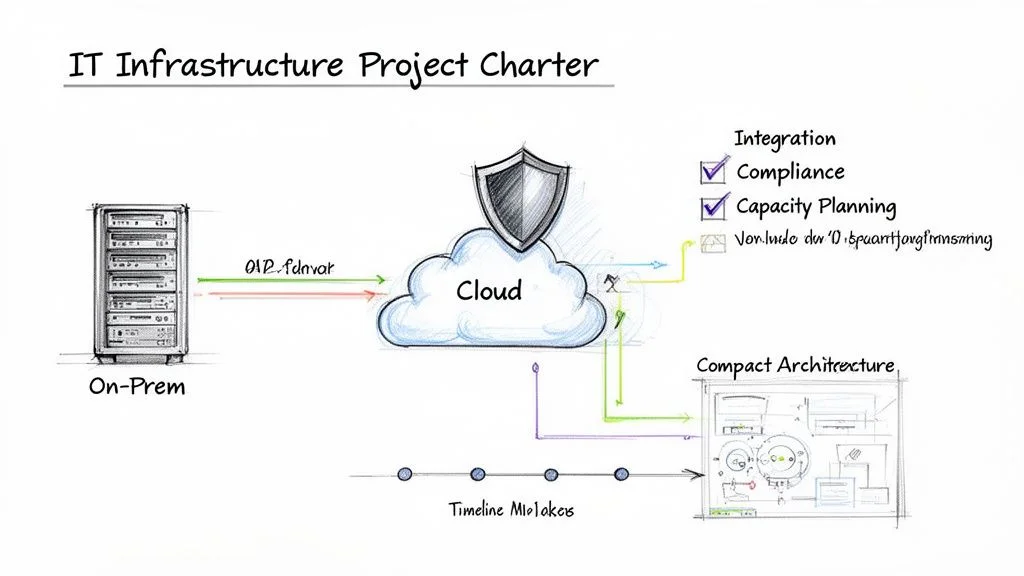
Technology projects involving cloud migrations, extensive network upgrades, or enterprise-wide systems implementations necessitate a specialized charter that addresses unique technical complexities from the outset. This type of charter is a vital one among examples of project charter document because it extends beyond standard project elements to include specifics like system integrations, stringent security compliance, disaster recovery planning, and critical infrastructure dependencies. It's a document built for and by technical teams, ensuring that architects, security analysts, and operations staff are fully aligned before a single server is provisioned or a configuration change is made.
Strategic Analysis for IT Professionals
The primary strength of an IT infrastructure charter is its proactive focus on risk mitigation within often high-stakes environments. A misconfigured firewall, a botched data center migration, or inadequate capacity planning can have immediate and catastrophic operational and financial consequences. This template, often informed by best practices from frameworks like ITIL, AWS Well-Architected Framework, and Microsoft Azure CAF (Cloud Adoption Framework), forces teams to document critical technical details early. This includes meticulously mapping all system interdependencies, defining explicit security and compliance requirements (e.g., GDPR, HIPAA, PCI DSS), and planning for non-functional requirements such as uptime, performance, scalability, and maintainability.
For IT professionals, particularly those working with cloud platforms or pursuing certifications like CompTIA Infrastructure+, AWS Certified Solutions Architect, or Azure Administrator, this document is a practical application of core concepts. It translates theoretical knowledge about architecture, security, and service transition into an actionable, approved plan. By addressing these critical technical factors comprehensively within the charter, organizations avoid costly rework, minimize operational disruptions, and ensure robust, secure IT environments.
Reflection Prompt: How can involving security teams from the initial drafting of an IT infrastructure charter significantly reduce compliance risks later in the project lifecycle?
When to Use This Template
- Cloud Migration Projects: Essential for initiatives like moving on-premise applications and data to AWS, Azure, or Google Cloud, where architecture, cost optimization, and robust security are paramount.
- Network & Security Upgrades: Perfect for enterprise firewall rollouts, implementing a Software-Defined Wide Area Network (SD-WAN), or establishing a Zero Trust architecture that has a wide-ranging organizational impact.
- Major System Implementations: Use for deploying new core platforms like a new ERP system, CRM (e.g., Salesforce), or a large-scale data warehousing solution, where complex integration points and data flows are critical.
Actionable Takeaways
To make this charter truly effective, involve infrastructure architects, network engineers, and security teams from the very first draft. Their specialized input is not optional; it's absolutely fundamental. Document all system dependencies and integration points visually with diagrams (e.g., architectural diagrams, network topology) to clarify complex relationships for both technical and non-technical stakeholders. Crucially, the charter must include specific sections for disaster recovery, data backup strategies, and environment planning (development, test, staging, production). This upfront planning prevents these critical elements from becoming an afterthought, ensuring operational resilience.
4. ServiceNow Implementation Project Charter Template
A ServiceNow implementation is often much more than a mere software deployment; it represents a strategic overhaul of IT service delivery and, often, broader enterprise workflows. This specialized charter is meticulously tailored for introducing the ServiceNow platform, covering specific modules such as ITSM, ITOM, CSM, or enterprise service management. As a critical one among examples of project charter document, it focuses intently on the unique challenges of platform migration, process re-engineering, and the extensive organizational change management inherent in such large-scale projects. It formally defines the goals of transitioning from legacy systems to a unified, modern service platform.
Strategic Analysis for IT Professionals
The strength of this template lies in its relentless focus on desired business outcomes rather than just technical features. A successful ServiceNow project is primarily measured by improved service levels, reduced resolution times, enhanced operational efficiency, and better user satisfaction – not merely by deploying modules. The charter forces a deep conversation around defining clear ITSM or enterprise process improvements as the primary objectives. It places heavy emphasis on planning extensive discovery workshops with IT stakeholders and business users to meticulously map current-state processes and design optimized future-state workflows, proactively preventing misalignment and rework later in the project.
Given that ServiceNow implementations frequently involve migrating data from multiple outdated systems, this charter prioritizes data integrity and quality. It includes explicit sections for identifying potential data quality issues, planning for data cleansing, and defining migration strategies before any data transfer begins. This preemptive approach significantly mitigates one of the most common failure points in enterprise platform rollouts. It also formalizes the need for strong executive sponsorship, which is paramount for driving the necessary adoption of new processes and cultural shifts across the organization.
Reflection Prompt: Why is defining clear ITSM process improvements as primary objectives in a ServiceNow charter more effective than simply listing the modules to be deployed?
When to Use This Template
- Enterprise ITSM Migrations: Perfect for organizations transitioning from a fragmented collection of legacy helpdesk tools to a single, unified ServiceNow ITSM platform for improved service delivery.
- ITOM and Cloud Management Deployments: Ideal for projects focused on deploying IT Operations Management (ITOM) for infrastructure monitoring, event management, or implementing cloud management services through the ServiceNow platform.
- Phased Module Rollouts: Well-suited for large-scale programs where different ServiceNow modules (e.g., ITSM first, then ITBM, then SecOps) are implemented in distinct phases over an extended timeline.
Actionable Takeaways
To make this charter profoundly effective, ensure that a detailed training curriculum is defined as a key deliverable, with separate plans tailored for different user roles like IT technicians, managers, end-users, and system administrators. Establish strong, visible executive sponsorship early to champion the necessary changes in workflow, process, and organizational culture. Finally, explicitly build post-implementation optimization and continuous improvement phases directly into the charter's high-level timeline and budget. Acknowledging that the platform will require refinement and enhancement 6-12 months after go-live sets realistic expectations and secures resources for long-term success.
5. Hybrid Cloud Migration Project Charter Template
A Hybrid Cloud Migration Project Charter is meticulously designed for the complex task of moving organizational workloads to a hybrid cloud environment, which typically involves a strategic mix of on-premises infrastructure and public cloud services like AWS or Azure. This is a critical example of a project charter document for modern IT, as it directly addresses unique challenges such as comprehensive cloud strategy, vigilant cost optimization (FinOps), robust security posture, and intelligent workload prioritization. It provides a formal, comprehensive framework to manage the inherent technical, financial, and operational risks of such a significant technological shift.
Strategic Analysis for IT Professionals
The power of this charter template stems from its intense focus on cloud-specific complexities. It moves beyond a generic project scope to include essential elements like detailed workload assessments, intricate network connectivity planning (e.g., VPN, AWS Direct Connect, Azure ExpressRoute), and a clear governance model tailored for a multi-cloud reality. Methodologies from established programs like the AWS Migration Acceleration Program (MAP) and the Azure Migration Program often inform this charter’s structure, ensuring it aligns with industry best practices and provides a robust roadmap.
For IT professionals studying for cloud certifications, actively engaging with and using this charter provides direct, practical experience. It compels a detailed consideration of topics extensively covered in AWS and Azure exams, such as establishing a Cloud Center of Excellence (CoE), implementing robust security and compliance controls in the cloud, and optimizing cloud spend. This charter acts as the strategic glue between an organization's overarching business goals and the intricate technical execution of its cloud strategy, proactively preventing costly missteps and ensuring the migration delivers on its promised value proposition.
Reflection Prompt: In a hybrid cloud migration, how does a charter help establish clear FinOps practices to prevent unforeseen budget overruns?
When to Use This Template
- Enterprise Data Center Consolidation: Perfect for projects aiming to significantly shrink or eliminate an on-premises data center footprint by strategically moving legacy applications and data to AWS, Azure, or other public clouds.
- Multi-Cloud Strategy Implementation: Essential when an organization decides to leverage services from multiple public cloud providers (e.g., AWS for compute, Azure for specific PaaS services) to avoid vendor lock-in or to access best-of-breed services.
- Projects with Strict Compliance Needs: Ideal for financial services, healthcare, or government migrations where regulations like PCI DSS, HIPAA, or FedRAMP demand rigorous documentation of security, data handling, and governance protocols from the very start.
Actionable Takeaways
To use this template effectively, begin with a comprehensive workload assessment using specialized tools like AWS Migration Evaluator or Azure Migrate. This data-driven approach removes guesswork and intelligently informs your migration priorities and strategy. Establish clear FinOps practices and assign explicit accountability for cloud spending before the migration begins. The charter should define specific roles and processes for continuous cost monitoring, reporting, and optimization to prevent unforeseen budget overruns. Finally, treat the charter as a living document in its initial stages; as detailed assessments reveal new risks, dependencies, or opportunities, update it and secure stakeholder re-approval to maintain continuous alignment.
6. Compliance and Security Implementation Project Charter Template
For projects predominantly centered on cybersecurity, regulatory compliance, and the overarching task of securing digital assets, a highly specialized charter is not just beneficial, but essential. A Compliance and Security Implementation Project Charter is a purpose-built document for initiatives like achieving ISO 27001 certification, implementing a robust Data Loss Prevention (DLP) solution, or deploying a Zero Trust architecture across the enterprise. This is a critical one among examples of project charter document because it places a necessary and non-negotiable emphasis on risk, controls, auditability, and legal obligations from the very beginning of the project lifecycle.
It formally initiates projects where the primary success criteria are not simply being on time and on budget, but fundamentally about meeting stringent security standards, passing critical audits, and demonstrating due diligence. This charter formally authorizes the project manager to coordinate with highly specialized teams across IT security, legal, risk management, and internal audit.
Strategic Analysis for IT Professionals
The inherent power of this template comes from its deep focus on proactive risk mitigation and strong governance. While standard charters might include "risks" as one section, here, a comprehensive risk assessment is the central driver of the entire project. It forces the organization to meticulously connect specific technical controls (ee.g., a firewall rule, multi-factor authentication) directly to mandated compliance requirements (e.g., mapping to a NIST CSF control, a GDPR principle). This creates an explicit and auditable trail that is invaluable during rigorous certification processes like SOC 2 Type II or ISO 27001 audits.
For IT and security teams managing complex and evolving compliance landscapes, this charter provides a single source of truth that meticulously aligns technical work with legal and regulatory obligations. When crafting a Compliance and Security Implementation Project Charter, understanding how to manage integrated risk through platforms like the ServiceNow IRM and GRC modules is invaluable for tracking controls, evidence, and audit readiness. Its structure ensures that security is not an afterthought or an add-on, but the foundational purpose and driver of the project.
Reflection Prompt: How can mapping specific technical controls to compliance requirements within a charter improve audit readiness for certifications like ISO 27001?
When to Use This Template
- Certification and Audit Projects: Essential for initiatives aimed at achieving or maintaining ISO 27001, SOC 2, HIPAA, GDPR, PCI DSS, or FedRAMP compliance, where demonstrating meticulous due diligence and control effectiveness is paramount.
- Security Framework Adoption: Ideal for implementing comprehensive frameworks like the NIST Cybersecurity Framework, establishing a Zero Trust security model, or deploying Security Information and Event Management (SIEM) systems across an enterprise.
- Critical Infrastructure Protection: Use when upgrading security for essential systems such as Industrial Control Systems (ICS), core financial platforms, or national critical infrastructure, where the impact of a breach is severe and far-reaching.
Actionable Takeaways
To effectively use this charter, begin with a thorough security risk assessment and a comprehensive gap analysis against the target compliance framework (e.g., NIST, ISO 27001). This assessment should directly inform and shape the project scope, objectives, and deliverables. Clearly define the roles and responsibilities of key stakeholders such as the Chief Information Security Officer (CISO), legal counsel, data privacy officers, and internal audit, as their oversight and input are crucial. Plan for continuous compliance from the start by building ongoing monitoring, reporting mechanisms, and mandatory security awareness training activities into the project's high-level milestones and budget.
7. Digital Transformation Capability Program Charter Template
Unlike a standard project charter focused on a single, distinct deliverable, a program charter for digital transformation orchestrates multiple, interconnected projects over a potentially multi-year horizon. This is one of the more strategic examples of project charter document because it governs an entire portfolio of initiatives aimed at fundamentally changing how a business operates leveraging technology. The foundation for this type of charter lies in a well-defined Digital Transformation Strategy, which outlines the high-level vision, overarching business goals, and desired future state.
The program charter then meticulously translates that strategic vision into an actionable framework. It establishes the robust governance structure, sustained funding, and executive authority needed to manage a complex web of technology upgrades, significant process re-engineering, and fundamental cultural change across the organization. Examples include a large bank’s shift to an API-first architecture, a manufacturing company implementing Industry 4.0 technologies, or a healthcare system’s comprehensive move to a cloud-based Electronic Health Record (EHR) system.
Strategic Analysis for IT Professionals
The power of a program charter is its unparalleled ability to maintain strategic alignment across numerous moving parts and diverse projects. While individual projects within the program might focus on deploying a new CRM, migrating to a public cloud platform, or automating specific business processes, the program charter ensures they all collectively contribute to a larger, overarching goal, such as creating a seamless omnichannel customer experience or achieving significant operational efficiencies. It actively prevents siloed efforts and ensures that critical resources are allocated to the most impactful initiatives that drive the broader transformation.
This document establishes a strong, executive-level governance structure, typically involving a steering committee comprised of senior leaders from across business units and IT. This committee provides crucial oversight, removes organizational roadblocks, and makes critical decisions about priorities, resource allocation, and strategic adjustments. For IT professionals aiming for senior leadership roles, such as CIO, CTO, or Head of Digital Transformation, mastering the creation and management of such a charter is a key differentiator, demonstrating the ability to think at a strategic, portfolio level.
Reflection Prompt: How does a digital transformation program charter prevent individual projects from becoming siloed efforts, disconnected from the overarching strategic vision?
When to Use This Template
- Enterprise-Wide Change Initiatives: Perfect for large-scale transformations like implementing Industry 4.0 across manufacturing operations, building a "smart city" platform, or moving to a fully digital government service delivery model.
- Multi-Year Strategic Programs: When the initiative spans several years and involves numerous, highly dependent project streams that collectively deliver a major business capability.
- High-Stakes Business Model Shifts: Essential for guiding programs that fundamentally alter how a company creates, delivers, and captures value, such as a traditional retailer moving to a primary omnichannel digital commerce model.
Actionable Takeaways
To make a program charter exceptionally effective, break the grand, long-term vision into smaller, logically sequenced phases or distinct projects, each with its own specific charter. This makes the overall program more manageable, allows for early wins to build momentum, and enables adaptive planning. Invest heavily in proactive change management and consistent, transparent communication to bring the entire organization along on the transformation journey. Finally, establish a regular cadence for strategic program reviews (e.g., quarterly) to assess progress against key performance indicators (KPIs), adapt the roadmap as business needs and technologies evolve, and ensure sustained executive commitment. The program charter is a living document that strategically guides, rather than rigidly dictates, the transformation.
8. ITIL Service Transition Project Charter Template
For projects specifically focused on introducing, modifying, or retiring an IT service, the ITIL Service Transition Project Charter Template provides a highly specialized and effective framework. This is a critical one among examples of project charter document because it meticulously aligns project goals with IT Service Management (ITSM) best practices, specifically the ITIL v4 framework. It formally authorizes projects that manage the transition of new or changed services into the live operational environment, ensuring they consistently meet user expectations and business objectives with minimal disruption.
This charter places a strong emphasis on elements like change enablement, release management, comprehensive knowledge transfer, and thorough service readiness validation. It fundamentally ensures that a project isn't considered "done" simply when the technology is built or deployed, but only when the service is fully operational, adequately supported, and demonstrably delivering value to the business.
Strategic Analysis for IT Professionals
The core power of this template comes from its service-centric viewpoint. Unlike a generic project charter that might focus only on delivering a technical product, the ITIL charter forces a holistic view of the entire service lifecycle. It ensures that operational readiness is a primary, explicit project objective, not an afterthought. This includes meticulous planning for support team training, documenting comprehensive knowledge base articles, establishing robust monitoring and alerting mechanisms, and clearly defining service level agreements (SLAs) and operational level agreements (OLAs).
This structured approach is essential for preventing common pitfalls like failed "go-lives" where a new system, though technically functional, causes widespread chaos due to poor user training, inadequate support, or unforeseen performance issues in a production environment. For IT professionals working in IT operations, service delivery, or pursuing ITIL certifications, understanding and applying this document is fundamental for ensuring seamless service introduction and continuous service improvement. More details on this can be found in resources like the ITIL 4 Foundation Study Guide.
Reflection Prompt: How does explicitly defining service readiness criteria in an ITIL charter help prevent "failed go-lives" where new systems technically work but cause operational chaos?
When to Use This Template
- Major Enterprise Software Upgrades: Perfect for large-scale transitions like moving to a new version of SAP, Oracle, Salesforce, or Microsoft Dynamics, where service continuity and minimal business disruption are paramount.
- Infrastructure Cutovers: Ideal for network upgrades, data center migrations, or cloud connectivity changes where the focus is on a seamless transition with zero unplanned downtime and robust fallback plans.
- New Service Implementations: Use for rolling out entirely new IT services, such as a new HR or payroll system, a new collaboration platform, or an internal developer tool, to ensure the support structure, processes, and documentation are ready from day one.
Actionable Takeaways
To use this template successfully, define clear, specific, and measurable service readiness criteria before the transition begins. Establish a robust Change Advisory Board (CAB) with the explicit authority to approve or deny the go-live based on these predefined criteria and a thorough risk assessment. Your project plan must include comprehensive testing at the system, integration, and user acceptance (UAT) levels to validate functionality and performance. Finally, schedule service desk and support team training well in advance, create comprehensive knowledge articles, and establish monitoring dashboards with clear alert thresholds before the new service is live in production. This proactive, service-centric approach ensures a smooth and successful transition from project completion to live operations.
Comparison of 8 Project Charter Templates
| Template | Implementation Complexity | Resource Requirements | Expected Outcomes | Ideal Use Cases | Key Advantages | Limitations |
|---|---|---|---|---|---|---|
| PMI Standard Project Charter Template | Medium–High — comprehensive, formal process | Trained PMs, executive sponsors, detailed documentation, PMO support | Formal project authorization, clear scope, defined milestones, budget allocation | Large enterprise projects (e.g., ERP, data center build-out), government initiatives, PMP exam prep | Globally recognized, comprehensive framework, strong stakeholder alignment, reduces ambiguity | Lengthy, heavy upfront detail, less suited to highly iterative projects, can be bureaucratic |
| Agile Project Charter Template | Low–Medium — lightweight, iterative focus | Cross‑functional agile teams, empowered product owner, evolving backlog | Vision‑driven roadmap, iterative delivery, strong team alignment, adaptable scope | Startups, mobile/web app development, CI/CD initiatives, Scrum/SAFe environments | Flexible, encourages continuous feedback, fosters rapid delivery, empowering for teams | Less formal authority and detailed upfront planning, not ideal for highly regulated contexts, risk of uncontrolled scope if not managed well |
| IT Infrastructure Project Charter Template | High — complex technical dependencies and integrations | Infrastructure architects, security specialists, dedicated testing environments, specialist vendors | Defined architecture, integration plans, compliance and capacity baselines, risk mitigation | Cloud migrations, data center modernization, network/security upgrades, platform deployments | Explicitly incorporates security and compliance, reduces technical risk, aligns well with ITIL operational principles | Highly technical, can alienate non‑IT stakeholders without careful communication, complex interdependencies can lead to unpredictable variables |
| ServiceNow Implementation Project Charter Template | High — platform‑specific configuration and integrations | ServiceNow specialists, data migration teams, dedicated change management resources | Configured modules, integrated CMDB, successful data migration, high user adoption, process improvement | Enterprise ITSM migrations, ITOM/CMDB implementations, HR/CSM ServiceNow rollouts | Tailored to ServiceNow platform nuances, reduces implementation failure risks, supports process transformation goals | Requires deep platform expertise, potentially costly due to licenses/consultants, ongoing license and support costs |
| Hybrid Cloud Migration Project Charter Template | Very High — multi‑platform complexity and strategy | Cloud architects, FinOps specialists, migration tools, network and security experts, governance team | Prioritized workload migration, cost optimization strategies, robust hybrid architecture, strong security posture | Data center consolidation, legacy app modernization, multi-cloud strategy, regulated cloud moves | Comprehensive risk/cost planning from strategic perspective, supports multi‑cloud strategies, focuses on business value | Deep cloud and architectural expertise required, high upfront investment, long timelines with continuous optimization |
| Compliance and Security Implementation Project Charter Template | High — regulatory requirements and technical controls | Security architects, auditors, legal/compliance teams, monitoring tools, CISO oversight | Improved security posture, mapped controls, certification readiness, reduced breach risk | ISO 27001, SOC 2, NIST CSF adoption, GDPR/HIPAA compliance projects, Zero Trust implementations | Proactive regulatory alignment, significantly reduces breach risk, produces auditor‑ready documentation, builds trust | Can be expensive to implement and maintain, ongoing maintenance burden, potential for organizational resistance to strict controls |
| Digital Transformation Capability Program Charter Template | Very High — program/portfolio scale, multi‑year horizon | Executive sponsorship, cross‑functional leadership teams, sustained funding, robust change programs | Strategic capability roadmap, coordinated multi-project outcomes, profound organizational change | Enterprise digital transformation (e.g., banking, healthcare, retail, manufacturing), major business model shifts, large-scale innovation initiatives | Holistic strategic alignment, prioritizes critical investments, drives long‑term value creation, fosters innovation | Extremely complex to manage, requires sustained executive sponsorship, ROI measurement challenges over long periods, significant organizational resistance to change |
| ITIL Service Transition Project Charter Template | Medium–High — process and release focus | Change Advisory Board (CAB), dedicated test teams, documentation specialists, service desk readiness teams | Assured service readiness, reduced operational disruption, validated releases, improved service quality | Major software upgrades, ERP/CRM go-lives, network cutovers, new service introductions, release management processes | Aligns directly with ITIL best practices, improves service quality and customer satisfaction, reduces downtime risk, strengthens operational resilience | Can be time‑consuming due to rigorous testing and documentation, may delay initial time-to-value if not managed efficiently |
Your Next Step: From Charter Example to Project Success
Throughout this guide, we have moved beyond theoretical discussions and delved deep into the practical application of one of project management's most foundational tools for IT professionals: the project charter. By examining a diverse set of examples of project charter document templates—from the classic PMI standard to specialized versions for IT infrastructure, cloud migrations, and ServiceNow implementations—a central truth emerges: the project charter is a dynamic, strategic instrument, not merely a static form to be completed. Its real, tangible value is realized not simply in its completion, but in its thoughtful creation, collaborative negotiation, and intelligent adaptation to unique project contexts.
An effectively crafted charter serves as your project's constitution, its foundational law. It transforms an abstract business need or a complex technical problem into a concrete, formally authorized mission. It serves as the primary source of truth, establishing clear project boundaries, defining success criteria, and critically, granting the project manager the formal authority required to marshal resources, navigate challenges, and guide the team towards predictable outcomes. This essential document acts as both a shield against insidious scope creep and a reliable compass when priorities become muddled or stakeholders diverge.
Synthesizing the Core Lessons for IT Professionals
From the detailed analysis of each charter example, several critical themes consistently appeared. Mastering these concepts is what differentiates an IT project manager who simply fills out a template from one who strategically directs a project from its complex inception through to successful delivery.
-
Context is King: We observed how the IT Infrastructure charter demanded granular detail on hardware dependencies, security protocols, and non-functional requirements, while the Agile charter prioritized an overarching product vision and empowered the team with flexibility to adapt. This unequivocally proves that a one-size-fits-all approach is a direct recipe for failure in the diverse world of IT projects. Your first, most crucial step should always be to thoroughly analyze the project's unique technical environment, its organizational context, key stakeholders, and inherent risks.
-
The Power of Precision: Vague, ambiguous language is the sworn enemy of a strong charter. Notice how the Compliance and Security charter demanded exact references to specific regulations (like GDPR or HIPAA) and technical controls, while the Service Transition charter specified precise, measurable success metrics for operational readiness. Ambiguity in the charter will inevitably multiply into confusion, conflict, and costly rework during execution. Be specific, ensure clarity, make objectives measurable, and leave absolutely no room for misinterpretation.
-
Authority is Granted, Not Assumed: A charter is far more than just a plan; it's a formal pact and a declaration of intent. The signature section, often overlooked, is arguably the most critical part of the entire document. It signifies a formal, public commitment from executive sponsors and key stakeholders, providing the project manager with the official mandate to procure budgets, assign critical resources, and make authoritative decisions. Without this explicit, signed authorization, an IT project manager is merely a coordinator with limited influence, constantly battling for resources and struggling for legitimacy.
Turning Knowledge into Actionable Skill
You are now equipped with more than just a collection of templates; you possess a strategic framework for thinking critically about project initiation within the IT domain. The next, most vital step is to put this newfound knowledge into practical application. Don't wait for the perfect project to fall into your lap; actively seek opportunities to apply these principles.
-
Conduct a Charter Audit: Take an active or recently completed IT project within your organization. Using the PMI standard or a relevant specialized example from this article as your guide, draft or critically redraft its charter. Does the new version provide significantly more clarity? Does it expose previously unaddressed technical risks, critical dependencies, or hidden assumptions? This exercise enhances your critical thinking.
-
Practice Stakeholder Scenarios: For the charter you just drafted, actively role-play the negotiation and communication process with various stakeholders. How would you justify the proposed cloud infrastructure budget to a skeptical CFO? How would you clearly define the project scope with a department head who persistently suggests "nice-to-have" features that threaten scope creep? This mental exercise is invaluable preparation for real-world project challenges.
-
Build Your "Starter Kit": Don't just passively download the provided templates. Customize them to fit your organization's specific needs and the types of IT projects you frequently encounter. Create your own hybrid charter that blends the best elements of the examples we've explored. Perhaps you need the robust structure of the PMI template but with the iterative flexibility and product vision focus of the Agile charter. Having a personalized, battle-tested starter kit will make you significantly more efficient and effective from day one of your next critical IT project.
Ultimately, mastering the project charter is a foundational and indispensable step in building a successful career in IT project management, IT service management, or technology leadership. For those rigorously pursuing certifications like the PMP, ITIL, or specialized credentials from AWS, Azure, or ServiceNow, understanding how to construct, defend, and effectively utilize a project charter is a non-negotiable skill. It powerfully demonstrates your ability to think strategically, communicate with authority, and meticulously align complex technical work with overarching business objectives. The examples of project charter document we have dissected are your launchpad. Use them not as rigid rules, but as proven models to inform your judgment, build your professional confidence, and lead your future IT projects to successful, predictable, and impactful outcomes.
Ready to move from studying examples to mastering the entire certification curriculum and truly leading successful IT projects? MindMesh Academy provides evidence-based study guides and realistic practice exams designed to build deep, practical knowledge for PMP, AWS, Azure, ITIL, and other key tech certifications. Go beyond rote memorization and develop the critical skills to confidently initiate and lead complex projects by exploring our comprehensive courses at MindMesh Academy.

Written by
Alvin Varughese
Founder, MindMesh Academy
Alvin Varughese is the founder of MindMesh Academy and holds 15 professional certifications including AWS Solutions Architect Professional, Azure DevOps Engineer Expert, and ITIL 4. He's held senior engineering and architecture roles at Humana (Fortune 50) and GE Appliances. He built MindMesh Academy to share the study methods and first-principles approach that helped him pass each exam.