
Master IT Certs With Exam Sample Questions in 2026
If you've ever found yourself endlessly rereading technical manuals or course chapters, only to feel like the information just isn't sticking, you're not alone. Many IT professionals preparing for certifications fall into the trap of believing that more hours buried in a study guide automatically leads to better results. At MindMesh Academy, we know the real secret isn't about working harder—it's about studying smarter and more strategically.
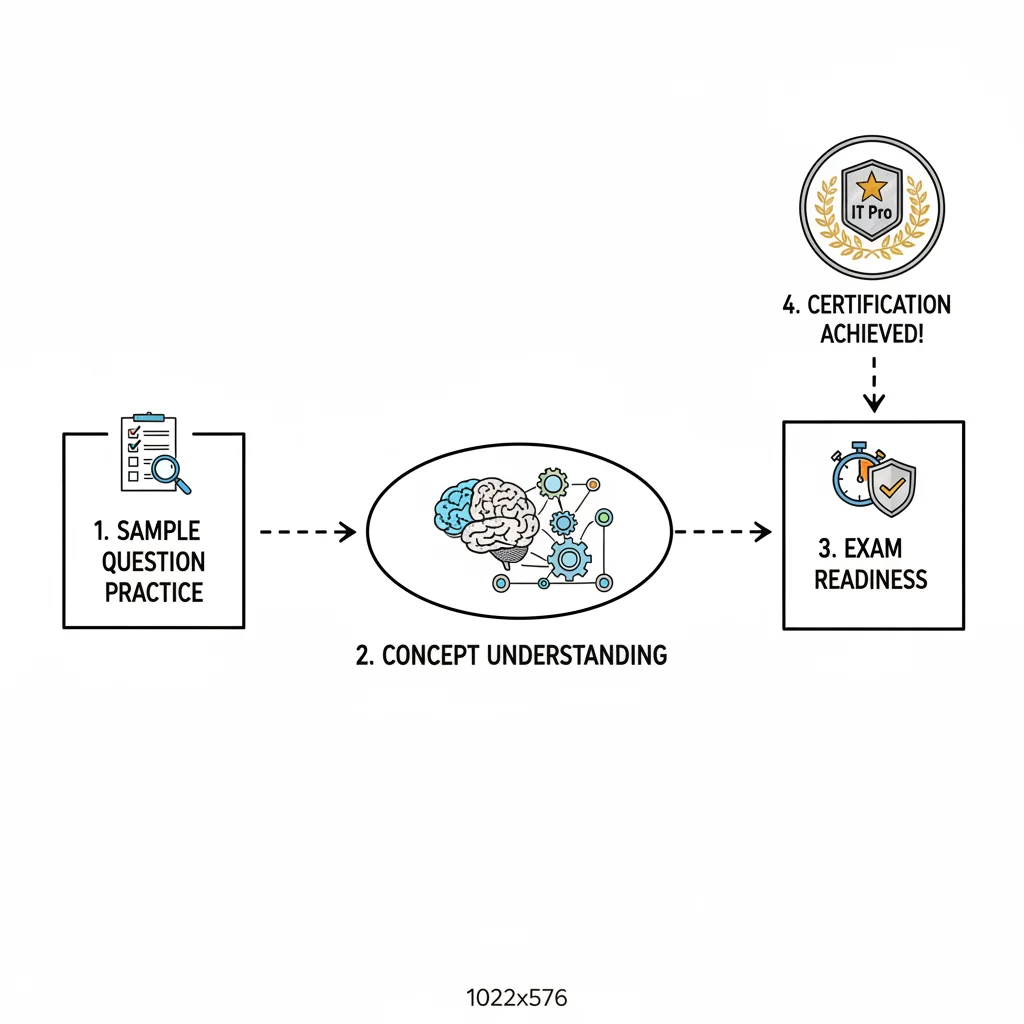
The most effective way to prepare for any IT certification, whether it's an AWS Solutions Architect, PMI PMP, or CompTIA A+ exam, is to fundamentally change your study approach. Instead of using exam sample questions as a final, high-stakes review, integrate them as your primary learning tool from the very beginning of your study journey.
Move Beyond Memorization to True Understanding
Traditional, passive study methods—like simply reading a chapter and highlighting text—rarely lead to genuine comprehension. True mastery for IT certifications like Azure Developer Associate or ISC2 CISSP comes from actively engaging with the material. Nothing forces this active engagement quite like wrestling with a well-crafted exam question.
This isn't just about quizzing yourself; it's a deliberate, iterative strategy designed to expose your blind spots and build a robust, conceptual foundation. You're shifting from passively absorbing information to actively solving problems, which mirrors the analytical and practical demands of the actual certification exam.
This smarter process involves three core phases:
- Understand: Deeply analyze the "why" behind each question, linking it back to core concepts.
- Diagnose: Identify your specific knowledge gaps based on your performance and the reasoning behind incorrect answers.
- Build: Systematically strengthen those weak areas by targeted review and further practice.
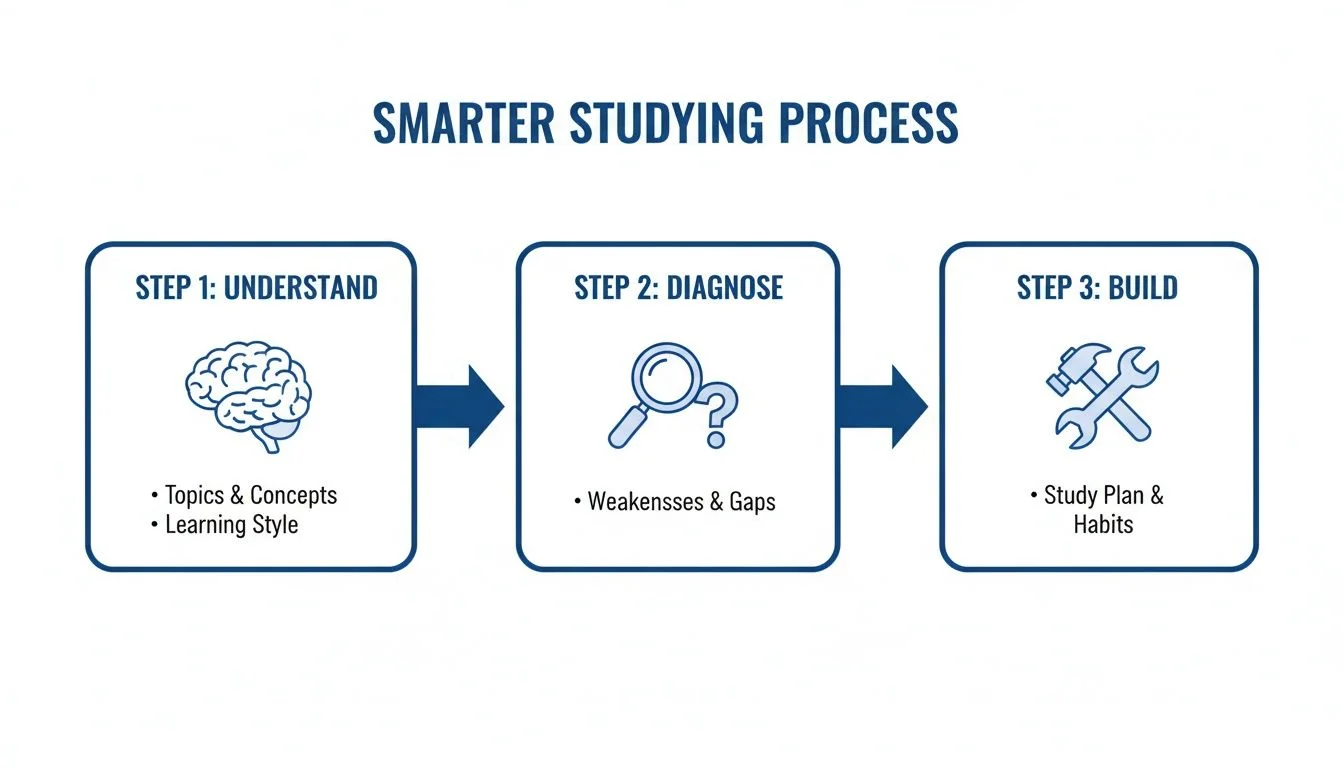
When you adopt this workflow, practice questions transform from simple assessments into your most powerful learning engine. You're no longer just chasing a score; you're gaining a precise roadmap that shows you exactly where to focus your precious study time.
Why a Question-First Approach Wins in Certification Prep
Placing exam sample questions at the core of your studying compels you to apply concepts, rather than merely recognizing them. This is a game-changer for how effectively you internalize complex IT material.
- Pinpoints Weaknesses with Precision: Getting an AWS-scenario question wrong isn't a failure; it's invaluable feedback. It’s a clear indicator pointing directly to a specific service, architectural principle, or configuration detail you need to revisit. For a PMP exam, it might reveal a misunderstanding of a particular process group or knowledge area.
- Builds Exam Endurance and Pacing: Answering a significant number of questions under timed pressure is a skill in itself. Consistent practice builds your mental stamina, improves your focus, and hones your time management instincts, crucial for multi-hour exams like the CISSP or longer CompTIA tests.
- Contextualizes Information for Deeper Retention: Questions bridge the divide between abstract theory (e.g., "what is a firewall?") and practical application (e.g., "given this network diagram, which firewall rule will allow traffic from X to Y?"). This contextual learning makes dense topics, like advanced networking or cloud security principles, feel much more concrete and memorable.
Every sample question should be treated as a mini-lesson. By dissecting them, you begin to understand the test-maker's logic, identify recurring patterns in problem types, and develop the kind of deep confidence that won't waver on exam day. This is the blueprint for achieving true competence, not just rote recall.
It's crucial to acknowledge that not all practice questions are created equal. Using low-quality or misleading questions can derail your study plan and lead to false confidence. The foundational step in your certification journey is to identify and utilize high-quality exam sample questions that accurately simulate what you'll encounter on test day. This is particularly vital for intricate exams from providers like AWS, Microsoft Azure, CompTIA, or PMI, where the question style and nuance are significant skills to master.
Where to Find Exam Sample Questions You Can Trust
Always begin your search with the official source. The certification body itself—such as ISACA for CISM, Amazon Web Services for their certifications, or Microsoft for Azure exams—typically provides a limited set of sample questions. While these won't constitute a full practice exam, they are the absolute gold standard, offering an unfiltered glimpse into the exam's structure, difficulty, and question style.
From there, broaden your search to reputable training providers that have a proven track record. These organizations invest heavily in developing practice questions with certified subject matter experts. Look for platforms that not only provide answers but also detailed explanations for both correct and incorrect options, and that directly map each question back to the official exam objectives.
Here’s a practical list of reliable sources:
- Official Certification Vendor Websites: The most accurate benchmark for question style and content.
- Authorized Training Partners: Companies officially recognized and vetted by the certification body (e.g., a Microsoft Learning Partner).
- Established eLearning Platforms: Look for platforms specializing in IT certification prep, which are dedicated to keeping content current and relevant.
- Community-Vetted Resources: Exercise caution here, but professional forums and study groups (e.g., on Reddit or LinkedIn) can offer recommendations for quality resources from recent exam passers.
How to Spot and Avoid Low-Quality 'Brain Dumps'
The most dangerous trap in certification preparation is falling for "brain dumps." These are sites that illegally compile and offer questions supposedly copied from live exams. Beyond the ethical implications, using them is a disastrous study strategy. The questions are frequently outdated, often contain incorrect answers, and provide a dangerously false sense of security.
A glaring red flag is any website that promises a "100% pass guarantee" or boasts about having "real exam questions." Legitimate providers prioritize helping you master the underlying material and problem-solving skills, not merely memorize answers.
Here’s what to scrutinize when vetting a study resource:
- Detailed Rationales: High-quality question banks explain why the correct answer is right and, critically, why the incorrect options (distractors) are wrong. This is where the deepest learning occurs.
- Professional Interface and Experience: A well-designed, intuitive study platform often reflects a well-researched and professionally developed content library. A sloppy interface can indicate sloppy content.
- Regular Content Updates: The provider should explicitly state that their content is regularly updated to align with the latest versions of the exam blueprint and objectives. IT certifications evolve rapidly, and outdated materials are detrimental.
The global demand for trusted certification preparation is immense. For instance, the International Software Testing Qualifications Board (ISTQB) has issued over 1 million certifications across 130 countries. This demonstrates the critical need for standardized, high-quality preparation materials that ensure professionals are truly competent.
Understanding the 'Why' Behind Each Question
Once you've secured a reliable source of exam sample questions, the next crucial step is to dissect the questions themselves. Certifications use diverse question formats to assess different cognitive skills, and recognizing the intent behind each one is paramount.
This table illustrates some common question formats you’ll encounter across major IT certifications, highlighting the shift from simple recall to complex problem-solving.
Question Type Analysis for Major Certifications
| Certification | Primary Question Type | Key Focus Area |
|---|---|---|
| CompTIA A+ | Multiple-choice, Multiple-response, Performance-based | Hardware/software troubleshooting, procedural knowledge |
| AWS Solutions Architect | Multiple-choice, Multiple-response, Scenario-based | Architectural design, problem-solving, best practices |
| PMI PMP | Multiple-choice, Multiple-response, Hotspot | Situational judgment, applying frameworks to scenarios |
| ISC2 CISSP | Multiple-choice, Advanced innovative questions | Analytical thinking, risk management principles, decision-making |
This analysis primes your brain for the task at hand. A straightforward multiple-choice question might test your recall of an ITIL definition. However, a lengthy, multi-part scenario question from AWS or Azure is designed to evaluate your ability to apply complex concepts to a messy, real-world problem, requiring critical thinking and synthesis of information.
As you work through practice tests, don't just answer the question; ask yourself why it's being asked in this particular way. What specific skill or knowledge area are the test designers trying to measure? You can delve deeper into effective exam preparation strategies in our detailed guide on exam preparation strategies.
Sometimes, your analysis will reveal a very specific knowledge gap, perhaps a particular command syntax, a networking protocol, or a specific calculation. When this occurs, you can seek out highly targeted resources, like finding one of the 7 Best Resources for Polynomial Practice Problems if foundational math is a weakness for a data science certification. This laser-focused approach is far more efficient than broad, generic practice.
Deconstruct Answers to Deepen Your Knowledge
Getting an answer correct on a practice test provides a momentary rush. However, that green checkmark can be dangerously misleading if you don't genuinely understand why your answer was correct.
True mastery emerges when you stop treating exam sample questions as simple pass/fail quizzes. Instead, view each question as a detailed case study to be dissected. Your objective is to grasp why the correct answer is unequivocally solid, and equally important, why every other option is flawed. This critical mindset shift differentiates rote cramming from profound learning.
Move Beyond Correctness to Comprehension
For your next practice question, try this transformative exercise: initially, completely disregard whether your answer was right or wrong. Instead, immediately navigate to the answer explanations.
Your primary goal is to meticulously examine the logic underpinning the correct answer. Don't passively accept it; actively challenge it. Ask yourself:
- Which specific concept or objective from the official exam blueprint is this question assessing?
- Can I articulate this rationale clearly and concisely in my own words, without referencing the provided explanation?
- Could I confidently explain this concept to a colleague or teach it to a junior team member right now, ensuring they understand it?
If you answer "no" to any of these questions, you haven’t fully extracted the learning value from that question. This deliberate, rigorous work is what builds knowledge you can genuinely rely on when the exam clock is ticking.
The most significant learning doesn't happen when you simply select the right letter. It occurs when you dissect the logic of the distractors—the incorrect options—and fully understand the specific flaw in each one. This transforms a single question into multiple invaluable learning opportunities.
Reflection Prompt: Consider a recent practice question you answered correctly. Did you move on immediately, or did you take the time to deeply understand why it was correct and why the alternatives were wrong? What insights might you have missed?
Hunt for the Logic in Distractors
Now, for arguably the most potent part of this exercise: analyzing the incorrect answers, or "distractors." Exam designers are skilled at psychological engineering, crafting tempting options that exploit common misconceptions or partial understandings. By learning to identify their traps, you become far more resilient to being misled.
For every single incorrect option, meticulously determine why it is wrong. It usually boils down to one of these classic exam design tricks:
- Partially Correct but Incomplete: The statement itself might be true, but it doesn't fully or directly address the specific nuance of the question being asked. For an AWS question, an answer might describe a valid service, but it's not the most cost-effective or most secure solution for the scenario.
- Conceptually Related but Irrelevant: This option uses real terminology or ideas from the study material, but it's utterly unrelated to the problem presented in the scenario.
- Logically Flawed or Factually Incorrect: The reasoning is fundamentally unsound, or the statement contains a factual error.
- Subtly Inaccurate: These are the trickiest. The answer is almost perfect, but it contains one tiny, critical word, phrase, or detail that renders it incorrect (e.g., "always" instead of "usually," or a single incorrect port number).
Pinpointing the exact flaw in each distractor is akin to discovering a small crack in your own understanding. This process immediately highlights precisely where you need to return in your notes or study materials to reinforce that specific concept. This level of granular analysis makes your study time incredibly efficient and effective.
This rigorous approach is precisely why many top-tier certifications maintain demanding pass rates. For instance, The IIA's global data reveals a 44% pass rate for CIA Part 1 and a 48% pass rate for Part 2. These statistics are not intended to instill fear; rather, they serve as powerful evidence that superficial knowledge is insufficient. You can review the complete breakdown by consulting the official certification pass rate data. It’s a stark reminder that your study methodology must cultivate deep, practically applicable expertise.
Simulate Real Exam Conditions to Beat the Clock
Knowing the material inside and out is one thing; performing effectively under the intense pressure of a timed exam is an entirely different challenge. I've witnessed many brilliant IT professionals falter not due to a lack of knowledge, but because the ticking clock and exam environment overwhelmed them. The most reliable way to mitigate test-day anxiety is through realistic practice.
By consistently utilizing exam sample questions within a timed, simulated environment, you develop the mental stamina, focus, and pacing strategies essential for success. The ultimate objective is to make the actual certification exam feel like just another well-rehearsed practice run—familiar, manageable, and significantly less intimidating. It's less about raw speed and more about cultivating smart decision-making when every second feels precious.
Create Your Personal Exam Simulation
Your initial step is to configure a practice test that meticulously replicates the conditions of the real exam. Avoid simply launching a random quiz. The precise details matter immensely, and accurately replicating them transforms casual practice into genuine preparation.
When setting up your simulation session, focus on calibrating these critical factors:
- Question Count: Match the exact number of questions for your specific exam. A 65-question AWS Certified Cloud Practitioner exam is a sprint, demanding swift decision-making, whereas a 150-question PMI PMP exam is a marathon, requiring sustained focus and endurance. Your pacing strategy will diverge significantly.
- Time Limit: Set a timer for the official exam duration. The goal isn't just to complete the questions, but to finish with ample time remaining to review any questions you've flagged for later consideration.
- Environment: This is paramount. Find a quiet, distraction-free space. Silence your phone (and place it out of sight), close all unnecessary tabs and applications on your computer, and ensure you won't be interrupted. Mimic the sterile, focused environment of a professional testing center as closely as possible.
By rigorously controlling these variables, you're doing more than just answering questions. You're actively rehearsing the entire exam experience, and this cultivated familiarity is your most potent defense against debilitating test-day jitters.
Recreating the exam environment does more than build speed—it trains your unwavering focus. When the actual test commences, your brain will recognize the familiar setup, enabling you to bypass initial panic and immediately engage with the task at hand.
Reflection Prompt: When you practice, do you typically use a timer and replicate the exam environment, or do you take your time? How might a more rigorous simulation impact your performance and confidence on actual exam day?
Master the Art of Pacing and Flagging
During your timed practice runs, you will inevitably encounter questions that make you hesitate. Becoming bogged down on a single difficult question is the quickest way to derail your entire exam. From extensive experience, the most successful certification candidates consistently employ a straightforward yet incredibly powerful flag-and-return method.
Here's your new mantra for timed exams: Answer the easy ones first.
On your initial pass through the exam, only answer the questions you know instantly and confidently. If any question requires more than a minute of deep analytical thought or feels ambiguous, flag it immediately and move on. Do not allow your ego or a desire for perfection to trap you trying to solve a tough problem in that moment.
This strategic approach yields two significant benefits:
- You Secure Easy Points: You immediately bank all the questions you were certain about, eliminating the risk of running out of time before reaching them.
- You Build Momentum and Confidence: Successfully answering a series of questions in a row provides a fantastic psychological boost. You’ll feel significantly more composed and capable when you circle back to tackle the harder, flagged questions on your second pass.
Once you’ve made a complete pass through all questions, return to your flagged items. It’s remarkable how often a subsequent question might spark a memory or provide a crucial clue for an earlier, challenging one. For example, in our AWS Certified Cloud Practitioner practice exam, we specifically design scenarios to help you hone this critical skill of efficient navigation and strategic flagging, ensuring you never leave points on the table simply because the clock expired.
Integrate Advanced Study Techniques for Lasting Recall

While rigorous timed practice exams are an excellent starting point, achieving true mastery of IT certification material necessitates moving beyond mere review into strategic, science-backed learning. This is where you incorporate potent methods designed to embed information into your long-term memory, ensuring it's readily accessible not only on exam day but throughout your professional career.
Let's explore Spaced Repetition and adaptive learning—these aren't just trendy buzzwords; they are empirically proven techniques that can profoundly enhance your certification preparation.
Harness Spaced Repetition to Lock in Knowledge
Instead of mindlessly drilling the same exam sample questions repeatedly, Spaced Repetition introduces an intelligent rhythm to your studies. The core principle is straightforward: you review information at progressively increasing intervals. A question you answered flawlessly might not reappear for a week or two, whereas one you struggled with could re-emerge the very next day. This method is heavily supported by cognitive science and is far more effective for long-term memory recall than traditional cramming.
You can implement this manually even without specialized software. After completing a practice test, categorize the questions—perhaps into digital folders or even physical piles—based on your performance:
- "Nailed It" Pile: These are questions you answered correctly and instantly. Schedule to review them in approximately one to two weeks.
- "Got It, but Hesitated" Pile: You selected the correct answer, but with some uncertainty or after significant thought. Revisit these in two to three days.
- "Completely Missed It" Pile: This is where the most critical learning occurs. These are your absolute top priority; review them thoroughly the very next day.
This intelligent approach ensures you are not squandering precious study time on concepts you’ve already mastered. Instead, you strategically focus your energy where it’s most needed, making your study sessions remarkably efficient. To delve deeper into structuring your learning for better retention, utilizing an ultimate study guide can provide valuable frameworks.
By intelligently spacing out your review of exam sample questions, you are collaborating with your brain's inherent learning processes, rather than working against them. This transforms studying from a brute-force effort into a precise, targeted strategy for building lasting competence.
Let Adaptive Learning Personalize Your Path
Many contemporary study platforms, including MindMesh Academy, elevate this concept further with sophisticated adaptive learning engines. Envision these systems as your dedicated personal tutor. They continuously analyze your performance on practice questions in real time, constructing a dynamic profile of your precise strengths and weaknesses across all exam objectives.
For example, imagine you are consistently missing questions related to a specific cloud networking topic within an Azure certification. An adaptive engine will promptly identify this pattern and automatically begin presenting you with more questions explicitly targeting that knowledge gap. This custom-tailored approach maximizes the value of every minute you study, as you are perpetually working on your weakest areas, ensuring comprehensive coverage.
The tangible value of such deep preparation is clearly evident across the IT industry. Certified professionals bring substantial value to their organizations; for instance, those specialized in AI can generate an average of over $30,000 for their businesses. This compelling return on investment underscores why professionals prioritize quality preparation that guarantees genuine expertise. The impact of IT certifications on business value is a well-documented phenomenon.
When you seamlessly integrate spaced repetition with the potent capabilities of adaptive technology, you are not merely studying to pass an exam. You are actively cultivating the kind of deep, foundational knowledge and practical skills that will genuinely accelerate your career trajectory. For more insights on leveraging these powerful methods, explore our guide on memory aids and advanced study techniques.
Your Top Exam Prep Questions, Answered
When you're intensely focused on certification preparation, it’s entirely natural for specific questions to arise about the optimal utilization of practice materials. Over the years, I’ve addressed numerous inquiries, but a few key uncertainties consistently emerge among professionals employing exam sample questions.
Let’s tackle some of the most common concerns I hear from IT professionals striving for their next certification. Getting clear, definitive answers to these questions can profoundly impact your study methodology, helping you avoid common pitfalls and construct a robust, effective strategy for passing your exam.
How Many Sample Questions Should I Do Before My Exam?
Everyone yearns for a definitive magic number, but in truth, no such number exists. The reality is, the quality and intentionality of your practice sessions will always significantly outweigh the sheer quantity of questions you attempt. I’ve observed countless individuals suffer burnout chasing a goal of answering thousands of random questions, only to discover they hadn't genuinely learned what was truly required.
Instead of merely aiming for volume, consider high-quality exam sample questions primarily as a diagnostic instrument. Your true objective isn't merely to see a green "correct" icon; it’s to meticulously identify and effectively patch every single hole in your knowledge. A carefully curated set of questions that comprehensively covers the entire official exam blueprint is immeasurably more valuable than an overwhelming mountain of generic or outdated ones.
So, when can you confidently say you're ready? A robust benchmark is consistently achieving above 90% on several distinct, full-length, high-quality practice exams. Once you can reliably hit this mark under timed pressure, it’s a powerful indication that you have systematically addressed your weak areas and are well-prepared for the challenges the actual test will present.
This disciplined approach ensures that you are genuinely understanding and applying the underlying concepts, not just memorizing isolated answers.
Are Free Exam Sample Questions Good Enough?
I completely understand the allure of "free." However, when your professional IT certification—and potentially your career progression—is at stake, relying on free question banks or "dumps" represents an enormous gamble. From my extensive experience, these free resources are a wildly inconsistent mixed bag at best, and frequently, they cause more harm than good to your preparation.
Most free question banks exhibit several critical, deal-breaking flaws:
- Outdated Content: They typically lag significantly behind exam updates, meaning you might be studying irrelevant topics or, worse, completely missing new, crucial material.
- Incorrect Answers and Explanations: Without a dedicated team of subject matter experts to vet them, many free questions contain outright incorrect answers or provide misleading explanations. This can actively teach you erroneous information, a fatal flaw in certification prep.
- Poor Quality and Inaccurate Style: They almost never accurately capture the nuance, the tricky wording, the depth of scenarios, or the overall difficulty of the actual exam questions. This creates a false sense of confidence that can rapidly shatter on test day.
Consider investing in premium practice exams from a reputable provider not as an expense, but as critical insurance. It’s an investment that significantly increases your likelihood of passing on your first attempt, saving you the considerable financial cost and acute stress of a retake.
What's the Best Way to Review My Incorrect Answers?
This phase is precisely where the profound learning truly begins. Merely glancing at the correct answer and moving on is, without doubt, the single biggest mistake you can make in your study process. Every incorrect answer should not be viewed as a failure, but rather as a bright, unmistakable arrow pointing directly to a specific knowledge gap that you absolutely need to fill.
You must adopt a forensic approach to reviewing every single question you answer incorrectly. Do not gloss over it; delve deep.
First, take a deliberate minute to analyze what transpired. Pinpoint why you chose the wrong answer. What was your specific line of reasoning or your initial assumption? Next, articulate the logic for the correct answer in your own distinct words. This intentional act forces you to truly internalize the concept and its application.
Finally, and this is the absolutely crucial part, use that hard-won insight to immediately return to your primary study materials. Reread the specific chapter, re-watch the relevant video, or consult official documentation that directly covers that particular topic. This active, iterative review process transforms your mistakes into your most powerful study tool, ensuring you significantly reduce the likelihood of making the same error when it truly matters on exam day.
At MindMesh Academy, our entire platform is meticulously built upon these proven, science-backed strategies. We are committed to providing high-quality, fully vetted practice questions and the advanced analytical tools you need to dissect your performance, identify your unique learning opportunities, and master the material with confidence. Stop guessing and start building genuine competence by exploring our comprehensive certification resources at https://mindmeshacademy.com.

Written by
Alvin Varughese
Founder, MindMesh Academy
Alvin Varughese is the founder of MindMesh Academy and holds 15 professional certifications including AWS Solutions Architect Professional, Azure DevOps Engineer Expert, and ITIL 4. He's held senior engineering and architecture roles at Humana (Fortune 50) and GE Appliances. He built MindMesh Academy to share the study methods and first-principles approach that helped him pass each exam.