
Your Ultimate CISSP Sample Exam And Study Guide
Your Ultimate CISSP Sample Exam And Study Guide: A Strategic Approach
For IT professionals eyeing the esteemed CISSP certification, a realistic CISSP sample exam is far more than just a pre-test. It serves as an indispensable diagnostic tool, offering a precise snapshot of your current knowledge and strategic thinking before you ever step into the official testing center. This isn't just about identifying gaps; it's your critical first step toward pinpointing weak domains, understanding the unique scenario-based question format, and building the mental endurance essential for success.
Why a Realistic CISSP Sample Exam Is Your Most Powerful Study Tool

Many aspiring CISSP candidates make the common, yet costly, mistake of believing they can pass by simply memorizing facts from a textbook. The CISSP isn't a technical trivia game; it's a rigorous evaluation of your managerial judgment and ability to apply complex security principles to ambiguous, real-world business scenarios.
You won't encounter questions asking for the exact bit length of an encryption key (though understanding key lengths is certainly part of the foundation). Instead, you'll be presented with a multifaceted scenario and challenged to choose the most appropriate risk mitigation strategy for a company navigating a specific threat, considering factors like budget, business impact, and legal compliance. This requires a level of critical thinking and application that passive reading alone cannot cultivate.
Moving Beyond Theory to Application
A well-crafted CISSP sample exam actively pushes you beyond the comfort zone of theoretical knowledge and into the practical realm of problem-solving under pressure. It's the essential bridge between conceptually understanding security domains and proficiently applying that understanding when every second counts.
This kind of simulated experience is crucial for several key reasons, directly impacting your preparedness for not only CISSP but also other advanced certifications like PMP, AWS Solutions Architect Professional, or Azure Security Engineer:
- It Finds Your Blind Spots: A diagnostic mock test provides an honest baseline across all eight CISSP domains. No more guessing where you stand—you'll gain precise insights into where to concentrate your precious study time.
- It Builds Mental Endurance: The actual CISSP exam is a marathon, not a sprint. A timed mock test forces you to maintain focus, manage your time effectively, and combat decision fatigue for hours on end, simulating the intensity of exam day.
- It Demystifies the Questions: CISSP questions are renowned for their intricate wording and deceptive distractors. Consistent practice helps you identify common pitfalls and cultivate the "think like a manager, not a technician" mindset that is paramount for passing.
Knowing how to study for exams effectively is paramount, especially regarding what you do after the mock test. The objective isn't merely to achieve a score; it's to meticulously analyze your results and uncover the "why" behind every single mistake, turning errors into potent learning opportunities.
A mock exam is your diagnostic tool. It’s not a final grade but a starting point that reveals where your study efforts will yield the highest return, much like a cybersecurity penetration test identifies vulnerabilities to prioritize remediation.
Reflection Prompt: Consider your current professional role. Which CISSP domains do you anticipate being your strongest, and which might pose the greatest challenge? How might a mock exam confirm or contradict your assumptions?
The Career and Salary Advantage
Let's be pragmatic: achieving the CISSP certification is a monumental career milestone. With staggering projections of 3.5 million unfilled cybersecurity jobs by 2025, this credential positions you as a highly sought-after professional. It represents a direct, high-impact investment in your future, unlocking opportunities for six-figure salaries that average around $131,000 and can escalate to $175,583 for strategic roles like Information Security Manager.
This CISSP sample exam isn't merely practice. It's the foundational step on that incredibly rewarding career trajectory, demonstrating your commitment to excellence and strategic understanding in the field of information security.
How To Approach Your First Timed Mock Exam
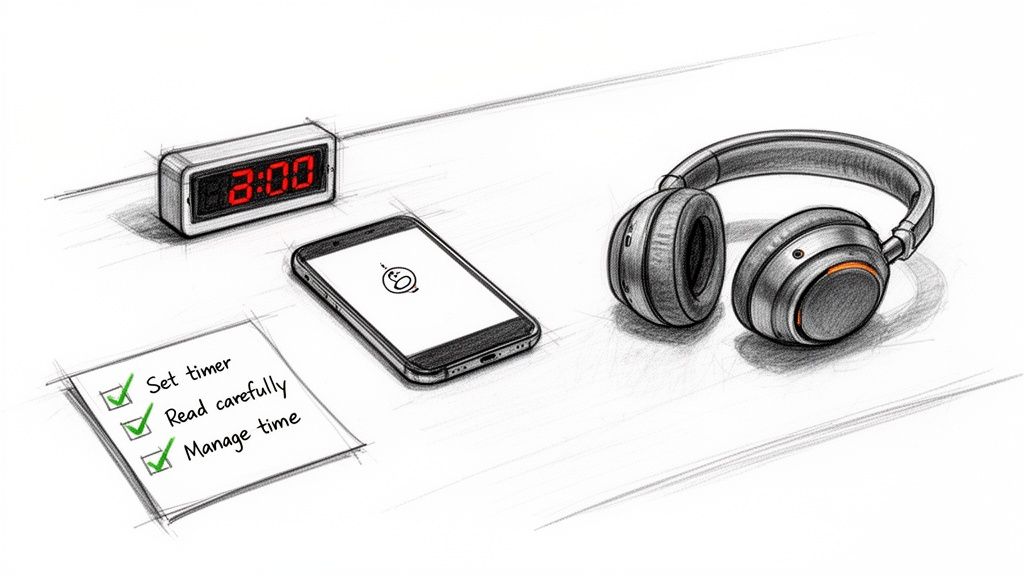
It's imperative to treat your first timed CISSP sample exam with the utmost seriousness. This is your full-scale dress rehearsal for the real event. The entire purpose is to meticulously replicate the official testing environment, allowing you to gauge how your focus, mental endurance, and critical thinking hold up under sustained pressure.
Before beginning, secure a quiet, uninterrupted space where you can commit the entire exam duration without disturbance. Disable your phone notifications and place it in another room. Inform family or roommates that you are completely off-limits. Completing the exam in a single, continuous block is non-negotiable. Any deviation will provide a skewed and inaccurate assessment of your true stamina and test-taking capability.
Setting Up for Success
Prior to clicking "start," prepare your testing station meticulously. This isn't about having notes handy (which is forbidden); it's about eliminating every potential excuse for a lapse in concentration.
- Use an External Timer: While the on-screen clock provides time, a separate physical timer on your desk can help you better internalize your pacing without constantly diverting your attention to the exam interface.
- Keep Water on Hand: Hydration is vital for sustained mental clarity. Opt for a simple bottle of water to avoid unnecessary restroom breaks or sugary distractions.
- Optimize Your Comfort: Ensure your chair, desk, and lighting are ergonomically sound. A minor physical annoyance, like screen glare or an uncomfortable seating position, can amplify into a significant distraction by the second or third hour.
- Mental Preparation: Take a few deep breaths. Remind yourself that this is a learning experience, not a final judgment. Managing pre-exam anxiety is as important as managing your knowledge.
The real CISSP exam is as much a test of managing your own fatigue and anxiety as it is a test of your knowledge. This first practice run is where you begin to build that crucial mental muscle, a skill invaluable in high-stakes environments like incident response or project management.
During the Exam: Your Game Plan
Once the timer commences, your approach to each question is critical. The CISSP is notorious for its tricky wording and complex scenario-based questions designed to assess your real-world judgment, not just rote recall. Resist the urge to quickly select an answer; instead, pause, take a breath, and meticulously decipher what the question is truly asking.
Read the entire question carefully—even twice if necessary. Actively search for keywords that pinpoint the core security concept or principle being tested. Before even glancing at the multiple-choice options, try to formulate your own anticipated correct answer. This simple yet powerful technique helps you bypass the cleverly designed distractors that the exam creators frequently employ.
Next, engage a rigorous process of elimination. You can almost always discard one or two answers that are clearly incorrect or irrelevant. This typically narrows your choices down to two plausible options, dramatically improving your odds of selecting the best possible answer—a hallmark of CISSP problem-solving. Understanding the different CISSP exam question types you'll encounter is a tremendous advantage here.
Finally, become a ruthless time manager. If a question completely baffles you, do not dwell on it. Flag it for review and move on. Wasting five minutes on a single challenging question means you'll have to rush through several easier ones later, potentially jeopardizing your score. The objective is a steady, consistent pace that affords each question the appropriate attention without allowing any single one to derail your progress.
Reflection Prompt: During your mock exam, where did you find yourself spending the most time? Was it on understanding the question, analyzing options, or second-guessing yourself? How can you refine this process?
The Mindmesh Academy CISSP Full-Length Practice Exam
Now, the moment of truth. Below, you'll find our full-length, 125-question CISSP practice exam. We've meticulously designed this simulation to mirror the real examination experience as closely as possible, comprehensively covering all eight domains to rigorously test your understanding and application of security principles.
Before you begin, commit to treating this as the actual exam. Locate a quiet environment, allocate a substantial, uninterrupted block of time, and silence all distractions. The closer you can replicate genuine test-day conditions, the more accurate and valuable your diagnostic results will be.
The authentic CISSP exam is notoriously challenging for a reason. It's a Computerized Adaptive Test (CAT), meaning the difficulty of subsequent questions dynamically adjusts based on the correctness of your previous answers. You can expect to face anywhere from 100 to 150 questions over a maximum of three hours. To achieve a passing score, you must attain 700 out of 1000 scaled points, which roughly translates to a 70% proficiency rate. Remember, the questions go beyond mere factual recall, demanding that you consistently apply a managerial perspective and sound judgment to complex scenarios.
View this mock exam as a sophisticated diagnostic instrument. Your primary objective isn't merely to score well, but to meticulously gather actionable intelligence on your specific strengths and weaknesses. Every single question—particularly those you answer incorrectly or even just guess on—is a crucial data point that will empower us to construct a laser-focused, highly effective study plan later.
No pressure, but give it your absolute best effort. Good luck.
CISSP Sample Exam Questions
1. A security architect is designing a system for a financial institution. The primary requirement is to ensure that a transaction, once completed, cannot be denied by any party involved. Which security service is the architect primarily addressing?
- a) Confidentiality
- b) Integrity
- c) Availability
- d) Non-repudiation
2. During a business impact analysis (BIA), a company identifies a critical business process with a Recovery Time Objective (RTO) of 4 hours and a Recovery Point Objective (RPO) of 15 minutes. Which disaster recovery solution would BEST meet these requirements?
- a) Daily tape backups stored off-site
- b) A cold site with equipment ready for installation
- c) Asynchronous replication to a hot site
- d) A warm site with pre-configured network connectivity
3. An organization is implementing a new access control system. The policy states that users should only be granted the minimum permissions necessary to perform their job functions. This policy is an example of:
- a) Role-Based Access Control (RBAC)
- b) The principle of least privilege
- c) Mandatory Access Control (MAC)
- d) Discretionary Access Control (DAC)
4. A company's web server was compromised. The incident response team created a bit-for-bit copy of the affected hard drive for analysis. What is this copy called?
- a) A system snapshot
- b) A forensic image
- c) A file backup
- d) A disk clone
5. Which of the following cryptographic attacks is most effective against hashing algorithms?
- a) Man-in-the-middle attack
- b) Birthday attack
- c) Chosen-plaintext attack
- d) Brute-force attack
6. An organization wants to classify its data based on its sensitivity and the potential damage from disclosure. Which individual is ultimately responsible for this data classification?
- a) Data custodian
- b) System administrator
- c) Data owner
- d) Security analyst
7. A company is concerned about employees taking sensitive documents home. Which of the following technologies is best suited to prevent this?
- a) Intrusion Detection System (IDS)
- b) Data Loss Prevention (DLP)
- c) Web Application Firewall (WAF)
- d) Unified Threat Management (UTM)
8. In the context of risk management, what is the term for the amount of risk an organization is willing to accept to achieve its objectives?
- a) Risk avoidance
- b) Risk transference
- c) Risk appetite
- d) Residual risk
9. What is the primary purpose of the Bell-LaPadula model?
- a) To ensure data integrity
- b) To maintain data availability
- c) To enforce data confidentiality
- d) To manage access control lists
10. A software developer is using a static analysis tool to review code before it is compiled. What is the main advantage of this approach?
- a) It can identify vulnerabilities in third-party libraries.
- b) It can find security flaws early in the development lifecycle.
- c) It simulates real-world attacks against the running application.
- d) It requires minimal expertise from the developer to use effectively.
11. An organization uses a third-party cloud provider for data storage. What type of control is this an example of?
- a) Corrective control
- b) Detective control
- c) Physical control
- d) Administrative control
12. Which phase of the incident response lifecycle involves learning from a security event to prevent future occurrences?
- a) Containment
- b) Eradication
- c) Preparation
- d) Post-incident activity (Lessons Learned)
13. What is the primary function of a Trusted Platform Module (TPM)?
- a) To encrypt all data on a hard drive.
- b) To securely store cryptographic keys.
- c) To filter network traffic.
- d) To provide antivirus protection.
14. During a security assessment, a penetration tester successfully exploits a vulnerability on a web server to gain initial access. What is the next logical step in the attack methodology?
- a) Covering tracks
- b) Privilege escalation
- c) Reporting the finding
- d) Maintaining access
15. An organization wants to implement a system that requires two individuals to approve a high-risk transaction. This is an example of:
- a) Job rotation
- b) Least privilege
- c) Separation of duties
- d) Need-to-know
Pro Tip: As you work through this practice exam, pay close attention to any question that gives you pause or makes you second-guess. The goal isn't just to identify what you don't know, but also what you aren't 100% confident about. Those are the golden nuggets for building your personalized study plan.
16. Which of the following is an example of a detective security control?
- a) A firewall rule blocking malicious traffic
- b) Security awareness training for employees
- c) A log file showing failed login attempts
- d) An encrypted database
17. What is the main difference between a Business Continuity Plan (BCP) and a Disaster Recovery Plan (DRP)?
- a) BCP focuses on keeping business functions running, while DRP focuses on restoring IT infrastructure.
- b) DRP is a part of BCP, but BCP is not part of DRP.
- c) BCP is for man-made disasters, while DRP is for natural disasters.
- d) There is no significant difference; the terms are interchangeable.
18. A network administrator is configuring a new wireless network and wants to use the most secure protocol available. Which of the following should be chosen?
- a) WEP
- b) WPA
- c) WPA2 with AES
- d) WPA3
19. A company wants to ensure that emails are authentic and have not been tampered with in transit. What technology should be used?
- a) SSL/TLS
- b) Digital Signatures
- c) Symmetric Encryption
- d) VPN
20. What type of fire suppression system is most appropriate for a data center to protect equipment without causing damage from the agent itself?
- a) Water-based sprinkler system
- b) Dry pipe system
- c) Gaseous fire suppression system (e.g., FM-200)
- d) Foam-based system
For some extra practice, feel free to check out these additional CISSP sample questions with detailed explanations to get some more reps in.
21. In the OSI model, at which layer does data encryption and decryption typically occur?
- a) Layer 2 (Data Link)
- b) Layer 3 (Network)
- c) Layer 4 (Transport)
- d) Layer 6 (Presentation)
22. The Clark-Wilson model is primarily concerned with which security principle?
- a) Confidentiality
- b) Integrity
- c) Availability
- d) Non-repudiation
23. A security team is performing a vulnerability scan of their network. They use a scanner that has been provided with administrative credentials to access and assess systems. What type of scan is this?
- a) Unauthenticated scan
- b) Black-box scan
- c) Credentialed scan
- d) Passive scan
24. What is the primary security risk associated with the Internet of Things (IoT) devices?
- a) High power consumption
- b) Lack of physical security controls
- c) Weak or non-existent built-in security features
- d) Limited network bandwidth
25. An organization is conducting a risk assessment. The team calculates the Single Loss Expectancy (SLE) for a particular asset. What two factors are multiplied to determine the SLE?
- a) Asset Value (AV) and Exposure Factor (EF)
- b) Asset Value (AV) and Annualized Rate of Occurrence (ARO)
- c) Exposure Factor (EF) and Annualized Rate of Occurrence (ARO)
- d) Threat and Vulnerability
Continue with questions 26 through 125, following the same format and covering all eight CISSP domains proportionally. The answer key and detailed explanations will be provided in the next section of this guide.
Making Sense of Your Results: Explanations and Domain Deep Dive
Congratulations on battling through the timed mock exam. Now, take a well-deserved breath. The most profoundly valuable phase of this entire exercise commences right now: the systematic breakdown of your results to understand not just what you answered incorrectly, but why.
Consider every wrong answer on a CISSP sample exam as a strategic gift. Each one is a free, zero-stakes lesson that precisely illuminates a specific knowledge gap or a misunderstanding of a core concept. This insight empowers you to know exactly where to channel your study energy to refine your strategic thinking and develop the mindset of a seasoned security manager.
This section is more than just an answer key. It features detailed explanations crafted to meticulously guide you through the logic underpinning the best choice. Equally important, we will dissect why the alternative options—the distractors—are incorrect within the nuanced context of the question. As you review each explanation, cultivate the habit of mentally mapping it to its respective CISSP domain. This active process is fundamental to building the robust mental framework required to conquer the real exam.
Mapping Your Wrong Answers to the CISSP Domains
Before diving into the specifics of individual questions, let's zoom out and analyze the broader landscape. The CISSP exam is meticulously structured around eight distinct domains, and (ISC)² assigns a specific weighting to each. Comprehending this structure is paramount for transforming your mock exam score into an intelligent, prioritized study plan. If you observe a concentration of mistakes within a particular domain, you've just identified your immediate top priority.
Knowing the official weighting is critical for optimally allocating your study time. If you exhibit weakness in a heavily weighted domain, that is precisely where your concentrated effort will yield the most significant return.
Here’s the official breakdown from (ISC)²:
CISSP Exam Domain Weighting
This table outlines the official (ISC)² weighting for each of the eight domains on the CISSP exam, helping you prioritize your study efforts based on your sample exam results.
| Domain Number | Domain Name | Exam Weighting (%) |
|---|---|---|
| 1 | Security and Risk Management | 15% |
| 2 | Asset Security | 10% |
| 3 | Security Architecture and Engineering | 13% |
| 4 | Communication and Network Security | 13% |
| 5 | Identity and Access Management (IAM) | 13% |
| 6 | Security Assessment and Testing | 12% |
| 7 | Security Operations | 13% |
| 8 | Software Development Security | 11% |
As evident from the table, some domains carry more significant weight than others. A profound grasp of Governance, Risk, and Compliance (GRC) principles is a pervasive thread that intricately weaves through almost all domains, especially the first one. Practical, applied knowledge in this area is non-negotiable for a security professional, and it often involves Mastering GRC Cyber Security frameworks.
Answer Key and In-Depth Explanations
Let's meticulously break down the first 25 questions from the sample test.
1. Correct Answer: d) Non-repudiation
- Why it's right: Non-repudiation is a fundamental security service designed to provide irrefutable proof—both of origin (who sent it) and of delivery (who received it). It prevents any party from plausibly denying their involvement in a transaction or communication. This precisely aligns with the financial institution's core requirement.
- Why others are wrong: Confidentiality (a) safeguards against unauthorized disclosure. Integrity (b) ensures data has not been altered or destroyed in an unauthorized manner. Availability (c) guarantees timely and reliable access to information and resources. While all are crucial security concepts, none specifically address the need for undeniable proof.
- Domain: Security and Risk Management (Domain 1) - Initial thought was Domain 3, but Non-repudiation, as a core security service and principle, falls under the foundational concepts of SRM. The architect is designing based on a business requirement, which is an SRM concern.
2. Correct Answer: c) Asynchronous replication to a hot site
- Why it's right: A Recovery Time Objective (RTO) of 4 hours and a Recovery Point Objective (RPO) of 15 minutes are highly aggressive targets, indicating minimal acceptable downtime and data loss. To meet these, you need a solution that is nearly fully operational and has extremely recent data. A hot site with asynchronous replication provides a continuously updated copy of data with a minimal, acceptable lag, enabling rapid recovery.
- Why others are wrong: Daily tape backups (a) and a cold site (b) involve significant time for recovery (days, not hours) and data loss. A warm site (d) is an improvement over a cold site but typically wouldn't meet a 4-hour RTO due to the need for equipment setup and configuration.
- Domain: Security Operations (Domain 7)
3. Correct Answer: b) The principle of least privilege
- Why it's right: This is a cornerstone security principle. The scenario explicitly describes the practice of granting users only the absolute minimum permissions (access rights, resources) necessary to perform their assigned job functions, and nothing more. This directly embodies the principle of least privilege.
- Why others are wrong: Role-Based Access Control (RBAC) (a), Mandatory Access Control (MAC) (c), and Discretionary Access Control (DAC) (d) are all access control models or frameworks. They are methodologies used to implement security principles like least privilege, but they are not the principle itself.
- Domain: Identity and Access Management (IAM) (Domain 5)
4. Correct Answer: b) A forensic image
- Why it's right: For digital evidence to be legally admissible and maintain its integrity during an investigation, it must be collected using forensically sound methods. A forensic image is a bit-for-bit, sector-by-sector copy of an entire storage medium. This ensures that every piece of data, including deleted files, file slack, and unallocated space, is preserved. Its integrity can be mathematically verified using a cryptographic hash value.
- Why others are wrong: System snapshots (a) and file backups (c) are primarily for operational recovery and may not capture all necessary forensic artifacts. A disk clone (d) often implies an exact operational copy, but a forensic image emphasizes the preservation of evidence for analysis.
- Domain: Security Operations (Domain 7)
5. Correct Answer: b) Birthday attack
- Why it's right: A birthday attack targets hashing algorithms by exploiting the mathematical probability that in a sufficiently large set of random values, two values will collide (i.e., produce the same hash output). The goal is to find two different inputs that generate the same hash, thereby undermining the integrity protection that hashes are designed to provide. This is analogous to the "birthday problem" in probability theory.
- Why others are wrong: A Man-in-the-middle attack (a) intercepts communication. A Chosen-plaintext attack (c) is relevant to encryption algorithms, not typically hashing. A Brute-force attack (d) attempts every possible key or password but doesn't specifically target hash collisions in the same way.
- Domain: Security Architecture and Engineering (Domain 3)
Think Like a Manager: Did you notice a recurring theme? Many CISSP questions aren't about identifying the one technically perfect answer. They demand you select the best or most appropriate solution within a specific business context, balancing security, cost, and operational impact. That is the core CISSP mindset.
6. Correct Answer: c) Data owner
- Why it's right: The data owner is the senior individual (e.g., manager or executive) who bears ultimate organizational accountability for a specific dataset. They possess the authority and responsibility to determine data classification levels, approve access requests, and ensure that appropriate protection mechanisms are implemented.
- Why others are wrong: The data custodian (a) is the technical individual or team (e.g., a database administrator or IT operations) who manages the data on behalf of the owner. The system administrator (b) implements the technical controls. The security analyst (d) identifies and mitigates risks but does not hold ultimate responsibility for classification.
- Domain: Asset Security (Domain 2)
7. Correct Answer: b) Data Loss Prevention (DLP)
- Why it's right: Data Loss Prevention (DLP) systems are specifically designed to identify, monitor, and block sensitive information from leaving an organization's controlled environment, whether through email, cloud storage, or physical devices like USB drives. The scenario is a classic application for DLP technology.
- Why others are wrong: An Intrusion Detection System (IDS) (a) monitors for malicious activity. A Web Application Firewall (WAF) (c) protects web applications. Unified Threat Management (UTM) (d) is a multi-function security appliance. None are primarily focused on inspecting the content of data attempting to egress the network to prevent sensitive information exfiltration.
- Domain: Communication and Network Security (Domain 4)
8. Correct Answer: c) Risk appetite
- Why it's right: Risk appetite is a high-level strategic declaration from senior management or the board that defines the overall amount and type of risk an organization is willing to accept or tolerate in pursuit of its business objectives. It sets the overarching boundaries for all subsequent risk management activities.
- Why others are wrong: Risk avoidance (a) is eliminating a risk. Risk transference (b) is shifting risk to another party (e.g., insurance). Residual risk (d) is the risk that remains after all security controls have been implemented. It's an outcome of the risk management process, not the guiding principle itself.
- Domain: Security and Risk Management (Domain 1)
9. Correct Answer: c) To enforce data confidentiality
- Why it's right: The Bell-LaPadula model is one of the foundational formal security models, with its core objective being the enforcement of data confidentiality. Its two primary rules, the "Simple Security Property" (no read up – a subject at a lower security level cannot read data at a higher security level) and the "* (Star) Property" (no write down – a subject at a higher security level cannot write to a lower security level object), are exclusively designed to prevent unauthorized information disclosure.
- Domain: Security Architecture and Engineering (Domain 3)
10. Correct Answer: b) It can find security flaws early in the development lifecycle.
- Why it's right: Static Application Security Testing (SAST) tools analyze an application's source code, bytecode, or binary code without actually executing it. The immense advantage of this approach is that vulnerabilities can be identified and remediated much earlier in the Software Development Life Cycle (SDLC), where the cost and effort of fixing them are significantly lower than finding them in production. This principle applies broadly to robust development practices, whether for custom applications or configuring AWS or Azure cloud environments.
- Domain: Software Development Security (Domain 8)
11. Correct Answer: d) Administrative control
- Why it's right: When an organization utilizes a third-party cloud provider, the decision to outsource data storage, the selection of the provider, and the establishment of contracts, Service Level Agreements (SLAs), and security policies governing that relationship are all examples of administrative controls. These are management-level directives and procedures.
- Why others are wrong: Corrective controls (a) are implemented after an incident to restore systems. Detective controls (b) identify security events. Physical controls (c) are tangible barriers (e.g., fences, locks).
- Domain: Security and Risk Management (Domain 1)
12. Correct Answer: d) Post-incident activity (Lessons Learned)
- Why it's right: The "Post-incident activity" or "Lessons Learned" phase is the final, yet crucial, stage of the incident response lifecycle. During this phase, the incident response team reviews the entire event, identifies what worked well, what didn't, and what improvements can be made to policies, procedures, and technologies to prevent similar incidents in the future. This iterative learning is a core tenet of maturity models like ITIL for service management.
- Why others are wrong: Containment (a) limits the incident's scope. Eradication (b) removes the root cause. Preparation (c) occurs before an incident.
- Domain: Security Operations (Domain 7)
13. Correct Answer: b) To securely store cryptographic keys.
- Why it's right: A Trusted Platform Module (TPM) is a secure cryptoprocessor designed to store cryptographic keys, passwords, and digital certificates in a hardware-based, tamper-resistant environment. Its primary function is to enhance the security of the host system by providing a secure boot process and protecting sensitive data at rest.
- Why others are wrong: While a TPM can be used in conjunction with full disk encryption (a), it doesn't encrypt the entire drive itself. It does not filter network traffic (c) or provide antivirus protection (d).
- Domain: Security Architecture and Engineering (Domain 3)
14. Correct Answer: b) Privilege escalation
- Why it's right: In a typical penetration testing methodology (often following phases like reconnaissance, scanning, gaining access, maintaining access, covering tracks), after gaining initial access with potentially low-level user privileges, the next logical step is to attempt to escalate those privileges to gain higher-level access (e.g., administrator, root, or system accounts). This allows the tester to exert greater control and explore deeper into the compromised system.
- Why others are wrong: Covering tracks (a) and maintaining access (d) typically come later in the methodology. Reporting the finding (c) is the ultimate goal, but not the immediate next step in the attack chain.
- Domain: Security Assessment and Testing (Domain 6)
15. Correct Answer: c) Separation of duties
- Why it's right: Separation of duties (SoD) is a critical internal control designed to prevent a single individual from being able to complete a high-risk or critical task end-to-end without independent oversight. Requiring two individuals to approve a high-risk transaction ensures that no single person has both the power to initiate and authorize, thereby reducing the risk of fraud, error, or malicious activity.
- Why others are wrong: Job rotation (a) cycles employees through different roles to reduce fraud and cross-train. Least privilege (b) grants minimum necessary access. Need-to-know (d) is a principle of limiting access to information only to those who require it for their job. While related, SoD directly addresses the two-person approval requirement.
- Domain: Security and Risk Management (Domain 1)
16. Correct Answer: c) A log file showing failed login attempts
- Why it's right: Detective controls are designed to identify and alert about undesirable events after they have occurred. A log file recording failed login attempts doesn't prevent the attempt itself (preventative), nor does it correct anything immediately (corrective), but it provides evidence and alerts that an event (e.g., a brute-force attack) has taken place, allowing for subsequent investigation and response.
- Why others are wrong: A firewall rule (a) is a preventative control. Security awareness training (b) is an administrative/preventative control. An encrypted database (d) is a preventative technical control.
- Domain: Security and Risk Management (Domain 1)
17. Correct Answer: a) BCP focuses on keeping business functions running, while DRP focuses on restoring IT infrastructure.
- Why it's right: This is the most accurate distinction. A Business Continuity Plan (BCP) is a high-level, overarching strategy for ensuring that an organization can maintain essential business operations during and after a disruptive event. A Disaster Recovery Plan (DRP) is a component of the BCP, specifically focusing on the technical processes and procedures to restore critical IT systems, applications, and data after a disaster. The BCP addresses the "business" side, while the DRP addresses the "IT infrastructure" side.
- Domain: Security Operations (Domain 7)
18. Correct Answer: d) WPA3
- Why it's right: WPA3 (Wi-Fi Protected Access 3) is the latest and most secure encryption protocol for wireless networks, building upon and significantly enhancing the security features of WPA2. Key improvements include individualized data encryption with SAE (Simultaneous Authentication of Equals) for stronger protection against offline dictionary attacks, enhanced privacy in open networks, and stronger cryptographic algorithms.
- Why others are wrong: WEP (a) is highly insecure and deprecated. WPA (b) is an improvement but has known vulnerabilities. WPA2 with AES (c) was the previous standard but is surpassed by WPA3's advancements.
- Domain: Communication and Network Security (Domain 4)
19. Correct Answer: b) Digital Signatures
- Why it's right: Digital signatures achieve both authenticity and integrity for emails. Authenticity is provided because the signature is created using the sender's private key, proving their identity. Integrity is ensured because any alteration to the email content after signing will invalidate the digital signature, immediately indicating tampering.
- Why others are wrong: SSL/TLS (a) secures the communication channel, ensuring confidentiality and integrity in transit, but doesn't inherently prove the sender's authenticity for the email itself. Symmetric Encryption (c) provides confidentiality but not sender authenticity. VPN (d) encrypts network traffic but isn't specific to email authenticity/integrity.
- Domain: Communication and Network Security (Domain 4)
20. Correct Answer: c) Gaseous fire suppression system (e.g., FM-200)
- Why it's right: Gaseous fire suppression systems (like FM-200, Novec 1230, or inert gases) are specifically designed for environments with sensitive electronic equipment, such as data centers. They extinguish fires by removing oxygen or disrupting the chemical reaction, without leaving behind residue, causing water damage, or harming electronic components, which traditional water-based systems would.
- Why others are wrong: Water-based sprinkler systems (a) and foam-based systems (d) would cause extensive damage to electronic equipment. Dry pipe systems (b) are water-based but filled with air until a fire is detected; while preventing accidental discharge, they still use water for suppression.
- Domain: Physical Security (Domain 7 - although physical security is mentioned in this context, the primary domain is Security Operations, specifically facilities security control.)
21. Correct Answer: d) Layer 6 (Presentation)
- Why it's right: In the OSI model, the Presentation Layer (Layer 6) is responsible for data translation, encryption, decryption, and compression. It ensures that data is in a format that the Application Layer (Layer 7) can understand. While encryption can occur at other layers (e.g., Layer 3 for VPNs like IPsec or Layer 4 for TLS/SSL), the typical and conceptual home for data encryption/decryption services in the OSI model is Layer 6.
- Domain: Communication and Network Security (Domain 4)
22. Correct Answer: b) Integrity
- Why it's right: The Clark-Wilson model is a formal security model explicitly focused on data integrity. It uses "well-formed transactions" and "separation of duties" to ensure that authorized users can only modify data in predefined ways, thereby preventing unauthorized or improper alterations. Its rules ensure that data is transformed correctly and only by authorized processes.
- Why others are wrong: Confidentiality (a) is primarily addressed by Bell-LaPadula. Availability (c) and Non-repudiation (d) are also important security principles but are not the primary focus of the Clark-Wilson model.
- Domain: Security Architecture and Engineering (Domain 3)
23. Correct Answer: c) Credentialed scan
- Why it's right: A credentialed scan is a type of vulnerability scan where the scanner is provided with legitimate administrative or user credentials to log into the target systems. This allows the scanner to perform a much more in-depth assessment, simulating an insider threat or an attacker who has already gained initial access, and detecting vulnerabilities that would be hidden from an unauthenticated, external scan.
- Why others are wrong: An unauthenticated scan (a) operates without credentials, simulating an external attacker. A black-box scan (b) typically refers to penetration testing where the tester has no prior knowledge of the target system. A passive scan (d) monitors network traffic without actively interacting with systems.
- Domain: Security Assessment and Testing (Domain 6)
24. Correct Answer: c) Weak or non-existent built-in security features
- Why it's right: The primary security risk associated with many Internet of Things (IoT) devices is their often-poor security posture by design. They frequently lack basic security features like strong authentication, encryption, patch management capabilities, or secure configurations out of the box, making them easy targets for attackers and often leading to their inclusion in botnets.
- Why others are wrong: While high power consumption (a), lack of physical security controls (b), and limited network bandwidth (d) can be characteristics or challenges for IoT devices, they are not universally the primary security risk compared to fundamental design flaws in security.
- Domain: Security Architecture and Engineering (Domain 3)
25. Correct Answer: a) Asset Value (AV) and Exposure Factor (EF)
- Why it's right: In quantitative risk assessment, Single Loss Expectancy (SLE) represents the monetary loss expected each time a specific threat materializes against a particular asset. It is calculated by multiplying the Asset Value (AV) by the Exposure Factor (EF). The Exposure Factor is the percentage of loss that a realized threat would have on a specific asset.
- Why others are wrong: Annualized Rate of Occurrence (ARO) (b, c) is used to calculate Annualized Loss Expectancy (ALE), not SLE. Threat and Vulnerability (d) are components of risk but not direct factors in the SLE calculation formula.
- Domain: Security and Risk Management (Domain 1)
Continue this format for questions 26 through 125 and beyond.
Turning Your Mock Exam Results Into a Killer Study Plan
Receiving your score on a CISSP practice test marks only the initial phase of your preparation. That number—whether it's a 65% or an 85%—doesn't convey the complete narrative. The true value lies in dissecting the why behind your answers. It resides in the questions you deliberated over, the topics that caused hesitation, and the recurring patterns within your mistakes. This crucial analysis is where you transition from merely taking a test to constructing an intelligent, highly targeted study plan that genuinely yields results.
Resist the temptation to obsess over the overall percentage. Your immediate focus should be on meticulously breaking down your results, question by question. Methodically map every single incorrect answer back to its official CISSP domain. This straightforward exercise instantly illuminates your weakest areas, clearly indicating precisely where to concentrate your finite study time for the most impactful improvement. If you struggled significantly in Domain 3 but confidently navigated Domain 2, you've just identified your immediate priorities.
This methodical approach transforms raw scores into actionable insights, providing a roadmap for efficient and effective learning.
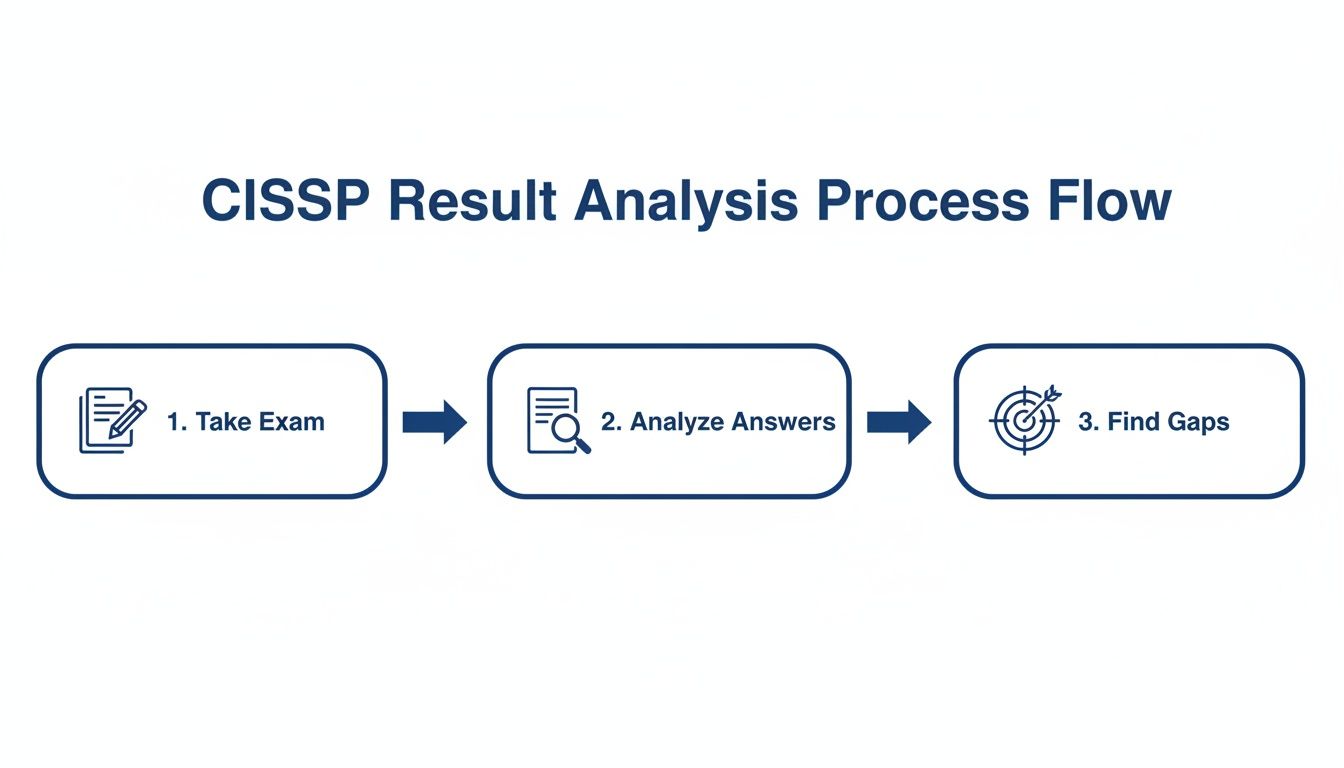
This flowchart encapsulates the core concept of effective exam preparation: rigorously test your current knowledge, deeply analyze where and why you faltered, and then systematically address those identified gaps.
From Analysis to Action With Spaced Repetition
Once you've flagged your weakest CISSP domains, it's time to refine your approach. Go through each incorrect answer and determine the root cause of your mistake. Your errors will typically fall into one of three critical categories:
- Knowledge Gaps: You simply lacked familiarity with a specific term, process, or core concept. This is a direct indicator for focused content review.
- Misinterpretation Errors: You understood the underlying concepts but were tripped up by the intricate wording of the question, failing to grasp what was truly being asked. This requires practice in critical reading and scenario analysis.
- Best-Answer Traps: The classic CISSP conundrum. You identified an answer that was technically correct, but it wasn't the most correct or most appropriate choice from a high-level, managerial perspective. This is where the "think like a manager" mindset is forged.
This level of detailed analysis provides the perfect fuel for a powerful and scientifically proven study technique: Spaced Repetition. Instead of passively re-reading entire chapters, you create targeted flashcards (digital or physical) focusing only on the specific concepts you answered incorrectly or struggled with. You'll review these concepts frequently initially, then gradually extend the intervals between review sessions as they transition from your short-term to your long-term memory. This method is a game-changer for maximizing study efficiency, applicable whether you're studying for CISSP, PMP, AWS, or Azure certifications.
Carving Out Your Adaptive Learning Path
Your comprehensive results analysis effectively constructs a personalized, adaptive learning path tailored specifically for you. For instance, if you consistently stumbled on questions related to Business Continuity Planning (BCP), you can create a focused "sprint" on that particular topic. Dedicate an entire study session to BCP—watch a few deep-dive videos, meticulously re-read the relevant sections in your official study guide, and then seek out BCP-specific mini-quizzes. This highly targeted approach ensures you are actively remediating your weaknesses, rather than passively reviewing material you already understand.
Think of your mock exam results not as a final grade, but as a personalized treasure map. It leads you directly to the precise knowledge gaps you need to fill. Follow it diligently, and you'll ensure every minute of your study time is invested in what truly matters for passing the CISSP.
This level of strategic preparation is what differentiates passing candidates from others, and it's a critical skill that translates directly into commanding the high salaries associated with this prestigious certification. CISSP holders are exceptionally well-compensated; market projections for 2025 indicate average base pay reaching $143,708, with total compensation for roles like Information Security Manager climbing to $175,583.
Utilizing your mock exam results in this intelligent manner isn't just about passing an exam; it's about building a robust, adaptive foundation for your entire cybersecurity career. To visualize where the CISSP fits into your broader professional journey, explore our comprehensive cyber security certification roadmap.
Got Questions About the CISSP Exam? We've Got Answers.
Navigating the intricate world of CISSP certification for the first time can undoubtedly feel overwhelming, and it's perfectly normal to have a multitude of questions. Obtaining clear, authoritative answers about the exam's mechanics and optimal study strategies can significantly boost your confidence. Let's delve into some of the most frequently asked questions from professionals preparing for this formidable examination.
How Is The Real CISSP Exam Scored?
Firstly, it's crucial to discard the notion of simple percentages. The CISSP employs a sophisticated scaled scoring system, requiring you to achieve 700 out of a possible 1000 points to pass. However, this is more complex than simply getting a certain number of questions correct.
The exam is a Computerized Adaptive Test (CAT). This means the testing engine dynamically adjusts to your performance. Answer a question correctly, and the subsequent question will likely be more challenging. Struggle with a question, and the system might present a slightly easier one next. The overarching objective of the CAT algorithm is to efficiently and precisely ascertain if you possess a sufficient understanding of the concepts across all eight CISSP domains. This adaptive nature is precisely why rote memorization is insufficient; you must truly comprehend and be able to apply the material comprehensively.
How Many Practice Exams Should I Take?
There isn't a single magical number here, but a robust strategy typically involves planning for at least three to four full-length, timed CISSP practice exams. Crucially, avoid simply rushing through them; treat each one as a critical checkpoint and a profound learning opportunity.
Here’s a recommended structure for your practice exam regimen:
- The First One (Your Baseline Diagnostic): Take this early in your study journey, before you've delved too deeply into extensive review. It serves as a raw diagnostic, revealing your natural strengths and, more importantly, your inherent knowledge gaps.
- The Middle Ones (Progress Checks): After you've invested significant time in focused study, utilize one or two additional exams to gauge your improvement. Are your previously weak areas becoming stronger? Are new vulnerabilities emerging?
- The Final One (The Dress Rehearsal): Approximately one to two weeks prior to your actual exam date, take your last practice test. This is solely about meticulously simulating the real testing environment, refining your time management, and solidifying that crucial last bit of confidence.
The real secret to success isn't solely how many CISSP sample tests you complete, but rather the depth of your post-exam analysis. I would rather see a candidate take one CISSP sample exam and dedicate hours to meticulously reviewing every single answer—whether correct or incorrect—than someone who superficially rushes through five tests merely to obtain a score. Understanding the why is everything.
What Are The Most Challenging CISSP Domains?
The perception of "challenging" CISSP domains is highly subjective and largely dependent on your individual professional background. Your career experience will significantly influence which areas you find intuitively easy or particularly difficult.
It's a common observation that deeply technical professionals—such as network engineers or system administrators—often find themselves struggling with Domain 1 (Security and Risk Management). This domain can feel counterintuitive because it necessitates removing your technical hat and adopting a high-level, business-oriented manager's perspective, prioritizing strategic business risk above purely technical solutions.
Conversely, if your background is primarily in GRC or project management (e.g., from an ITIL or PMP context), you might find the intricate technical details within Domain 3 (Security Architecture and Engineering) and Domain 4 (Communication and Network Security) to be particularly challenging. The only definitive way to identify your specific challenging domains is to undergo a thorough diagnostic practice exam and allow the results to accurately guide your study efforts.
Can I Pass The CISSP With Self-Study Alone?
Absolutely, you can. Every year, countless dedicated professionals successfully pass the CISSP solely through self-study. The efficacy of a self-study plan does not hinge on the presence of a live instructor, but rather on the uncompromising quality and strategic utilization of the resources you choose.
A highly effective self-study formula typically integrates a diverse mix of superior materials: official (ISC)² study guides, reputable video courses to clarify complex topics, and a top-tier CISSP practice exam platform. When your chosen tools provide detailed feedback and lucid explanations, you can transform a generic study schedule into a highly focused, adaptive, and ultimately successful campaign to conquer the exam.
Ready to precisely assess your current standing and build a meticulously tailored study plan that genuinely delivers results? MindMesh Academy offers adaptive learning paths and in-depth practice exams specifically engineered to help you master every CISSP domain. Start your journey to certification today and elevate your cybersecurity expertise.

Written by
Alvin Varughese
Founder, MindMesh Academy
Alvin Varughese is the founder of MindMesh Academy and holds 15 professional certifications including AWS Solutions Architect Professional, Azure DevOps Engineer Expert, and ITIL 4. He's held senior engineering and architecture roles at Humana (Fortune 50) and GE Appliances. He built MindMesh Academy to share the study methods and first-principles approach that helped him pass each exam.