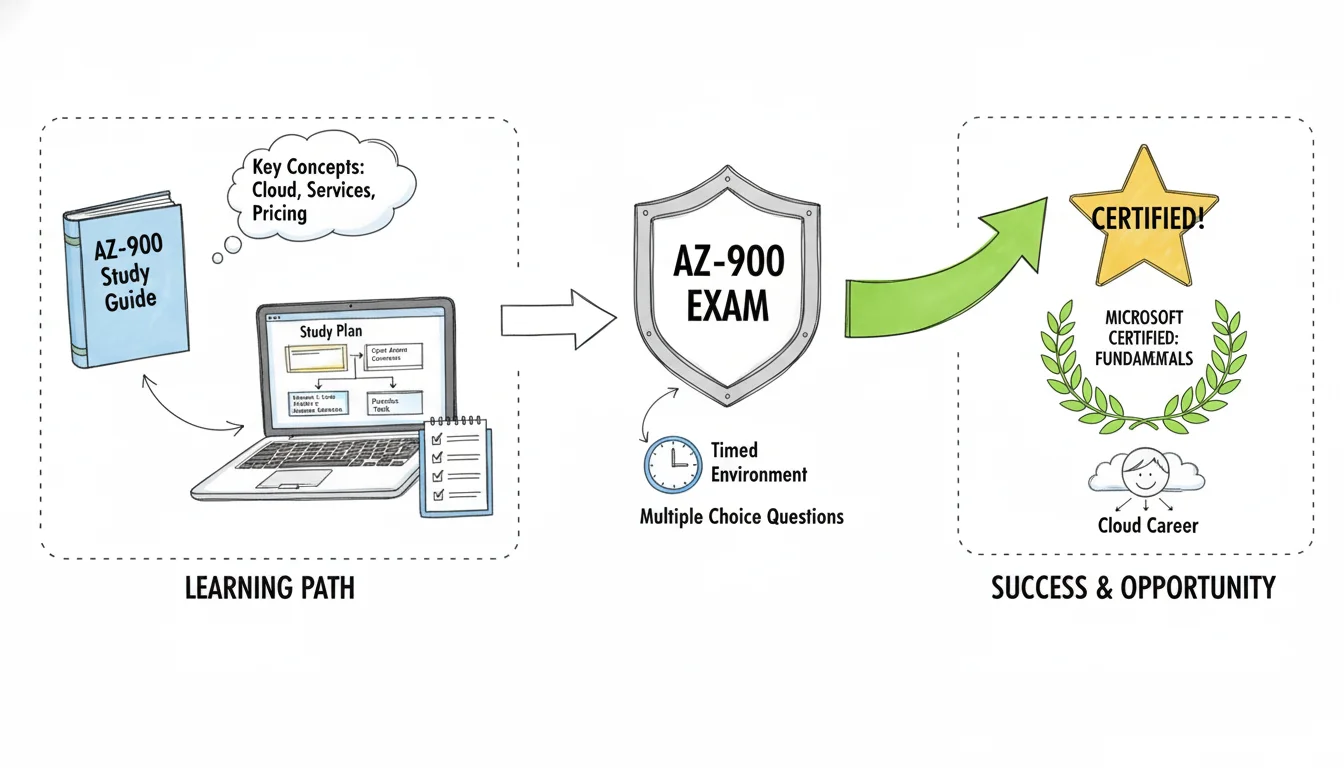
Your AZ 900 Practice Exam Guide to Success
Your Strategic Guide to Acing the AZ-900 with Practice Exams
For IT professionals eyeing a Microsoft Azure Fundamentals (AZ-900) certification, a practice exam isn't just a test run—it's an indispensable strategic asset. Far more than a simple quiz, it’s a powerful simulation tool designed to replicate the nuances of the actual certification test. Utilizing practice exams effectively is the crucial differentiator between merely hoping for success and confidently walking into your exam prepared to excel. This guide will reveal how to leverage these tools to pinpoint weaknesses, optimize time management, and master Microsoft's question style long before your exam date.
How to Strategically Utilize Practice Exams to Master Azure Fundamentals
Simply taking a practice test once or twice offers minimal benefit. The true educational power emerges when you treat it as a diagnostic instrument. Instead of viewing it as a pass/fail assessment, interpret it as a personalized blueprint of your Azure knowledge. It will clearly delineate your areas of expertise and, more critically, illuminate the topics demanding your dedicated focus.
This diagnostic approach fundamentally transforms your study methodology. Rather than passively reviewing documentation, you are compelled to actively apply learned concepts to problem-solving—a skill precisely what the real AZ-900 exam mandates. You'll develop an intuitive understanding of the exam's pace and learn to deconstruct Microsoft's specific question phrasing.
Reflection Prompt: Consider your past study experiences. Have you ever used a practice exam purely for diagnosis rather than just a score? How might this approach shift your current study habits?
Pinpoint and Rectify Your Knowledge Gaps
The primary function of a high-quality practice exam is to expose your areas of vulnerability. Perhaps you confidently navigated questions on Core Azure Services but found yourself grappling with topics related to Security, Compliance, and Trust. This specific feedback is invaluable. It enables you to construct a laser-focused study plan, eliminating the inefficiency of rereading an entire syllabus when only specific sections require attention.
Any reputable AZ-900 practice test should furnish a score breakdown aligned with the official exam domains. This data is the foundation for intelligent study.
MindMesh Academy Insight: A common misstep among certification candidates is an undue focus on the overall score. While a composite score provides a snapshot, the profound value resides in the domain-by-domain performance breakdown. For example, if your score in "Azure Pricing and Support" is significantly lower than other sections, this isn't just a number; it's a direct directive to dedicate your subsequent study sessions to mastering that particular domain. This targeted approach is key to achieving the necessary 700 out of 1000 passing score.
Deciphering Exam Priorities: What the AZ-900 Truly Values
To maximize the efficacy of practice tests, it's essential to comprehend the inherent priorities of the AZ-900 exam. Not all topics carry equal weight. Some domains contribute a greater percentage of points, thus exerting a more significant influence on your pass-fail outcome.
The following infographic illustrates the proportional weighting of each section within the AZ-900 exam.
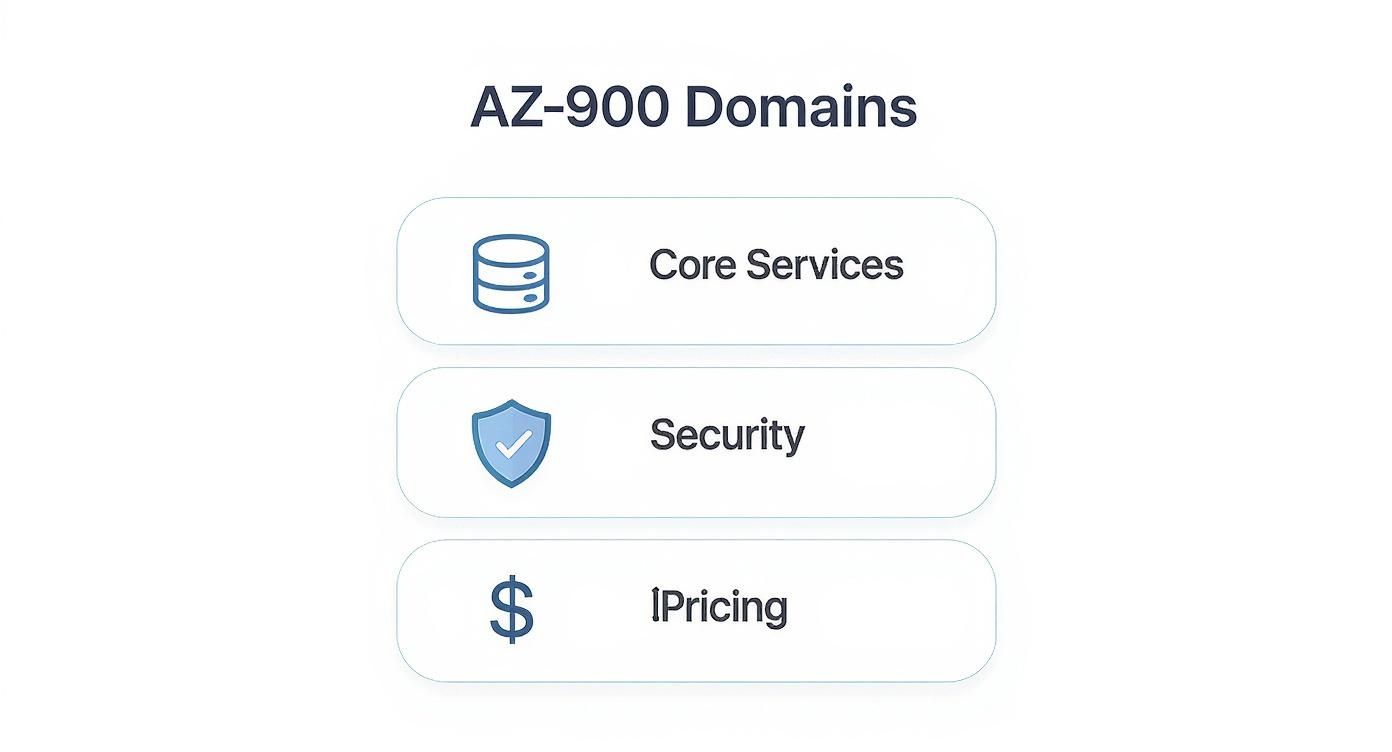 An infographic illustrating the percentage weight of each domain in the AZ-900 exam.
As evident, Core Azure Services and the security-related topics are the most heavily weighted. Achieving proficiency in these sections is paramount for building confidence and securing a passing score.
The official exam domains are strategically weighted to ensure candidates possess a comprehensive and balanced understanding of Azure's foundational elements. Here’s a detailed breakdown:
Official AZ-900 Exam Domain Weighting
| Exam Domain | Percentage Weight |
|---|---|
| Cloud Concepts | 15-20% |
| Core Azure Services | 30-35% |
| Security, Compliance, and Trust | 25-30% |
| Azure Pricing and Support | 20-25% |
Given that a score of 700 out of 1000 is required to pass, this table precisely indicates where those critical points originate. By aligning your study time with these percentages, you intelligently allocate your energy to areas that will yield the greatest impact on your final score. A superior AZ-900 practice exam from MindMesh Academy is meticulously structured to mirror this official breakdown, providing the most realistic preparation available.
Identifying High-Quality Practice Exam Resources
 An IT professional carefully evaluating study resources on multiple screens, highlighting the importance of selection.
When seeking AZ-900 practice exams, a simple online search will yield numerous options. This necessitates a discerning approach. Selecting the correct resource is among the most pivotal decisions within your study regimen.
An inappropriate choice can lead to a false sense of preparedness or, worse, impart inaccurate information. Conversely, a high-quality practice exam serves as your essential training partner, meticulously preparing you for the rigor of the actual certification test.
My primary criterion for selection is always recency. Azure's ecosystem evolves rapidly, and Microsoft regularly updates its exams to reflect these changes. A practice test from a couple of years ago is effectively a historical artifact, not a current exam preparation tool. Prioritize providers who explicitly state that their materials are updated to align with the latest official exam blueprint.
Navigating Free vs. Paid Options
This presents a classic dilemma for IT professionals: should one opt for free resources or invest in paid alternatives? Free practice tests can be beneficial for a preliminary self-assessment, but they frequently come with significant limitations. Many contain outdated questions, lack comprehensive explanations, or offer a level of difficulty that is substantially lower than the actual exam.
Experience has shown that investing in a reputable, paid AZ-900 practice exam almost invariably proves to be a superior decision. You're not merely purchasing a set of questions; you're acquiring a complete learning experience replete with features genuinely designed for improvement.
From a premium resource, you should anticipate:
- Detailed Explanations: It's insufficient to merely know you answered incorrectly. A robust platform elucidates why an answer is wrong and, more crucially, justifies why the correct option is the optimal choice. This pedagogical approach transforms errors into profound learning opportunities, applicable across various certifications like AWS Cloud Practitioner or ITIL Foundation.
- Varied Question Formats: The AZ-900 is not exclusively a multiple-choice examination. You will encounter drag-and-drop scenarios, case studies, and multiple-select questions. Your chosen practice materials must accurately replicate this diversity to ensure holistic preparation.
- Realistic Simulation: A robust practice exam accurately mimics the real test's duration, user interface, and overall difficulty. This cultivates the mental endurance and familiarity required on exam day, reducing anxiety and improving performance.
Key Takeaway: While free resources can serve as a decent supplement, a single high-quality paid exam typically delivers a significantly greater return on investment. The granular analytics and accurate difficulty calibration are the true catalysts for readiness under the pressure of a professional testing environment.
Hallmarks of a Trustworthy Practice Exam Provider
How does one distinguish a reliable provider? Trustworthy providers are characterized by transparency. They should clearly articulate their content development process and explicitly demonstrate how their questions align with the official Microsoft exam domains.
Another critical indicator is comprehensive performance tracking. The most effective platforms offer more than just a final score. They provide a detailed breakdown of your performance across each category, such as "Describe Cloud Concepts" or "Describe Azure Pricing and Support." This data is invaluable, pinpointing precisely where to allocate your subsequent study efforts. For a deeper understanding of what constitutes a top-tier resource, explore this guide on using AZ-900 practice exams for success.
Identifying Red Flags to Avoid
Just as there are indicators of quality, certain red flags should prompt immediate caution. If any of these are present, it is advisable to seek alternative resources.
Common Red Flags:
- "Guaranteed Pass" Claims: This is a major warning. No legitimate provider can guarantee a passing score. Such promises indicate a focus on aggressive marketing over educational quality.
- Vague or Absent Explanations: If a test merely reveals the correct answer without any contextual explanation, it offers limited learning value. The objective is conceptual understanding, not rote memorization.
- Prevalent Typos and Grammatical Errors: While minor errors can occur, a resource riddled with them suggests a lack of professionalism and raises concerns about the accuracy and reliability of its technical content.
- "Brain Dumps": Immediately avoid any site purporting to possess the exact questions from the real exam. Using such materials is unethical, violates exam integrity agreements, and is an ineffective study method—it fosters memorization rather than genuine comprehension.
Selecting the appropriate AZ-900 practice exam involves identifying a tool that challenges you, educates you, and provides a realistic preview of the actual test environment. Focus on up-to-date content, comprehensive feedback, and a variety of question types to build authentic confidence and competence.
Constructing Your Personal Practice Exam Strategy
Do not simply initiate your first AZ-900 practice exam without a predefined strategy. Approaching it haphazardly is a missed opportunity. The objective is not a flawless score; it is to gain an honest, unvarnished appraisal of your current knowledge. Frame this initial attempt as a diagnostic—its purpose is to map your strengths and, crucially, to brightly illuminate your areas for improvement.
Treat this inaugural attempt as if it were the actual exam. This entails configuring your environment to replicate a professional testing center. Locate a quiet space free from interruptions. Seriously, sequester your phone in another room, close all extraneous browser tabs, and inform those around you that you require uninterrupted concentration.
The fundamental aim is to eliminate distractions, ensuring your score accurately reflects your grasp of Azure concepts, rather than your ability to filter external noise.
Mastering the Real Exam Clock
Effective time management is not a skill one can improvise on exam day; it is a discipline that must be cultivated. The official AZ-900 typically allocates approximately 60 minutes for 40-60 questions. A quick calculation reveals that protracted deliberation on individual questions is not an option.
For your initial practice run, set a timer and adhere to it rigorously.
If a question presents a significant challenge, allocate a maximum of one minute. Most effective practice exam platforms incorporate a "flag for review" feature, which you should leverage extensively. Make your best educated guess, flag the question, and proceed. Maintaining momentum is often more critical than wrestling indefinitely with a single difficult question. This practice cultivates the mental agility necessary to complete the entire exam within the allotted time.
Strategic Guidance: Your objective during this initial attempt is data acquisition, not performance validation. Flagging every question you harbor even a slight uncertainty about provides a rich trove of information for your subsequent review. It is significantly more advantageous to flag ten questions and complete the exam on time than to become bogged down and leave a substantial portion unanswered.
Cultivating Focus Under Pressure
Sustaining intense concentration for a full hour, particularly with dense technical material, is challenging. This is where mental preparation plays a pivotal role. As you formulate your exam strategy, consider integrating proven strategies to focus effectively while studying to enhance your outcomes. Even a simple technique like taking a few deep, centering breaths before commencing can yield substantial benefits.
Perceive this practice session as a controlled experiment, rather than a high-stakes performance. This cognitive reframing can diminish anxiety and foster clearer thinking. It is a skill you will refine with each successive practice test.
Here are actionable tips to implement immediately:
- Read Every Question Meticulously. This seems elementary, yet misinterpreting a question is an infuriatingly common error. The first pass is for general comprehension; the second is to identify critical keywords such as "NOT" or "BEST."
- Employ the Process of Elimination. For multiple-choice questions, immediately discard options you definitively know are incorrect. This significantly improves your probability of selecting the right answer, even when absolute certainty is lacking.
- Trust Your Initial Instinct. If you feel confident about an answer, rely on that initial intuition. Overthinking is a classic pitfall that often leads to altering a correct answer to an incorrect one. Adhere to your first choice unless a concrete, logical reason dictates a change.
By adopting this structured methodology, your initial AZ-900 practice exam transcends a mere quiz—it becomes a potent diagnostic instrument. You are not just answering questions; you are actively developing the mindset and endurance essential to approach the actual exam with preparedness and confidence. This baseline assessment forms the bedrock of an intelligent, targeted study plan.
Transforming Your Results into a Targeted Study Plan
Completing your initial AZ-900 practice exam marks a significant milestone, but the true work commences the moment you conclude it. That final score is merely a numerical representation. The genuine insight is embedded within the granular details of your responses—both correct and incorrect. This is the pivotal moment where you transition from merely assessing your knowledge to actively enhancing your skills with a precisely targeted study plan.
The objective here extends beyond identifying errors; it is to deeply analyze and comprehend why those errors occurred. This is the critical step differentiating individuals who achieve consistent improvement from those who remain stagnant, repeating the same test with perpetually frustrating outcomes. Envision your results as a personalized roadmap, directly highlighting the areas demanding your concentrated attention.
Deconstructing Your Performance by Domain
Any reputable practice exam will segment your score by the official Microsoft domains: Cloud Concepts, Core Azure Services, Security, Compliance, & Trust, and Azure Pricing & Support. This breakdown represents your initial and most crucial piece of feedback. For a moment, disregard the overall percentage and direct your focus to these individual domain scores.
So, you achieved an impressive 90% in Core Azure Services but a less confident 55% in Azure Pricing and Support? Excellent. You have just precisely identified where your study time will generate the greatest impact. This is a far more effective strategy than a vague intention to simply "study more Azure."
Reflection Prompt: Review your most recent practice exam results (or imagine them). Which domain showed the most significant difference between your best and worst performance? How does this data immediately redirect your study focus?
Expert Tip: Do not limit your review to only the questions you answered incorrectly. Scrutinize any questions you flagged during the exam but ultimately answered correctly. These often represent fortunate guesses, and that tenuous understanding could easily lead to an error on the actual exam. This is especially true for certifications like PMP, where situational questions can be deceptively tricky.
Performing a Root Cause Analysis on Incorrect Answers
Once your weakest domains are identified, it's time to meticulously examine each individual question you missed. For every incorrect response, pose a fundamental question: "Why did I get this wrong?" The underlying reason almost invariably falls into one of these distinct categories:
- Knowledge Gap: You lacked the foundational understanding of the concept. Perhaps you were unfamiliar with Azure Policy, or the distinction between CapEx and OpEx remained unclear. This indicates a need for core learning.
- Misinterpretation: You understood the topic but failed to accurately grasp the question's intent. This is common with artfully worded questions, particularly those employing negative phrasing such as "Which of the following is NOT..." or requiring "BEST" vs. "LEAST" solutions. This points to a need for improving question deconstruction skills.
- Careless Error: You possessed the correct answer but selected the wrong option due to haste, misread a critical detail, or overlooked a key constraint. This category highlights issues with pacing, focus, or exam mechanics, rather than a lack of subject matter knowledge.
Categorizing your errors in this manner is exceptionally powerful. It dictates whether you need to return to fundamental learning (a knowledge gap), refine your test-taking technique (misinterpretation), or improve your focus and pacing (careless errors). This granular analysis is crucial for all certifications, from the AZ-900 to more advanced AWS or CompTIA exams.
Developing Your Actionable Study Checklist
Now, translate that comprehensive analysis into a concrete, actionable checklist. This document will become your dynamic guide, dictating your study priorities between now and your next AZ-900 practice exam.
Your checklist items must be highly specific. A vague objective like "Study Azure Security" is ineffective. Instead, a well-formed item should resemble: "Review the purpose and use cases for Azure Active Directory, Azure Defender for Cloud, and Network Security Groups (NSGs) including their practical application scenarios." Observe the distinction? This specificity transforms a broad weakness into a series of manageable, achievable tasks.
To facilitate your process, we’ve structured a simple framework for reviewing your results. Utilize this table to dissect your performance and construct a study plan that genuinely yields improvements.
Your Practice Exam Analysis Framework
Use this structured approach to review your practice exam results and create a targeted study plan that addresses your specific weaknesses.
| Analysis Step | Action to Take | Outcome |
|---|---|---|
| Identify Weakest Domain | From your practice exam report, pinpoint the domain with the lowest score. | Your highest-priority area for focused study. |
| Categorize Wrong Answers | For each incorrect question, label the error as a Knowledge Gap, Misinterpretation, or Careless Error. | A clear understanding of why mistakes are occurring. |
| Create Specific Tasks | For every Knowledge Gap identified, formulate a precise checklist item to research and master that specific Azure service or concept. | A targeted, actionable list of topics to master. |
| Refine Your Technique | If misinterpretation errors are frequent, add a task to practice methodical question reading and keyword identification. | Improved test-taking skills, leading to enhanced accuracy. |
This structured process elevates your practice test results from a mere score to an intelligent, personalized guide. It ensures that every minute you allocate to studying is precisely focused where it will exert the greatest positive influence on your exam day performance.
Attaining the Microsoft Certified: Azure Fundamentals (AZ-900) credential is an outstanding foundational step for a cloud computing career. By mastering this analytical process now, you are not merely preparing for a single exam; you are cultivating a transferable skill applicable to every future certification journey.
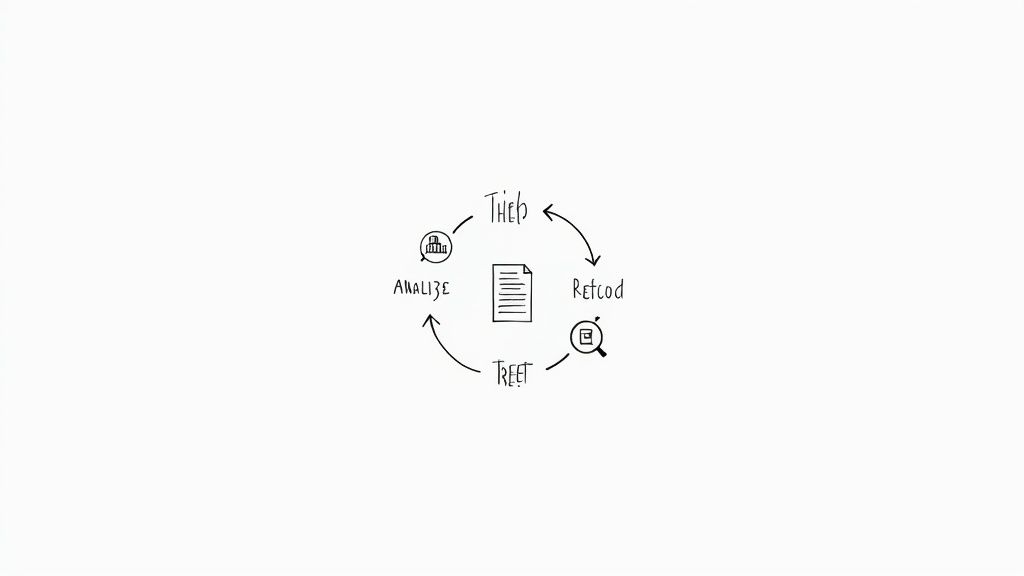
The Study Loop: Your Secret Weapon for AZ-900 Success
 A visual representation of the continuous study loop: Test, Analyze, Study, Repeat, fostering iterative improvement.
Here's an undeniable truth about preparing for the AZ-900: last-minute cramming is ineffective. Genuine mastery is forged through consistent, incremental progress, and the most effective method for achieving this is by instituting a structured study loop.
This isn't about indiscriminately taking tests. It's a deliberate, iterative cycle: you complete a full-length AZ-900 practice exam, meticulously analyze your results, laser-focus your study on identified weaknesses, and then repeat the entire process. With each iteration of this loop, you're not just memorizing facts; you're constructing a robust understanding and the intrinsic confidence that accompanies it. This mirrors agile development cycles in IT, where continuous feedback drives improvement.
Establishing Your Study Rhythm
A common pitfall is to rapidly consume practice exams one after another. This approach invariably leads to burnout. Worse, it encourages memorization of questions rather than deep comprehension of concepts. This constitutes a fragile strategy that will inevitably collapse if the actual exam presents a concept in slightly different phrasing.
So, what is the optimal cadence?
- Set Your Baseline: Undertake your very first practice exam early in your study journey, even before you feel entirely "ready." This establishes your initial performance benchmark.
- Intensive Study: Following that initial assessment, set aside the practice tests. Dedicate a focused period of 7-10 days to intensive study, directly addressing the weaknesses identified by your baseline test.
- Assess Progress: After this concentrated study block, take a second practice exam. You should observe a discernible improvement in your score, validating your targeted efforts.
- Final Phase: In the two weeks leading up to your exam date, you can incrementally increase the frequency to one practice test every 3-4 days. This builds mental stamina and enhances your comfort with time constraints, simulating the real exam environment.
This structured rhythm provides your brain with the necessary time to assimilate and interconnect concepts. This entire process seamlessly integrates with proven learning techniques like spaced repetition, which is founded on reinforcing knowledge over extended periods. For a deeper dive into this powerful method, you can learn how to master spaced repetition for studying.
Analogy for IT Pros: Consider this process akin to a software development lifecycle. You don't continuously push code without testing and refactoring. You develop, test, identify bugs, fix them, and then re-test. Your brain, much like a complex system, requires these "debug cycles" to grow stronger and solidify its knowledge base.
Tracking Your Achievements, Both Large and Small
It is crucial to have tangible evidence that your diligent effort is yielding results. Resist the urge to merely glance at your overall score and move on.
Utilize a notebook or a simple spreadsheet to meticulously track your scores for each exam domain across multiple practice tests. It is incredibly motivating to witness your "Azure Pricing and Support" score progressively climb from a tentative 60% to a confident 85% over several weeks. This isn't just an anecdotal feeling; it's hard data unequivocally demonstrating the effectiveness of your study strategy.
Recognizing When to Diversify Your Resources
After completing two or three practice exams from the same provider, you will likely develop a degree of familiarity with their specific question style and phrasing. This familiarity serves as a clear signal for a change.
Deliberately transitioning to a different provider for your subsequent AZ-900 practice exam is a shrewd strategic maneuver. It compels you out of your comfort zone by exposing you to novel ways of formulating questions about the same core topics—precisely what the real exam will do. This ensures you are not merely becoming proficient in one particular test format, but that you genuinely comprehend the underlying material thoroughly.
This methodical loop of testing, analyzing, studying, and repeating is the fundamental secret separating those who pass from those who do not. You will enter the testing center not merely hoping for readiness, but armed with the data-backed confidence that you are truly prepared.
Common Questions About AZ-900 Practice Exams
 An individual pondering common questions about the AZ-900 exam, a typical scenario for certification candidates.
As you integrate practice exams into your comprehensive study plan, it's natural to encounter several questions. These queries consistently emerge from professionals preparing for the AZ-900 and other foundational certifications like CompTIA A+ or ITIL.
Addressing these common concerns upfront will empower you to study more intelligently, foster greater confidence, and ensure you extract maximum value from these exceptionally useful tools. Let’s delve into the most frequently asked questions regarding the AZ-900 practice exam.
How Many Practice Exams Should I Take?
This is arguably the most prevalent question. While there isn't a singular magic number, a robust approach involves completing 3-5 full-length practice exams sourced from at least two distinct providers.
Consider your initial attempt as a diagnostic. Take it without prior intensive study to establish your baseline and identify immediate weaknesses. Your subsequent exams then serve as progress markers after you’ve dedicated quality time to reinforcing those weaker areas.
The true efficacy lies in variety. Relying solely on one source is a strategic error, as you will become proficient only in their particular question style. By utilizing multiple providers, you expose yourself to diverse approaches to the same core topics, which is crucial for cultivating a genuine and adaptable understanding. Your ultimate objective is not merely to pass a single practice test, but to consistently achieve scores significantly above the 700-point passing threshold on tests you have not previously encountered.
Cautionary Note: Avoid the trap of simply churning through ten exams from the same provider. Beyond the fourth or fifth attempt, you are no longer truly assessing your Azure knowledge; you are merely testing your short-term memory of their specific question bank. This leads to a false sense of security.
Are Free Practice Exams Sufficient for Passing?
Free practice tests are excellent for an initial, quick validation of your existing knowledge, but relying on them as your exclusive preparation strategy is a substantial risk. Candidly, they often harbor significant deficiencies.
You'll frequently find that many free resources feature outdated questions, provide zero explanation for why an answer is correct, or are considerably less challenging than the actual exam. This last point is the most perilous—it can instill a misleading sense of confidence that tragically crumbles on exam day.
My professional recommendation? Utilize free tests as a complementary resource, but unequivocally invest in at least one high-quality, paid practice exam provider. The detailed answer explanations, realistic exam simulation, and granular performance tracking offer a return on investment that far outweighs their cost. It is a prudent investment in your professional career trajectory.
What if My Practice Scores Are Not Improving?
Encountering a plateau is undoubtedly frustrating, yet it also serves as a critical signal. It indicates that your current study methodology has ceased to be effective. The solution is not to simply take more tests. This is analogous to repeatedly striking the same nail with a hammer and expecting it to drive straight when it's already bent.
When your scores stagnate, you must pause and conduct a deep, analytical review of your results.
- Are you consistently struggling with questions within a particular domain, such as Azure Security or Pricing and Support?
- Do specific question formats consistently trip you up? For instance, do you struggle with case studies, drag-and-drop, or scenario-based questions?
If you identify a persistent pattern, that is your cue to revert to primary source materials. Re-read the official Microsoft Learn documentation, consult official Azure architectural guides, or watch in-depth training videos specifically addressing those problematic topics. A stagnant score almost invariably signifies an underlying core concept that has not been truly assimilated.
How Closely Do Practice Scores Correlate to the Real Exam?
A top-tier practice exam serves as an excellent barometer of your readiness, but it should not be expected to predict your final score with absolute precision. Its core function is to rigorously test your knowledge under pressure and to refine your time management capabilities.
Here’s a practical guideline I share with my students: if you consistently achieve scores in the 85-90% range on high-quality practice tests, you are exceptionally well-positioned to pass the real exam, which necessitates a 700/1000 (70%) score.
However, avoid becoming fixated on that specific number. Instead, concentrate on the process. Meticulously investigate the "why" behind every single question you answer incorrectly. If you diligently apply this analytical approach, achieving a passing score on the actual certification will, almost inevitably, follow.
Ready to cultivate the skills and confidence required to excel in your certification journey? MindMesh Academy offers expertly curated study materials and practice exams meticulously designed to help you master Azure concepts, fostering true comprehension, not mere memorization. Start your journey to certification success today.
Ready to Get Certified?
Prepare with expert-curated study guides, practice exams, and spaced repetition flashcards at MindMesh Academy:

Written by
Alvin Varughese
Founder, MindMesh Academy
Alvin Varughese is the founder of MindMesh Academy and holds 15 professional certifications including AWS Solutions Architect Professional, Azure DevOps Engineer Expert, and ITIL 4. He's held senior engineering and architecture roles at Humana (Fortune 50) and GE Appliances. He built MindMesh Academy to share the study methods and first-principles approach that helped him pass each exam.