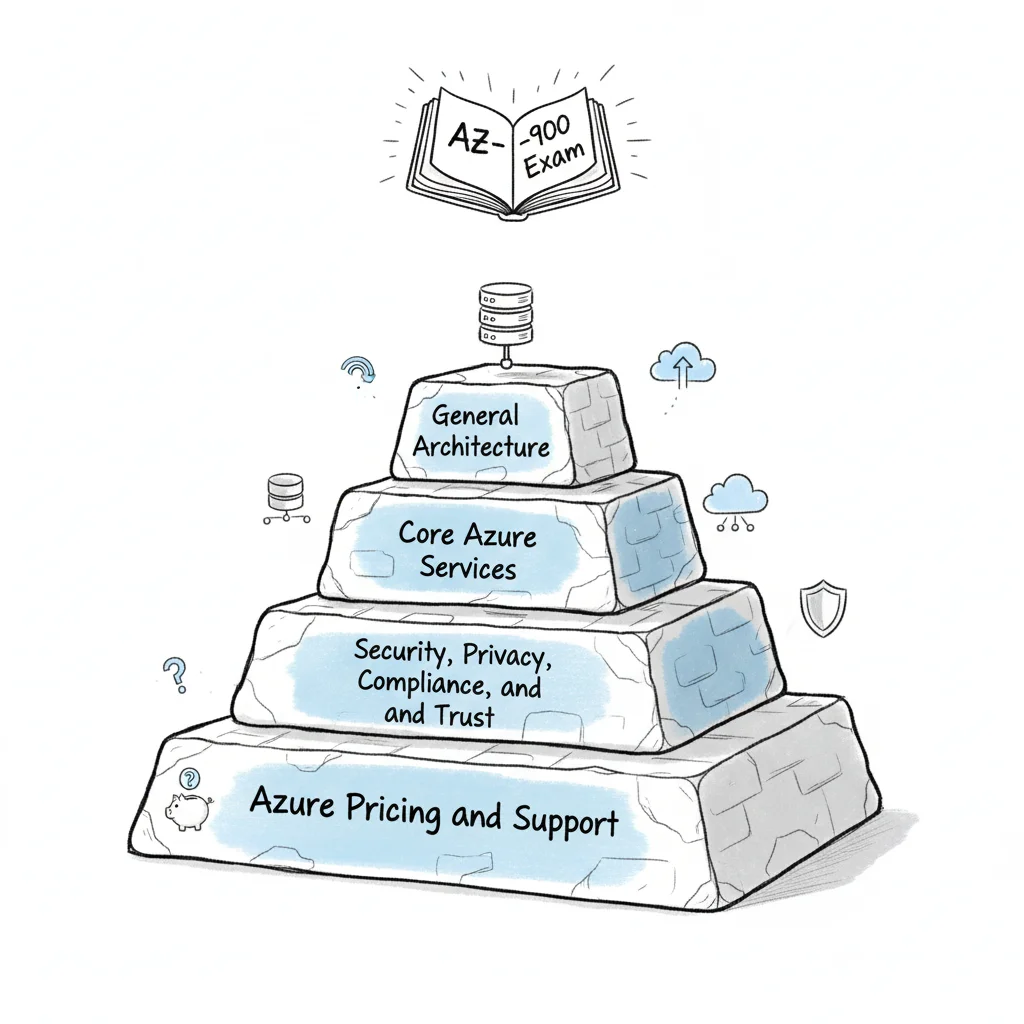
AZ-900 Guide: Pass the Azure AZ-900 Exam Easily
Your Expert Guide to Acing the Azure AZ-900 Certification: Cloud Fundamentals for IT Pros
So, you're contemplating the Microsoft Azure Fundamentals AZ-900 certification? That's an excellent strategic move for any IT professional, student, or even business stakeholder looking to solidify their understanding of cloud computing. Think of this guide from MindMesh Academy as your essential roadmap, meticulously crafted to equip you with the knowledge and confidence to not only pass but truly understand the foundational concepts of Azure.
Whether you're an experienced IT professional pivoting to cloud technologies, a project manager needing to speak the language of cloud with your teams, or a student charting a course in a new field, we're here to demystify the AZ-900 exam. We'll cover its structure, the types of questions you'll encounter, and the fundamental Azure concepts you absolutely need to master, including core Azure services, security, and pricing.
Your Complete Roadmap to AZ-900 Certification
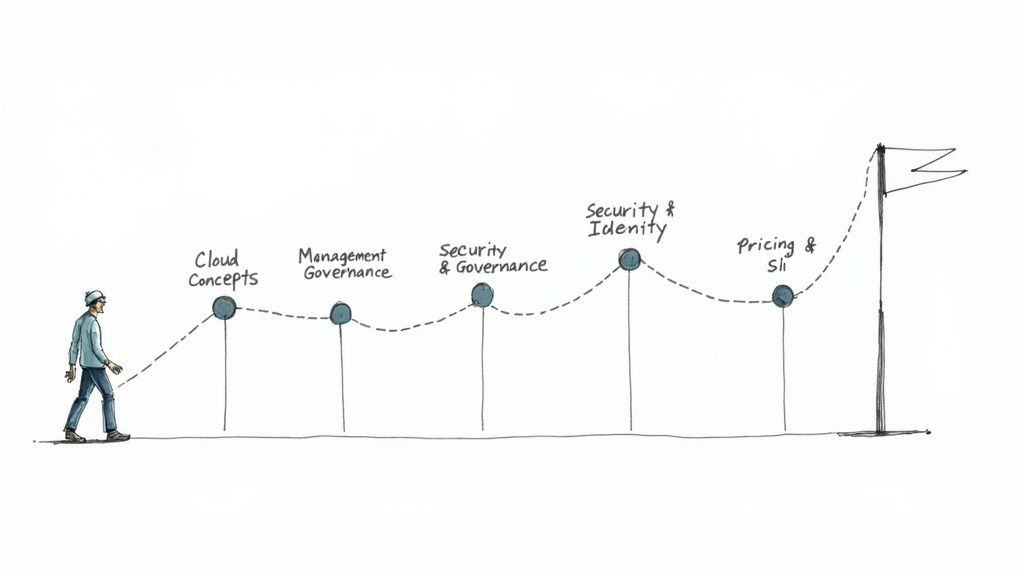 A focused IT professional delves into study materials, leveraging digital tools for their AZ-900 certification journey.
Forget the dry, theoretical approach often found in traditional textbooks. What you need is a practical, step-by-step plan that connects concepts to real-world applications. We'll guide you through everything, starting with foundational cloud concepts and progressively delving into the specifics of Azure services, security mechanisms, and cost management via pricing models.
Our goal is to instill in you the confidence and the deep understanding necessary to not just sit the exam, but to pass it decisively. This is your crucial first step into the expansive world of Microsoft Azure, and we're dedicated to making it a successful one.
AZ-900 Exam at a Glance
Before we dive into the specifics, let's get a clear overview of the AZ-900 exam itself. Understanding these key details will help you frame your study plan and manage your expectations.
| Exam Feature | Details |
|---|---|
| Exam Name | Microsoft Azure Fundamentals (AZ-900) |
| Number of Questions | 40-60 questions |
| Time Allotted | 60 minutes |
| Passing Score | 700 / 1000 |
| Question Types | Multiple choice, drag-and-drop, case studies |
| Prerequisites | None |
| Recommended Experience | Basic IT knowledge, but no Azure experience required |
Having these statistics in mind is vital for strategizing your preparation. It's not just about accumulating knowledge; it's also about honing your ability to perform efficiently and accurately under exam conditions.
Understanding the Exam Structure
The AZ-900 is your official introduction to the Azure ecosystem. It's meticulously designed to validate your foundational grasp of core cloud concepts and their practical application within Microsoft Azure. Consider it the essential ground floor for all subsequent, more specialized Azure certifications.
You'll face between 40 and 60 questions and be allotted a tight 60 minutes to complete them. To achieve a passing score, you'll need at least 700 out of a possible 1000 points. While considered an entry-level exam, it demands thoughtful preparation, not just superficial memorization.
To truly internalize the material, it's beneficial to understand how to learn effectively. This isn't about rote memorization; it's about genuine comprehension, enabling you to apply concepts across various scenarios.
Reflection Prompt: How might understanding the specific number of questions and time limit influence your pacing strategy during the actual exam?
Who Should Take This Exam?
The AZ-900 certification caters to a remarkably broad audience. It's an ideal credential for individuals in non-technical roles—such as sales, marketing, or project management—who need to communicate intelligently about cloud solutions with clients and technical teams. For instance, a PMP-certified project manager leading a cloud migration project would significantly benefit from the foundational understanding the AZ-900 provides.
Moreover, it serves as a fantastic starting point for seasoned IT professionals who are new to the cloud paradigm. If you're looking to validate your foundational cloud knowledge before embarking on more specialized Azure certifications (like those for AWS or ITIL professionals transitioning to Azure), this is precisely where your journey should begin.
In essence, if your current role touches cloud technology in any capacity, or if you aspire for it to, the AZ-900 equips you with the essential vocabulary and framework to advance your career with confidence.
Why an AZ-900 Certification Can Kickstart Your Career
Deciding to pursue a certification is a significant commitment, often requiring substantial time and effort. In today's landscape, where cloud skills are paramount, the AZ-900 is far more than just another bullet point on your resume. It serves as a clear, verifiable signal to employers that you possess a fundamental understanding of cloud computing and can effectively engage in discussions about Microsoft Azure.
The sheer scale of Microsoft Azure is undeniable. Its substantial market share isn't merely a statistic; it directly translates into a soaring demand for professionals proficient in navigating the platform. Organizations across virtually every sector—from finance and healthcare to retail and public administration—are increasingly relying on Azure for their core operations. This ubiquitous adoption necessitates a continuous influx of professionals who grasp the fundamental Azure services and principles.
The First Step to Bigger Things
Consider the AZ-900 your indispensable entry ticket. It's the foundational certification that proves you have a solid grasp of cloud concepts and their specific application within Azure. This crucial first step can unlock doors to more specialized and potentially higher-paying roles further down your career path. Think of it similarly to how a CompTIA A+ certification serves as a baseline for IT support, preparing you for deeper dives into networking (like CompTIA Network+) or security.
Once you’ve achieved the AZ-900 certification, you're strategically positioned to pursue more advanced certifications and forge a specialized career path. You could aim for:
- Azure Administrator (AZ-104): Ideal if you aspire to implement, manage, and monitor Azure environments. This is a hands-on role focused on operational excellence.
- Azure Developer Associate (AZ-204): The logical progression for developers keen on building and deploying applications on the cloud.
- Azure Security Engineer (AZ-500): A critical pathway for those dedicated to safeguarding cloud data, applications, and networks from threats.
This structured progression isn't coincidental; it allows you to build your expertise layer by layer, transforming an initial certification into a dynamic career trajectory. Hiring managers highly value this demonstrated commitment to continuous professional development.
Having the AZ-900 on your resume immediately sets you apart in a competitive job market. It provides a distinct competitive edge, verifying that you possess the foundational skills to contribute meaningfully in a cloud-focused role from day one.
Proving You Have In-Demand Skills
The influence of this certification extends globally. Microsoft Azure maintains a dominant position on the world stage, with significant penetration in critical sectors like public administration and finance. Consequently, industry analyses consistently underscore the enduring value of the AZ-900. In fact, some reports predict it will remain one of Microsoft’s most relevant and career-boosting certifications for years to come—even surpassing some more specialized credentials in administration or AI for its foundational impact. You can delve deeper into the value of Azure certifications on datacamp.com.
Ultimately, earning the AZ-900 goes beyond merely acquiring knowledge; it confers immense credibility. It signals to prospective employers your serious commitment to a career in the cloud and provides verifiable proof that you've invested the effort to build a solid, foundational skill set. This initial investment in yourself has the potential to yield substantial dividends for years to come.
Decoding the Core AZ-900 Exam Domains
To maximize your chances of passing the AZ-900 exam, a well-defined strategy is paramount. This strategy begins with a thorough understanding of the exam's content structure. The exam is segmented into several key knowledge areas, or "domains," each contributing a specific percentage to your final score. These domains function as the principal chapters of your study guide; mastering each one is crucial for achieving certification.
We'll dissect these core domains individually, emphasizing the practical knowledge you actually need. Our focus isn't on rote memorization of definitions but on truly understanding the "what" and the "why" behind Azure's most critical concepts and services.
First, let’s examine how Microsoft officially blueprints the exam.
AZ-900 Exam Domain Weighting
Not all topics on the AZ-900 exam are weighted equally. Microsoft provides clear transparency on this, assigning a percentage weight to each domain. This weighting serves as your strategic roadmap, indicating where to allocate your study efforts. A higher percentage suggests a greater number of questions will originate from that topic, making it prudent to adjust your study time accordingly.
Here’s an overview of the current AZ-900 exam blueprint:
| Exam Domain | Percentage Weight |
|---|---|
| Describe Cloud Concepts | 25–30% |
| Describe Azure Architecture and Services | 35–40% |
| Describe Azure Management and Governance | 30–35% |
As evident, Azure Architecture and Services constitutes the largest segment of the exam. However, the other two sections are almost equally substantial. You cannot afford to neglect any domain; a balanced, comprehensive approach is your most effective strategy for success.
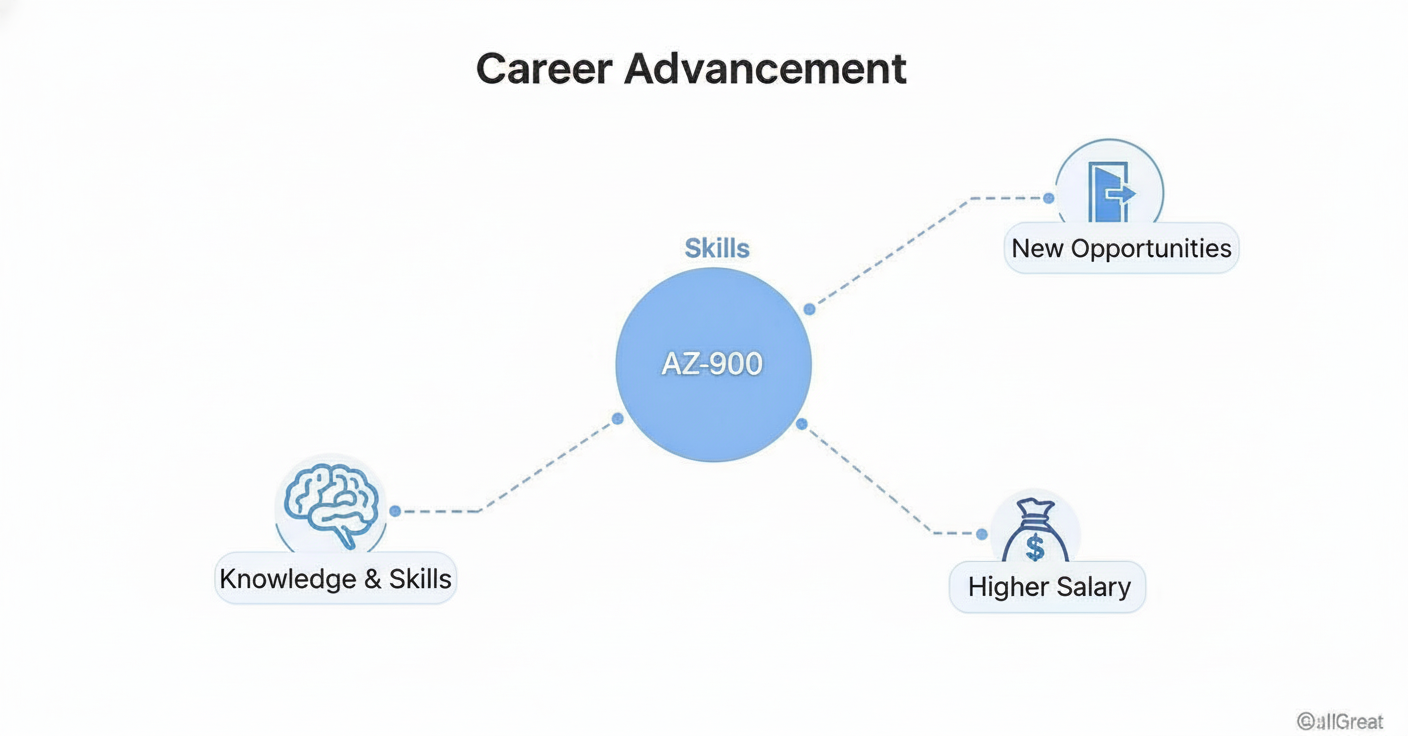 This infographic illustrates how the AZ-900 certification serves as a launchpad, enabling professional growth through enhanced skills, new career opportunities, and increased earning potential.
The bottom line? This certification rigorously validates the foundational cloud knowledge that employers are actively seeking, directly fueling your professional development.
Domain 1: Cloud Concepts
This initial domain is entirely dedicated to the fundamentals of cloud computing. It is absolutely critical because without a firm grasp of these core ideas, the specific Azure services we'll explore later will lack context and practical meaning. Microsoft has consistently increased the emphasis on this area, signaling their desire for all certified individuals to possess a rock-solid theoretical foundation.
Following a significant update in 2025, the weight of the cloud concepts domain increased to 25-30%. The message is unequivocal: understanding the principles of cloud computing is non-negotiable. For those interested in the evolving landscape, numerous expert analyses offer breakdowns of the Azure certification roadmap, highlighting these shifts.
One of the most effective ways to understand the cloud service models is through the popular "pizza as a service" analogy:
- Infrastructure as a Service (IaaS): This is akin to buying the oven, dough, sauce, and cheese yourself. You acquire the raw ingredients (virtual servers, storage, networking components), but you are responsible for assembling, baking, and serving the final pizza. Example: Migrating an on-premises application server to an Azure Virtual Machine, where you manage the OS, runtime, and application.
- Platform as a Service (PaaS): Think of this as ordering a take-and-bake pizza. The provider furnishes a ready-made platform—the prepared pizza—and you merely handle the final cooking. You manage your application code and data, not the underlying hardware, operating system, or infrastructure. Example: Deploying a web application to Azure App Service, focusing solely on your code while Azure handles scaling, patching, and infrastructure.
- Software as a Service (SaaS): This is simply ordering pizza delivery. You select what you want, and it arrives ready to enjoy. You manage nothing in the kitchen, no oven, and no delivery logistics; you just consume the final product. Example: Using Microsoft 365 for email and productivity, where Microsoft manages all infrastructure and software updates.
You'll also need to be adept at differentiating between public, private, and hybrid clouds. A public cloud is like a city bus—shared, cost-effective, and accessible to anyone. A private cloud is analogous to your own car—exclusive and secure, but you bear all maintenance and operational costs. A hybrid cloud offers the best of both worlds, allowing you to leverage the public cloud for scalable, non-sensitive workloads while retaining critical applications in a private, on-premises environment.
Reflection Prompt: Can you think of a real-world scenario (besides pizza) for each of the three cloud service models (IaaS, PaaS, SaaS) and explain why that model is the best fit?
Domain 2: Azure Architecture and Services
Welcome to the heart of the AZ-900 exam. This is the largest and arguably most crucial domain, accounting for 35-40% of your score. Here, we transition from abstract theory into the tangible world of what Azure actually provides. You'll be tested on your comprehension of core Azure products and how they integrate seamlessly.
A significant component of this domain is understanding the Azure global infrastructure, encompassing concepts such as Regions and Availability Zones. Imagine a Region as a major metropolitan area, like London or New York. Within that city, Availability Zones are physically separate, independent data centers, each with its own power, cooling, and networking. This distributed setup is precisely what bestows Azure with its exceptional reliability, fault tolerance, and disaster recovery capabilities.
While you won't need to memorize every single Azure service, you absolutely must be familiar with a core set of offerings:
- Azure Virtual Machines (VMs): The foundational building block of IaaS in the cloud. It's simply a digital instance of a physical server that you can provision and configure in minutes, offering maximum control.
- Azure App Service: A robust PaaS offering perfectly suited for hosting web applications, APIs, and mobile backends without requiring you to manage the underlying servers.
- Azure Storage: A comprehensive suite of services, including Blob Storage for unstructured data (like images, videos, and backups), File Storage for traditional network file shares, and Table Storage for NoSQL key-value data.
- Azure SQL Database: A fully managed relational database service. Azure handles all the tedious administrative tasks like patching, backups, and scaling, freeing you to focus on your data and applications.
- Azure Virtual Network (VNet): This is your isolated network in the cloud, allowing resources to communicate securely and enabling hybrid connectivity to on-premises environments.
Key Takeaway: The secret to excelling in this domain isn't memorizing every feature of every service. It's about understanding the purpose of each service, its primary use case, and how it differs from other, seemingly similar services. For example, knowing when to choose a Virtual Machine (when you need complete OS control) versus an App Service (when rapid web app deployment is the priority) is what the exam truly assesses.
Domain 3: Azure Management and Governance
The final domain focuses on the practicalities of managing and governing an Azure environment. This encompasses keeping resources secure, organized, and, critically, cost-effective. Without robust governance, a cloud deployment can quickly devolve into a chaotic and expensive landscape, leading to unforeseen "budget overrun" scenarios.
This section emphasizes the tools and features Azure provides to maintain control. You'll need to be proficient with:
- The Azure Portal: Your primary web-based graphical interface for managing all your Azure resources.
- Azure PowerShell and Azure CLI: Command-line tools that enable powerful automation of management tasks through scripting—an indispensable skill for any serious cloud administrator.
- Azure Policy: A service for creating and enforcing organizational standards and compliance rules. For instance, you could implement a policy that permits only specific VM sizes to be deployed to manage costs effectively.
- Role-Based Access Control (RBAC): Azure's granular security model for managing who can access your Azure resources and what specific actions they are authorized to perform. It's fundamental for implementing the principle of least privilege.
- Azure Monitor: A comprehensive solution for collecting, analyzing, and acting on telemetry from your Azure and on-premises environments, crucial for performance and availability.
A substantial part of governance revolves around financial management. Be prepared for questions concerning the Azure Pricing Calculator and the Total Cost of Ownership (TCO) Calculator. These tools are indispensable for estimating future costs and demonstrating the financial advantages of migrating to the cloud. You'll also need to understand Service Level Agreements (SLAs), which represent Microsoft's formal commitments regarding uptime, performance, and connectivity for its services.
Reflection Prompt: Imagine you're managing a new Azure subscription for a company. Which three Azure management and governance tools would you implement first, and why, to ensure security and cost control?
Your Actionable Four-Week Study Plan
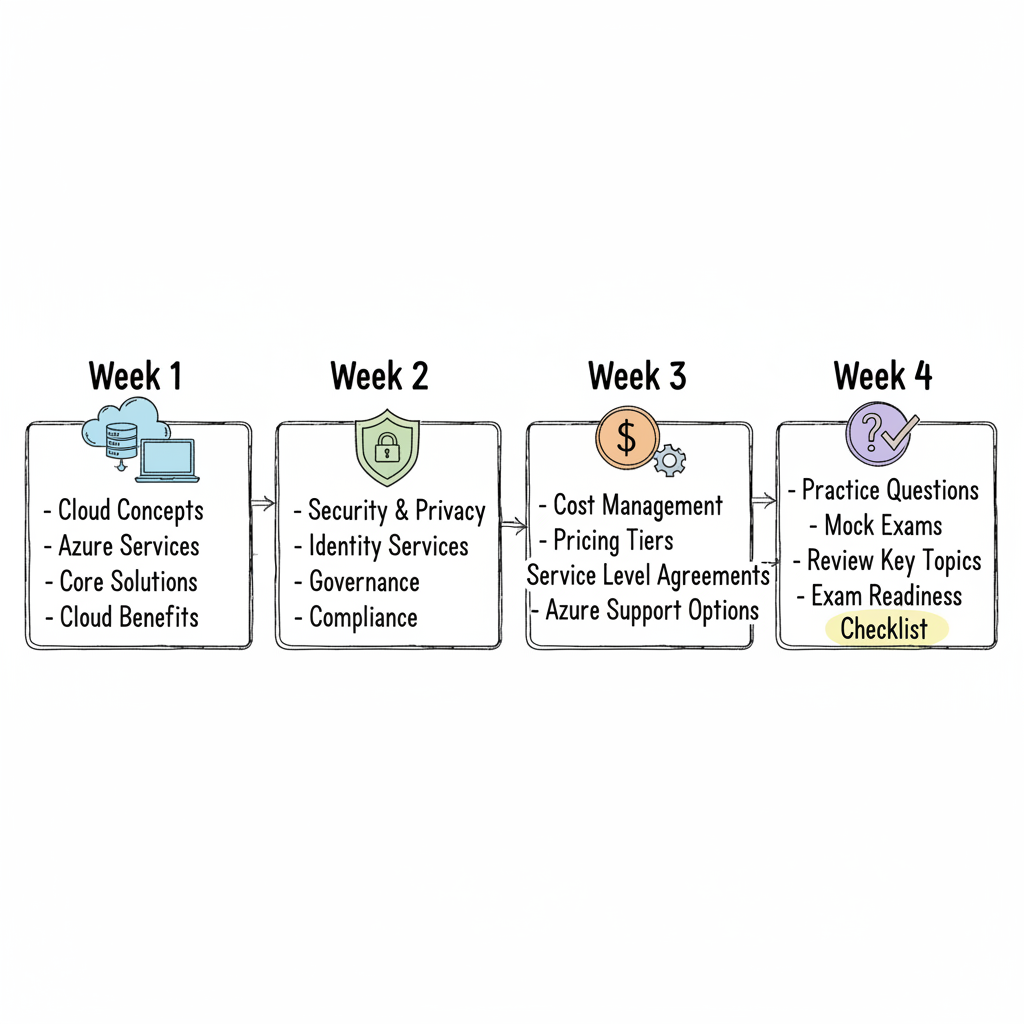 A structured four-week calendar visualizes a methodical approach to AZ-900 exam preparation, emphasizing consistent progress.
Feeling daunted by the volume of material for the AZ-900? The most effective approach is a structured study plan, not a last-minute cramming session. This four-week schedule is designed to break down the entire curriculum into manageable, bite-sized chunks, allowing you to build knowledge and confidence incrementally.
Consider this a flexible blueprint. Feel free to adapt it based on your existing knowledge and the realistic amount of time you can dedicate each day. The true secret to success here is consistency in your study methods.
Week 1: Laying the Foundation with Cloud Concepts
Your inaugural week is dedicated to constructing a rock-solid foundation. Seriously, do not rush this phase. All subsequent Azure concepts and services are predicated on these core ideas. Your primary objective is to genuinely grasp the why behind cloud computing before you immerse yourself in the what of specific Azure services.
Your main focus this week is to thoroughly understand the first exam domain, "Describe Cloud Concepts." By the end of this week, you should be able to articulate the following with clarity and confidence:
- Cloud Models: Understand the fundamental differences between Public, Private, and Hybrid clouds. Be ready to provide concrete examples of when each model would be most appropriate.
- Service Models: Can you explain IaaS, PaaS, and SaaS using a simple, relatable analogy—perhaps like the distinction between owning a car, leasing one, or using a ride-sharing service? Crucially, you need to know what you are responsible for managing versus what the cloud provider handles.
- Economic Principles: Gain a firm grasp of Capital Expenditure (CapEx) versus Operational Expenditure (OpEx) and how the cloud's consumption-based model fundamentally alters financial planning and budgeting.
By Friday, you should be able to explain these core cloud concepts to someone entirely unfamiliar with cloud technology. This foundational understanding is the bedrock upon which all your subsequent Azure knowledge will be built.
Week 2: Diving into Azure Architecture and Services
Alright, it's time to get specific. Week two is dedicated to the largest segment of the AZ-900 exam: Azure's core architecture and its most frequently used services. This is where you connect the abstract cloud concepts from week one to tangible, real-world Azure products.
This week, you're tackling the "Describe Azure Architecture and Services" domain. Here’s what requires your focused attention:
- Understand the Global Infrastructure: Learn about Regions, Availability Zones, and Region Pairs. More importantly, understand why these structural elements are absolutely critical for ensuring application uptime, high availability, and disaster recovery.
- Master Core Compute Services: Discern the differences between Azure Virtual Machines, Azure App Services, and Azure Container Instances. The exam won't demand granular details for every feature, but it will expect you to know the optimal use case for each.
- Explore Storage and Databases: Become comfortable with Azure Blob Storage, File Storage, and Table Storage. You'll also need to understand the basic purpose and benefits of Azure SQL Database and Cosmos DB.
Pro Tip: Avoid the pitfall of trying to memorize every single feature of every service. Instead, concentrate on the problem each service is designed to solve and its primary benefits. The AZ-900 exam is largely about assessing your ability to select the most appropriate tool for a given scenario.
Week 3: Mastering Management and Governance
Now that you've familiarized yourself with the services, your third week shifts to how you effectively manage, secure, and govern them. This domain, "Describe Azure Management and Governance," represents the intersection of technology and real-world cloud operations. Without proper governance, costs can escalate uncontrollably, and security vulnerabilities can proliferate rapidly.
Zero in on these key areas:
- Management Tools: Spend dedicated time exploring the Azure Portal. You should also comprehend the utility of the Azure CLI and Azure PowerShell, particularly for automation and scripting repetitive tasks.
- Security and Identity: Grasp the fundamentals of Azure Active Directory (Azure AD), Azure's identity and access management service, and Role-Based Access Control (RBAC). Understand Multi-Factor Authentication (MFA) and why it's an essential security measure.
- Governance Features: Learn how tools like Azure Policy and Resource Locks help you enforce organizational standards, ensure compliance, and prevent accidental modifications or deletions of critical resources (e.g., stopping someone from accidentally deleting a production server).
This week's focus leans less on raw technology features and more on operational processes and control mechanisms. It's about ensuring your Azure environment remains organized, secure, and within budget as it scales.
Week 4: Final Review and Practice
This final week marks your home stretch. It’s entirely dedicated to synthesizing everything you’ve learned, shoring up any remaining weak spots, and becoming comfortable with the unique pressures of the exam format. This is where all your diligent work truly culminates.
Here’s your essential checklist for the final push:
- Pricing and Support: Revisit Azure Service Level Agreements (SLAs), understand the distinctions between the various support plans, and get hands-on experience with the Azure Pricing Calculator and TCO Calculator.
- Comprehensive Review: Cycle back through all your notes from the preceding three weeks. Prioritize any topics that initially caused confusion or required deeper investigation.
- Take Practice Tests: This step is absolutely non-negotiable. The most effective way to feel prepared for the actual AZ-900 exam is to simulate the experience. To accurately gauge your readiness, utilize a high-quality AZ-900 practice exam that genuinely replicates the style and difficulty of the official test. A powerful study method is to learn how to create effective practice tests from your notes to rigorously test your understanding.
By the end of this intensive week, you shouldn't just know the material—you should feel unequivocally confident that you can apply it accurately and efficiently when the clock is ticking.
Essential Resources and Smart Study Techniques
*Learn effective study strategies that can dramatically improve your retention and understanding for certification exams.*When it comes to passing the AZ-900 certification, the key isn't merely about dedicating countless hours—it's about employing smart study techniques. Mindlessly rereading dense textbook pages until your eyes glaze over is a sure path to burnout, not success. The true secret lies in embracing active learning methods that ensure the information genuinely sticks.
Consider this approach: instead of simply highlighting a section on "Infrastructure as a Service (IaaS)," try explaining the concept aloud to a colleague (or even articulate it to yourself) without glancing at your notes. This straightforward act of retrieving information from your memory, known as active recall, creates significantly stronger neural pathways. This robust memory retention is precisely what you’ll need when under the pressure of the exam.
Of course, theoretical knowledge only takes you so far. Nothing solidifies your understanding quite like getting your hands on the keyboard and actually interacting with Azure. It’s the critical difference between merely reading a recipe and successfully cooking the meal.
Leverage the Azure Free Tier
Microsoft generously offers a golden opportunity to gain this invaluable hands-on experience without immediate financial commitment. The Azure Free Tier serves as your personal sandbox, providing free access to popular services for 12 months and a substantial credit to explore virtually everything else for your first 30 days.
Don't just read about Azure Virtual Machines—spin one up and connect to it. Don't just memorize the definition of Blob Storage—create a storage account and upload a file. This practical engagement is how abstract cloud concepts transform into concrete, verifiable skills, which are invaluable for both the AZ-900 exam and your future career.
Here are a few actionable suggestions for your free Azure account:
- Deploy a simple web app using Azure App Service to witness Platform as a Service (PaaS) in action firsthand. Observe how little infrastructure management is required.
- Create a Virtual Network (VNet) and a subnet to gain a practical understanding of how Azure networking is structured and how resources communicate securely.
- Set up an Azure SQL Database to appreciate the benefits of a fully managed database service, comparing it mentally to the administrative overhead of self-hosting a database.
- Configure Role-Based Access Control (RBAC) on a resource group to understand how to grant specific permissions and enforce the principle of least privilege.
Why this matters: The objective isn't to become an instant cloud expert. It's about developing comfort within the Azure Portal and building a practical familiarity with the core services. This hands-on exposure makes the AZ-900 exam content feel far less theoretical and much more grounded in reality.
Curated Library of Study Materials
Relying solely on a single study guide is akin to attempting to construct a house with only a hammer—you need a comprehensive toolbox. Combining diverse resources—official documentation, engaging video courses, and rigorous practice questions—cultivates a much more robust and stimulating learning plan.
Each format offers unique advantages. Microsoft’s own materials, particularly Microsoft Learn, provide the definitive source of truth, ensuring accuracy and alignment with exam objectives. High-quality video instructors can effectively break down complex topics into easily digestible segments using analogies and practical demonstrations.
Practice exams are non-negotiable. They acclimatize you to the question types, help you refine your time management skills, and crucially, highlight your areas of weakness that require further review.
Top-Tier Resources for Your AZ-900 Journey:
- Microsoft Learn: This is your absolute ground zero. The official Azure Fundamentals learning path is completely free and directly aligns with the AZ-900 exam objectives. It's the closest you'll get to an official study guide.
- Video Courses: For visual learners, platforms like Coursera, Pluralsight, and the vast library of free tutorials on YouTube are excellent. They frequently employ clear analogies and live demos that help concepts truly click.
- Practice Exams: As mentioned, these are vital. Taking good practice tests familiarizes you with the question style, helps you master your timing, and precisely identifies your knowledge gaps. For comprehensive preparation, explore our guide on the best study methods for exams to refine your approach and ensure your efforts translate into a passing score.
- Community Forums: Never underestimate the collective power of a supportive community. Platforms like Reddit's r/Azure or the Microsoft Tech Community are brimming with individuals who have successfully navigated this journey. You can ask questions, find study partners, and glean insights from their experiences.
By strategically blending these resources with effective study habits, you will construct a powerful system poised for success.
The Home Stretch: Exam Day and What Comes Next
You've dedicated the hours, diligently completed the work, and now the AZ-900 exam is imminent. This final push isn't about cramming more information; it's about ensuring you are logistically and mentally prepared. The last thing you need is a preventable obstacle disrupting your focus on exam day.
A simple pre-flight checklist can be incredibly beneficial. Double-check your exam time and location (or virtual setup requirements). Confirm your identification is valid and readily accessible. If you're testing from home, ensure your environment is quiet, organized, and free from distractions. A little proactive organization significantly reduces last-minute stress, allowing you to approach the exam with calm confidence.
Once the timer commences, remember that time management is paramount. You have 60 minutes to address 40-60 questions, necessitating a steady and efficient pace. If you encounter a question that genuinely stumps you, do not dwell excessively. Flag it for review and move on. Successfully answering the questions you know first builds momentum and allocates more time for you to circle back to the trickier ones later.
Passing is Just the Beginning
Achieving that coveted "Pass" screen is an incredibly rewarding feeling—it's official, verifiable proof that you've mastered the fundamentals of the cloud. However, it's crucial to understand that the AZ-900 isn't the finish line; it's merely the starting block. It represents the foundational credential that opens the door to a vast array of specialized cloud roles and more advanced Azure certifications.
Your journey in Azure is truly just commencing. This certification serves as the indispensable launchpad you need to pursue higher-level credentials that align precisely with your long-term career aspirations.
Think of your AZ-900 certification as the solid foundation of a house. It's robust, absolutely essential, and you cannot build without it. But the real value—and the exciting part—is deciding what kind of magnificent structure you wish to build upon that foundation.
With your core cloud knowledge now officially validated, you are empowered to meticulously map out your future path. Do you envision yourself as the architect who keeps the cloud infrastructure running seamlessly? Or are you more enthralled by the prospect of developing cutting-edge, cloud-native applications?
Charting Your Course in Azure
The AZ-900 is specifically designed to provide a natural progression into several specialized tracks within the Azure ecosystem. Each subsequent path builds upon the broad cloud concepts you've just mastered, delving deeper to transform foundational knowledge into job-ready expertise.
Here are a few of the most popular next steps for IT professionals:
- For the Hands-On Administrator: The AZ-104 Azure Administrator Associate is the most common and logical next step. This certification involves getting your hands dirty, learning to implement, manage, and monitor actual Azure environments.
- For the Code-Driven Developer: If your passion lies in writing code, the AZ-204 Developing Solutions for Microsoft Azure is your next logical step. This certification focuses on designing, building, testing, and maintaining cloud-native applications and services.
- For the Data-Obsessed Professional: If you're fascinated by data management and analysis, the DP-900 Azure Data Fundamentals is an excellent follow-up. It applies your foundational knowledge specifically to core data concepts and services within Azure, such as relational and non-relational databases, big data, and analytics.
Choosing your next certification path is a significant decision. To gain a clearer perspective on the myriad possibilities, take the time to explore the various Azure learning paths and certifications available. Visualizing the road ahead will empower you to select the credential that truly resonates with your professional ambitions.
Got Questions About the AZ-900? We've Got Answers.
Even with the most meticulously crafted study plan, a few common questions invariably arise. Let's address some of the most frequent queries we hear from students, ensuring you can approach your AZ-900 exam feeling entirely confident and clear-headed.
How Many Questions Are on the AZ-900 Exam?
You can anticipate encountering between 40 and 60 questions on the AZ-900 exam. It's important to note that the exam isn't solely composed of straightforward multiple-choice questions. Microsoft often incorporates a mix of different formats, such as drag-and-drop, matching, and occasionally even small case studies that require you to apply your knowledge to a scenario.
You will have precisely 60 minutes to complete the entire exam, which underscores the critical importance of time management. Maintaining a steady pace is just as vital as possessing a comprehensive understanding of the material.
What’s the Passing Score for the AZ-900?
To successfully pass the AZ-900, you need to achieve a score of 700 out of a possible 1000 points. It's worth noting that this doesn't necessarily mean you need to answer exactly 70% of the questions correctly. Microsoft utilizes a scaled scoring system, which can be somewhat intricate, taking into account the difficulty of individual questions.
Our advice? Don't get overly fixated on the precise number. Instead, channel your energy into cultivating a robust and comprehensive understanding across all the defined exam domains, and your passing score will naturally follow.
Do I Need Any Prior Experience to Take This Exam?
No, not at all! This is one of the most appealing aspects of the AZ-900 certification. It is explicitly designed as a true entry-level certification with no official prerequisites. You do not require any prior hands-on Azure experience to begin your preparation.
While having a general IT background can certainly be beneficial, this exam is meticulously structured to serve as the ideal launching pad for anyone new to the cloud, regardless of their starting point.
The AZ-900 is genuinely accessible. It's built for everyone—from seasoned technical professionals seeking to pivot into cloud roles to business managers who simply need to understand and speak the language of Azure.
Does the AZ-900 Certification Expire?
This is an excellent question, and the answer is even better: the AZ-900 certification does not expire. Once you successfully pass the exam, that credential is permanently yours, serving as a lasting testament to your foundational cloud knowledge.
This policy distinguishes it from many more advanced Microsoft certifications, which often require periodic renewal to maintain their validity. Your AZ-900 is a permanent badge, signifying your mastery of the cloud fundamentals.
What Happens If I Fail the Exam?
It happens to the best of us. Taking a challenging exam is inherently stressful, and sometimes, despite thorough preparation, you simply have an off day. The reassuring news is that failing is not the end of your journey. Microsoft has a clear and straightforward retake policy:
- First Retake: If you are unsuccessful on your initial attempt, you must observe a 24-hour waiting period before you are eligible to retake the exam.
- Subsequent Retakes: Following that, a waiting period of 14 days is required between any subsequent attempts.
View this waiting period as a valuable opportunity. Utilize it to review your score report, meticulously pinpoint the areas where you struggled, and dedicate focused study to those specific cloud concepts. Remember, you will need to pay the exam fee for each attempt.
Ready to transition from simply studying to genuinely mastering Azure cloud concepts? The MindMesh Academy platform is specifically engineered to empower you to pass the AZ-900 certification with unwavering confidence. Our evidence-based study tools and comprehensive practice exams are directly mapped to the official blueprint, ensuring you are thoroughly prepared for every aspect the exam may present. Explore our AZ-900 resources today.
Ready to Get Certified?
Prepare with expert-curated study guides, practice exams, and spaced repetition flashcards at MindMesh Academy:

Written by
Alvin Varughese
Founder, MindMesh Academy
Alvin Varughese is the founder of MindMesh Academy and holds 15 professional certifications including AWS Solutions Architect Professional, Azure DevOps Engineer Expert, and ITIL 4. He's held senior engineering and architecture roles at Humana (Fortune 50) and GE Appliances. He built MindMesh Academy to share the study methods and first-principles approach that helped him pass each exam.