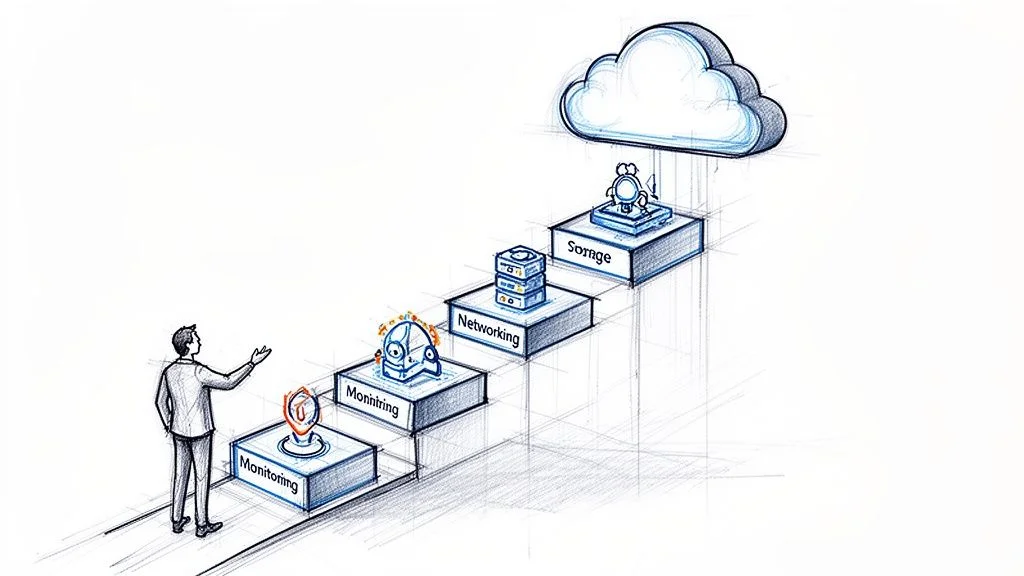
The Ultimate AZ 104 Study Guide for Azure Administrators
You're embarking on an exciting and highly rewarding journey to become a certified Microsoft Azure Administrator. The AZ-104 exam isn't just another test; it's a critical validation of your ability to manage, monitor, and secure cloud environments—skills that are in immense demand across the IT landscape. This guide is your meticulously crafted roadmap, designed to cut through the complexity and provide a clear, actionable plan for success.
Think of this not merely as a list of topics, but as a structured pathway, guiding you from your very first study session to the confident moment you pass your exam. We at MindMesh Academy are committed to equipping you with the knowledge and practical expertise you need, focusing on real-world application rather than rote memorization.
Your Path to Becoming an Azure Administrator
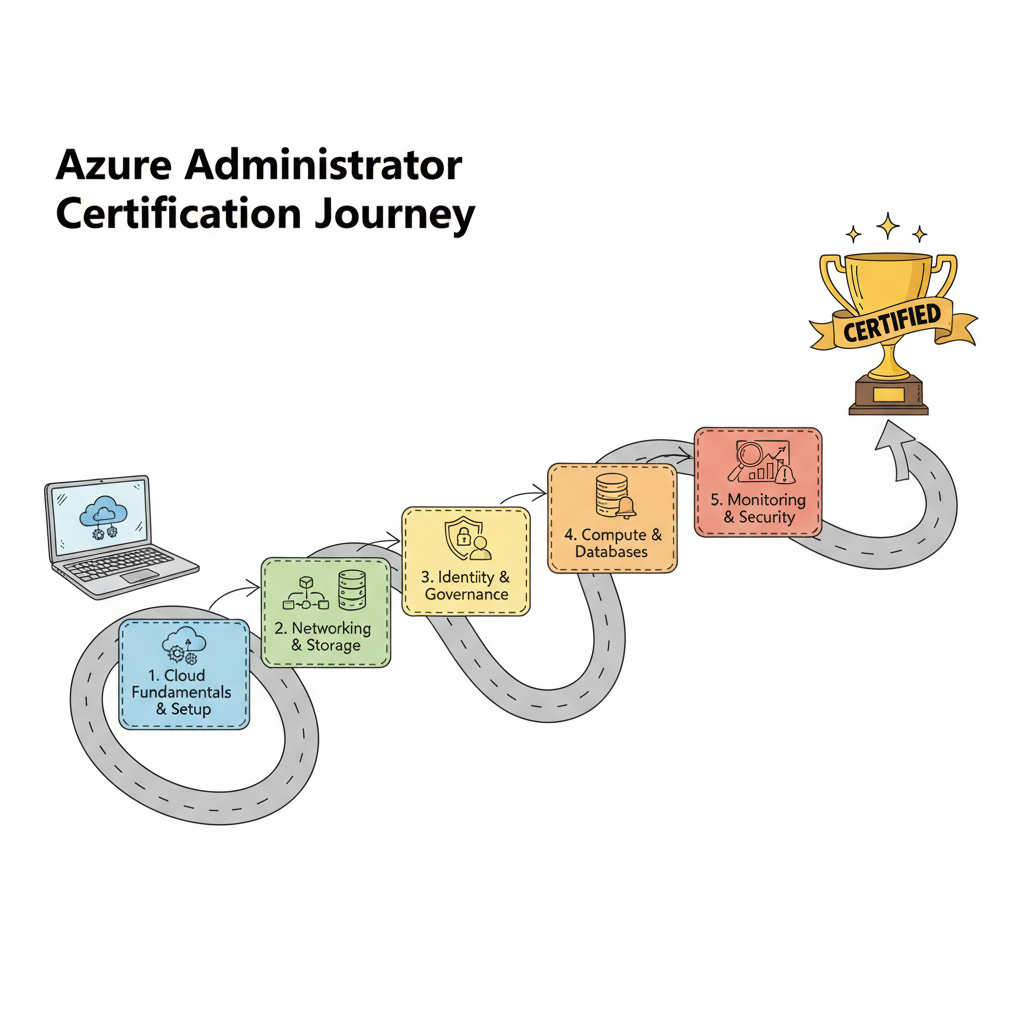
Earning the AZ-104 certification is a significant career milestone for any IT professional. As organizations worldwide accelerate their migration to cloud platforms like Microsoft Azure, the role of the Azure Administrator has become central to maintaining robust, scalable, and secure IT infrastructures. You're the professional on the front lines, responsible for ensuring everything runs smoothly—from granular identity and access management to deploying resilient virtual machine architectures and safeguarding network traffic within a Microsoft Azure environment.
This exam transcends mere theoretical recall; it's designed to validate your practical, hands-on proficiency in managing a modern cloud platform. These are not just buzzwords; these are skills that are critically sought after. Consider the staggering growth: worldwide spending on cloud services reached $675.4 billion in 2023, more than doubling in just three years. This explosive growth directly fuels the urgent need for skilled, certified Azure experts like yourself.
What This Guide Will Cover
We’ve meticulously structured this guide to demystify the entire AZ-104 preparation process, breaking it down into manageable, strategic steps. Our goal is to empower you to study smarter, not just harder, by zeroing in on the content and practice that truly matters for certification success and real-world competence.
The AZ-104 exam is not a test of memory. It’s a validation of your ability to apply knowledge to real-world administrative scenarios. Success comes from consistent hands-on practice and a deep understanding of how Azure services work together to form cohesive solutions.
To ensure you start on the strongest possible footing, it’s essential to understand the exam's scope and its target audience. For a more comprehensive overview, we encourage you to explore our dedicated guide on understanding the AZ-104 exam's purpose and audience.
Here’s a snapshot of the comprehensive insights and tools this study guide will provide:
- A Detailed Breakdown of Exam Objectives: We’ll dissect each of the five core domains—from identities and governance to monitoring and backup—providing clarity on their weighting and practical implications for the exam.
- A Strategic, Multi-Week Study Plan: A structured schedule with daily goals and crucial lab exercises, designed to foster consistent progress without leading to burnout.
- Curated Learning Resources: Hand-picked links to the most effective courses, official Microsoft Docs, interactive sandboxes, and hands-on labs to solidify your understanding.
- Effective Study Techniques: Insights into scientifically proven methods like adaptive learning and spaced repetition to help you achieve long-term knowledge retention and mastery.
By diligently following this roadmap, you won't just be prepared to pass the AZ-104 exam; you'll gain the confidence and foundational skills to excel as a highly capable Azure Administrator in any professional setting.
A Look Inside the Core AZ-104 Exam Domains
To successfully pass the AZ-104, a precise understanding of the exam's content is paramount. The official Microsoft exam objectives serve as the definitive blueprint for your entire study strategy. They articulate exactly what Microsoft deems essential for an Azure Administrator, and this guide is meticulously structured to help you master every single one.
The exam is not a random collection of Azure facts; it’s a rigorous, practical assessment of your skills across five fundamental areas. By understanding what each domain encompasses and its approximate weight on the exam, you can strategically allocate your study time and energy for maximum impact. Let's delve into each domain.
Manage Azure Identities and Governance (20-25%)
This domain constitutes one of the largest segments of the exam, and for a very critical reason: identity is the foundational security perimeter in the cloud. This section is dedicated to mastering who can access what resources within your Azure environment, establishing a secure, scalable, and compliant foundation for all subsequent operations.
You'll need to develop a deep familiarity with Microsoft Entra ID (formerly known as Azure Active Directory). This involves comprehensive knowledge of creating and managing user accounts and groups, assigning software licenses, and securely collaborating with external users and partners (B2B collaboration). Imagine you're the lead administrator for a rapidly expanding organization—your responsibilities would include onboarding new employees, logically segmenting them into appropriate teams (groups), and ensuring they possess the necessary licenses to perform their roles efficiently.
However, this domain extends far beyond basic user management to encompass robust governance strategies:
- Role-Based Access Control (RBAC): This is the cornerstone of the principle of least privilege. You must understand how to effectively assign built-in roles (e.g., "Contributor," "Reader," "Owner") at the appropriate scope—whether it's an entire Azure subscription, a specific resource group, or a single resource like a virtual machine. Reflection Prompt: Consider a scenario where a new developer needs temporary access to deploy a web app within a specific resource group. Which RBAC role would you assign, and at what scope, to grant just enough access without over-provisioning?
- Azure Policy: Envision Azure Policy as the comprehensive guardrails for your cloud environment. The exam will test your ability to implement policies that enforce organizational standards, such as restricting resource creation to specific geographic regions or mandating specific security configurations for newly deployed resources.
- Resource Management: This covers the day-to-day organizational structure of your Azure environment. It includes managing subscriptions, utilizing resource locks to prevent inadvertent deletion of critical production resources, and applying descriptive tags for cost allocation, operational reporting, and resource organization.
Implement and Manage Storage (15-20%)
Every application, from a simple web service to a complex data analytics platform, requires a robust storage solution. This makes Azure Storage a fundamental building block of the platform. This domain assesses your ability to intelligently select, deploy, and manage the most appropriate storage solutions for diverse data requirements and workloads.
Think of Azure Storage as a comprehensive toolkit—you must know precisely which tool to utilize for a given task. A significant part of this involves creating and configuring storage accounts, which serve as the top-level containers for all your data. You will definitively be tested on selecting the optimal redundancy option, such as LRS (Locally-Redundant Storage) for cost-effective local copies or GRS (Geo-Redundant Storage) to safeguard against regional disasters.
You must possess a thorough understanding of the core Azure Storage services:
- Azure Blob Storage: Your primary choice for storing massive amounts of unstructured data—think images, video files, backups, archival data, and log files. You’ll need to manage blob containers, strategically utilize storage tiers (Hot, Cool, and Archive) to optimize costs, and implement lifecycle management policies to automate data movement between tiers.
- Azure Files: Provides fully managed file shares in the cloud that can be seamlessly mounted and accessed just like traditional server Message Block (SMB) shares. Expect questions on creating file shares, connecting them to Azure VMs or on-premises servers, and securing access using identity-based authentication (Azure AD DS or on-premises AD DS).
Security is intrinsically linked to all storage operations. Understanding how to protect your data is non-negotiable. For a broader perspective on the types of threats you’ll be defending against in a cloud context, this guide on mitigating cloud computing security risks offers valuable insights. In the exam, you'll need the practical skills to configure storage firewalls, implement virtual network service endpoints, and generate Shared Access Signature (SAS) tokens to grant secure, time-limited, and granular access to your data.
Deploy and Manage Azure Compute Resources (20-25%)
This domain focuses on the computational powerhouses of your cloud infrastructure: the virtual machines, containerized applications, and web services that drive your business operations. This section carries a substantial weighting, accurately reflecting the considerable time Azure administrators dedicate to these services in real-world scenarios.
Virtual Machines (VMs) are often the initial focus here, and you must understand their entire lifecycle intimately:
- Creation: Deploying new VMs efficiently using the Azure portal, PowerShell, or the Azure CLI.
- Configuration: Selecting appropriate VM sizes, attaching additional data disks for storage, and meticulously configuring networking settings.
- Management: Relocating VMs between resource groups, implementing availability sets or availability zones for high availability and resilience, and encrypting disks to protect sensitive data at rest.
However, modern cloud environments are not solely reliant on VMs. The AZ-104 also expects familiarity with containerization and Platform-as-a-Service (PaaS) offerings.
Being a highly effective Azure administrator means discerning when a traditional VM offers the necessary control, when a container provides superior portability and efficiency, and when an Azure App Service simplifies web application hosting. The exam tests your judgment in selecting the appropriate compute solution for various scenarios.
You'll need to navigate Azure Container Instances (ACI) for deploying simple, isolated containers and Azure App Service for hosting scalable web applications and APIs. This includes practical skills such as configuring auto-scaling, utilizing deployment slots for zero-downtime updates, and securing your applications with custom domains and TLS/SSL certificates. Reflection Prompt: Your development team wants to deploy a new microservice quickly without managing underlying infrastructure. Would you recommend a VM, ACI, or App Service, and why?
Configure and Manage Virtual Networking (15-20%)
Networking acts as the crucial connective tissue that integrates your entire Azure environment. This domain evaluates your capacity to design and implement secure and high-performance networks, enabling seamless communication between your Azure resources, the internet, and potentially your on-premises datacenters. You'll need to approach this with the mindset of a network administrator, planning and deploying virtual networks (VNets) from the ground up.
This encompasses creating VNets and logically segmenting them into subnets, meticulously planning your IP address space, and establishing secure connections between different virtual networks using VNet peering. A very common real-world task involves troubleshooting communication issues between two VMs, which necessitates a deep understanding of network traffic flow and configuration.
Network security is an absolutely critical component of this domain. You must be proficient with Network Security Groups (NSGs), which function as fundamental firewalls for your VMs and subnets. You’ll need to create precise rules to allow or deny traffic based on source/destination IP addresses, ports, and protocols, and accurately determine the precedence of applied rules. The exam also expects knowledge of Azure Bastion for secure, browser-based RDP or SSH access to your VMs, significantly reducing your attack surface by eliminating public IP exposure for management.
Monitor and Maintain Azure Resources (10-15%)
Finally, your responsibilities as an Azure Administrator extend far beyond initial deployment. This concluding domain covers the essential skills required to maintain the health, performance, and cost-efficiency of your Azure environment. It’s all about adopting a proactive, rather than merely reactive, approach to operational management.
Azure Monitor is the primary tool you'll leverage here. You must know how to collect, analyze, and visualize metrics and logs from all your Azure resources. This includes configuring sophisticated alert rules that notify you when critical thresholds are crossed—for instance, if a VM’s CPU utilization spikes or a web application begins reporting an excessive number of errors.
Backup and disaster recovery are equally vital skills. You will be tested on your ability to:
- Create and configure a Recovery Services vault, which serves as a central repository for backups.
- Establish and manage backup policies for your Azure VMs and other supported services.
- Execute and validate restore operations to recover data or entire VMs after an incident or failure, ensuring business continuity. Reflection Prompt: How would you configure Azure Monitor alerts to ensure you're immediately aware if a critical production VM's disk space is nearing capacity?
Your Strategic Four-Week AZ-104 Study Plan
Knowing what is on the AZ-104 exam is the first step, but understanding how to effectively study for it is where true preparation lies. Simply consuming random videos or superficially reviewing Microsoft Docs is unlikely to lead to success. Passing this rigorous exam demands a structured, progressive plan that systematically builds your knowledge, ensuring deep conceptual understanding without succumbing to burnout.
This four-week study plan is meticulously crafted to achieve precisely that. We've deconstructed the vast amount of information into manageable daily and weekly objectives. Each week strategically focuses on specific exam domains, integrating theoretical knowledge ("book smarts") with critical, hands-on lab exercises that develop real-world muscle memory and practical competence.
Visualize the exam domains as a logical narrative. You must first grasp the foundational concepts before you can fully comprehend the more advanced topics. This timeline illustrates how core concepts naturally build upon one another, ensuring a coherent learning progression.

Beginning with Identity and Governance establishes the bedrock—it’s akin to establishing the security protocols and organizational rules for a building before any valuable assets are placed inside. Once this foundation is solid, you can progressively introduce other essential resources like Storage, Compute, and Networking.
Week 1: Foundations in Identity, Governance, and Storage
Your inaugural week is dedicated to constructing this crucial bedrock. We’ll begin with the most heavily weighted domain—Identities and Governance—and then introduce fundamental storage concepts. The overarching goal is clear: master the principles of access control and resource organization before you start deploying numerous resources.
To help you effectively manage your time, here’s a sample schedule you can adapt.
Sample One-Week Study Schedule
| Day | Focus Topic | Suggested Lab Exercise |
|---|---|---|
| Mon-Tue | Microsoft Entra ID | Create several test users and organize them into a "Developers" group. Assign a sample software license and configure self-service password reset (SSPR) for a user. |
| Wed-Thu | Access Control (RBAC) & Governance | Practice assigning built-in roles like "Reader" and "Contributor" at different scopes (subscription, resource group, individual resource). Implement an Azure Policy to enforce a "Deny" rule, preventing the creation of a specific VM size. |
| Fri | Intro to Azure Storage | Create a general-purpose v2 storage account. Explore and compare the various redundancy options (e.g., LRS, GRS). Familiarize yourself with Blob and Files services within the account. |
| Weekend | Review & Reinforce | Actively review the week's topics. As a practical exercise, apply a resource lock (e.g., CanNotDelete) to the storage account you created to prevent accidental deletion, then try to delete it to confirm the lock's effect. |
This learn-then-do structure is critically important for cementing knowledge and developing practical proficiency.
Week 2: Diving Deep into Storage and Compute
With a robust governance foundation now established, Week 2 shifts focus to the resources that perform the core operational heavy lifting. You'll complete your in-depth exploration of storage and then transition into the heart of Azure compute services, with a particular emphasis on Virtual Machines.
This week is designed for intensive hands-on practice. You will be actively deploying, configuring, and managing the fundamental building blocks of almost any cloud infrastructure you'll construct in Azure.
By the conclusion of this week, you should feel adept not just at provisioning a VM, but also at meticulously configuring its associated storage, networking, and high-availability options from scratch. This practical mastery is a core competency for any certified Azure Administrator.
Here’s a recommended approach to tackle this week:
- Day 1 (Advanced Storage): Concentrate on Blob and Azure File storage. Create a blob container, practice uploading different file types, and then configure a lifecycle management policy to automatically transition older, less frequently accessed data from the Hot tier to the Cool or Archive tier to optimize costs.
- Day 2 (Securing Storage): This is a high-priority topic. Configure a storage account firewall to restrict access to specific virtual networks or IP ranges. Subsequently, create and utilize a Shared Access Signature (SAS) token to grant a specific user or application temporary, time-limited, and granular access to a particular file or container.
- Days 3-4 (The VM Lifecycle): Dedicate these two days to immersive work with VMs. Deploy both a Windows Server VM and a Linux VM. Practice resizing them, attaching new data disks, and moving a VM between different resource groups. Explore the nuances of public vs. private IP addresses and network interfaces.
- Day 5 (High Availability & Containers): Investigate availability sets and availability zones. Deploy two VMs into an availability set to understand how Azure provides resilience against hardware failures within a single datacenter. Following this, deploy a simple, stateless application using Azure Container Instances (ACI) to grasp container fundamentals.
- Weekend (Review & Practice): Connect the concepts learned. A highly beneficial lab involves deploying a basic web server (e.g., IIS on Windows, Nginx on Linux) on a VM you created earlier, and then meticulously configuring its Network Security Group (NSG) to permit HTTP/HTTPS traffic, making the web server accessible to the internet.
Week 3: Mastering Azure Networking
You’ve deployed your resources; now, how do they communicate securely and efficiently? Week 3 is entirely devoted to virtual networking. This domain can initially feel challenging, but it is absolutely indispensable for designing and implementing any functional cloud solution.
You will learn to design and implement virtual networks (VNets), precisely control traffic flow with security rules, and effectively diagnose communication issues. For strategies on staying organized and optimizing your study time, these tips on creating an effective study schedule will be invaluable.
- Days 1-2 (VNet & Subnetting Fundamentals): Begin by creating a VNet with multiple subnets. Deploy VMs into these distinct subnets and observe their default communication capabilities. Practice subnetting calculations to ensure efficient IP address allocation.
- Day 3 (Network Security Groups - NSGs): This is a non-negotiable, critical topic. Create an NSG from scratch and write inbound and outbound rules to permit essential traffic (e.g., RDP or SSH) while explicitly blocking other unwanted traffic. Practice applying this NSG at both the network interface level and the subnet level to understand their respective impacts.
- Day 4 (VNet Peering & DNS): Establish VNet peering to securely connect two separate virtual networks, enabling private communication between resources in different VNets. Then, gain hands-on experience with Azure DNS, practicing how to set up public and private DNS zones to resolve custom domain names for your Azure resources.
- Day 5 (Secure Access & Load Balancing): Elevate your management security! Implement Azure Bastion to provide secure, browser-based RDP/SSH access to your VMs, eliminating the need to expose management ports publicly. Next, deploy a basic Azure Load Balancer to distribute incoming traffic efficiently between two web server VMs you configured previously, enhancing application availability.
- Weekend (Review & Troubleshoot): The most effective way to truly master networking is through deliberate troubleshooting. Intentionally misconfigure an NSG rule, block a necessary port, or create an IP address conflict. Then, utilize tools like Azure Network Watcher's IP flow verify and next hop features to systematically diagnose and resolve the issue. This active problem-solving builds crucial diagnostic skills.
Week 4: Monitoring, Backup, and Final Review
Your final week is dedicated to ensuring your Azure environment is healthy, protected, and, most importantly, that you are fully prepared for the AZ-104 exam. You’ll complete your study of monitoring and backup, then transition into a comprehensive review to solidify all learned concepts.
- Days 1-2 (Azure Monitor & Alerts): Dive deep into Azure Monitor. Learn to analyze built-in metrics for a VM (e.g., CPU percentage, disk I/O, network in/out) and then run basic Kusto Query Language (KQL) queries against its diagnostic logs within Log Analytics workspaces. Your primary goal is to configure an alert rule that automatically triggers an email notification when a VM's CPU utilization consistently exceeds 80% for a defined period.
- Day 3 (Backup & Recovery): Create and configure a Recovery Services vault. Set up a robust backup policy for one of your critical VMs, specifying frequency and retention. The ultimate test? Perform a granular file-level restore from that backup to confirm its functionality and your ability to recover data effectively.
- Days 4-5 (Final Review & Practice Exams): This is your final concentrated push. Revisit any topics or concepts where you still feel uncertain. Now is the ideal time to take full-length practice tests to simulate the actual exam experience—familiarizing yourself with question styles, time management, and the overall pressure. Afterward, meticulously analyze your results to identify any remaining knowledge gaps and target them for last-minute review. This AZ-104 practice exam is an excellent resource to gauge your readiness and build crucial confidence.
- Day 6 (Light Review & Rest): It is absolutely critical not to cram the day before your exam. Over-cramming often leads to increased anxiety and diminishes performance. Conduct a light review of your condensed notes or key challenging concepts in the morning, and then take the remainder of the day off to relax and recharge. Seriously. A well-rested mind performs significantly better than a stressed one. You've put in the work; trust your preparation.
Essential Tools and Resources for Your Success
A robust study plan provides the map, but the right resources are the essential fuel that propels you toward your certification destination. To truly master the concepts within this AZ-104 study guide, you must leverage high-quality materials that effectively bridge the gap between theoretical understanding and practical application.
The sheer volume of online videos, blogs, and documentation can be overwhelming. To streamline your preparation, we’ve assembled a curated list of indispensable tools. Think of this as your professional Azure toolkit: some resources are foundational, while others are for the fine-tuning required to cross the finish line with confidence.
The Official Microsoft Foundation
Always begin with the authoritative source. Microsoft's own documentation and learning paths represent the definitive truth for the exam. They are meticulously designed to align with the official exam objectives, making them non-negotiable components of your study.
- Microsoft Learn: The AZ-104 Learning Path on Microsoft Learn functions as your official, interactive textbook. It's a superb collection of free, self-paced modules that meticulously cover every single exam objective, offering clear explanations, interactive exercises, and quick knowledge checks. A standout feature is the inclusion of free sandbox environments, allowing you to execute Azure commands and deploy resources without incurring any cost or configuring your own subscription.
- Microsoft Docs: When a learning module prompts further questions or you require deeper technical insights, Microsoft Docs is your comprehensive encyclopedia. For instance, if you're wrestling with the intricate details of Network Security Groups (NSGs), the official docs will provide exhaustive details, practical code examples, and best practices that most introductory courses can only briefly touch upon.
Gaining Hands-On Experience
You can absorb theoretical knowledge about Azure all day, but the AZ-104 exam is explicitly designed to test what you can do. It is a practical skills assessment, and passive learning alone simply won't suffice. You absolutely must get your hands dirty and actively engage with the Azure platform.
Success on the AZ-104 exam is directly proportional to the amount of quality time you spend actively working within the Azure portal and command-line interfaces. Theoretical knowledge provides the conceptual map, but hands-on practice is akin to learning how to confidently drive the car.
Begin cultivating that crucial muscle memory immediately. The free sandboxes available within Microsoft Learn are an excellent starting point for initial exploration and experimentation.
When you're prepared for more complex, real-world scenarios, the official AZ-104 GitHub Labs are your next essential step. These labs guide you through practical exercises like deploying virtual machines, configuring virtual networks, setting up backup policies, and much more. Becoming comfortable and efficient in the Azure portal is a significant part of the battle, and our comprehensive guide on navigating the Azure portal and CLI will further enhance your proficiency.
Validating Your Knowledge
How do you accurately assess your readiness for the exam? This is where high-quality practice tests become an invaluable component of your preparation strategy. They are the final, critical piece of the puzzle.
An effective practice test goes beyond simply quizzing you; it familiarizes you with diverse question formats, helps you manage the strict exam timing, and critically, shines a spotlight on any lingering weak areas you might have.
Seek out practice exams from reputable providers that offer detailed, constructive explanations for every answer, whether you got it right or wrong. Simply knowing you missed a question isn't helpful; you need to understand why you missed it and what the correct approach entails. This detailed feedback loop is what transforms a good score into a passing score and instills the confidence required to walk into that exam room fully prepared.
How to Accelerate Your Learning and Retention
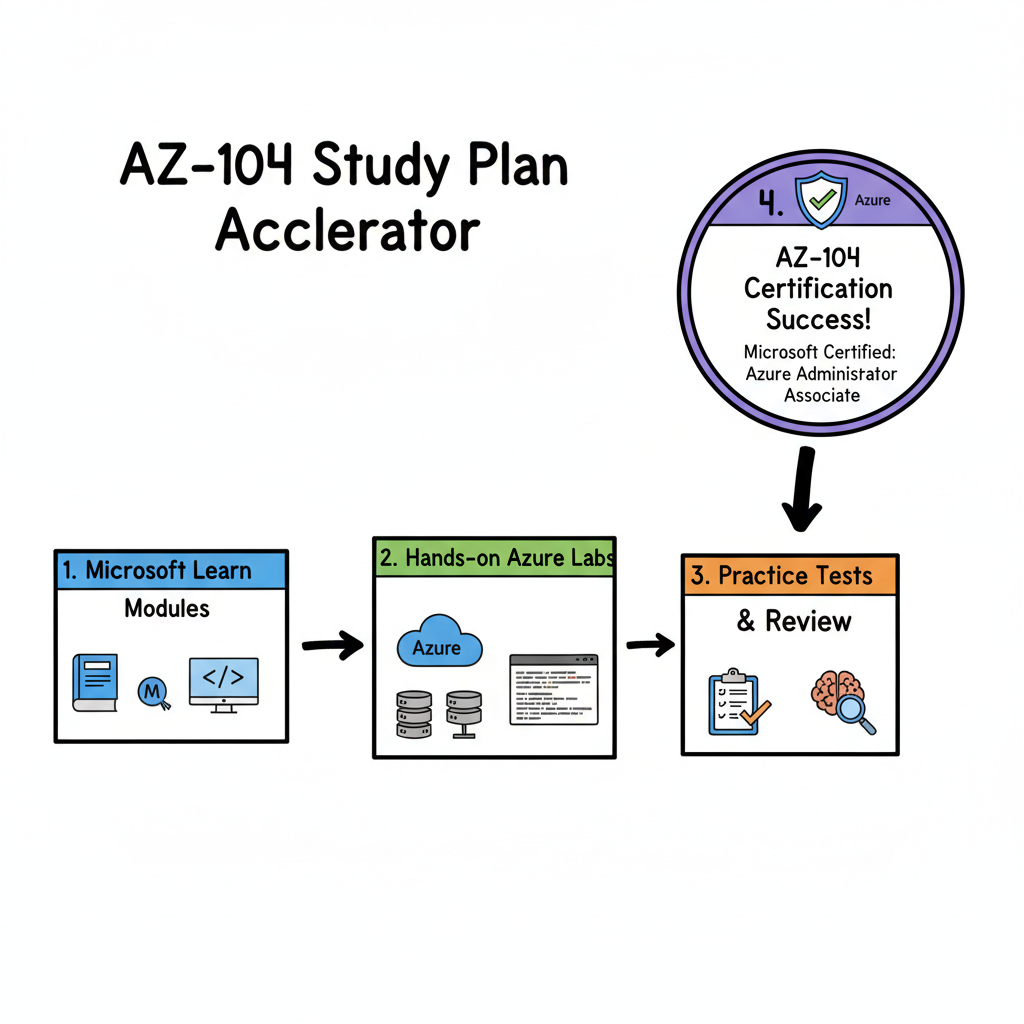 Let's be candid: preparing for the AZ-104 certification is a marathon, not a frantic sprint. It's not about the sheer number of hours you put in, but rather the effectiveness and quality of those study hours. Relying solely on passive methods like simply watching videos or reading documentation often leads to rapidly forgetting the material.
A far more potent approach involves working with your brain's natural learning mechanisms, rather than against them. This means moving beyond passive consumption. True mastery emerges from actively grappling with concepts, precisely identifying your knowledge gaps, and then consistently reinforcing those challenging areas until they become second nature. This is the pathway to building genuine technical skill, not just temporary memorization for a test.
Adopt an Adaptive Learning Mindset
Adaptive learning is essentially a sophisticated way of saying you should strategically focus your energy where it yields the greatest return. Instead of allocating equal study time to every topic, you intelligently double down on the concepts that present the most difficulty. This prevents you from wasting valuable time reviewing material you already know well.
Imagine having a personalized coach for your Azure studies. A good coach doesn't prescribe the same generic workout every day. Instead, they observe your performance, pinpoint your weaknesses, and assign targeted exercises to strengthen those specific areas. An adaptive study system operates on the same principle—it intelligently identifies your knowledge gaps and delivers precisely the right material to address and rectify them.
This personalized approach is precisely how platforms like MindMesh Academy are engineered to function. Our system monitors your performance on practice questions and then intelligently directs you towards the specific labs, lessons, or documentation you need to shore up your weak points. It’s a significantly smarter, more targeted, and ultimately more efficient way to prepare for your certification.
Beat the Forgetting Curve with Spaced Repetition
Have you ever experienced the frustration of feeling like you've completely mastered a concept one day, only for it to mysteriously vanish from your memory a week later? That phenomenon is the "forgetting curve" in action, and it's a significant impediment to long-term learning. The most powerful weapon against this natural memory decay is a scientifically proven technique called spaced repetition. It involves strategically reviewing information at progressively longer intervals.
The core principle is elegantly simple: you revisit a concept precisely at the moment you're about to forget it. This deliberate timing compels your brain to exert slightly more effort to retrieve the information, which dramatically strengthens the neural connections associated with that memory. It’s the critical distinction between knowledge that lasts merely a day and knowledge that endures for a lifetime.
Therefore, instead of engaging in a grueling, eight-hour cram session on Azure networking, you might dedicate an hour to it today, conduct a brief review tomorrow, revisit it again in three days, and then touch on it once more next week. This distributed approach feels less intense, yet it is profoundly more effective for building robust, long-term recall and understanding.
Visualize Your Progress and Stay Motivated
Few things provide as powerful a boost to motivation as clearly seeing your tangible progress. Having a transparent, data-driven visualization of your study journey is an immense motivator and enables you to make informed decisions about where to direct your efforts next. Any effective study plan inherently requires a mechanism to measure and track your growth.
A dashboard that vividly breaks down your proficiency by each exam domain is an incredibly valuable asset. It transforms that nebulous feeling of "Am I truly ready?" into a concrete, visual, and quantifiable answer.
A quick glance at such a progress tracker might immediately reveal that you are exceptionally strong in Compute Resources but require additional practice and review in Virtual Networking. This type of immediate, visual feedback is invaluable. It empowers you to cease guessing and instead formulate a clear, actionable plan to confidently achieve your certification goals.
Your Top AZ-104 Questions, Answered
Embarking on a significant certification like the AZ-104 naturally brings forth a multitude of questions. Beyond the technical aspects, you're likely pondering the exam logistics, the prerequisites for success, and whether the considerable investment of time and effort will truly yield a worthwhile return.
Let's cut through the common misconceptions and provide you with straightforward, actionable answers. Consider this the essential FAQ section, informed by the collective experience of seasoned IT professionals and certification experts.
What’s the Passing Score for the AZ-104 Exam?
To successfully pass the AZ-104, you need to achieve a score of 700 on a scaled scoring system that ranges up to 1000.
It's crucial to understand that this is not a straightforward 70% raw score. Microsoft employs a scaled scoring method, meaning that individual questions may carry different weights, often correlated with their difficulty or importance to the role. This methodology ensures fairness and consistency across different exam versions, even if candidates receive slightly varied question sets.
What does this imply for your preparation? Resist the urge to fixate on how many questions you can afford to miss. This approach is counterproductive. The most effective strategy is to cultivate a robust, well-rounded, and deep understanding of every single topic outlined in the official exam blueprint. Focus on mastery, not just hitting a percentage.
How Much Hands-On Experience Do I Really Need?
Microsoft's official recommendation suggests approximately six months of hands-on experience as an Azure administrator. However, don't let that number be a rigid barrier. It's less about a formal job title and more about your demonstrable, practical, real-world skills. Many successful candidates gain this experience through dedicated self-study and lab work.
You can absolutely build this essential experience yourself, even if you're not currently in a dedicated Azure role. The key is consistent, deliberate, and focused practice.
- Activate a free Azure account: Don't merely read about Azure services—actively deploy virtual machines, meticulously configure storage solutions, and systematically troubleshoot common issues. Deliberately break things (in a safe, isolated environment) and then methodically figure out how to fix them. This iterative process is invaluable.
- Immerse yourself in labs: Diligently work through the official GitHub labs for the AZ-104 and consistently leverage the Microsoft Learn Sandbox environments whenever possible. These provide guided, practical exercises that mirror real-world scenarios.
- Master the command line: While the Azure portal is user-friendly, a truly proficient administrator navigates with ease through PowerShell and the Azure CLI. The exam will definitely expect you to demonstrate competence in these command-line tools.
Ultimately, the AZ-104 exam is designed to test what you can do. If you are confident in performing the core administrative tasks covered in the exam objectives, you are well on your way to readiness.
What Kinds of Questions Are on the AZ-104 Exam?
Prepare for an assessment that extends beyond your typical multiple-choice quiz. The AZ-104 utilizes a diverse range of question types to comprehensively evaluate your knowledge, problem-solving abilities, and practical skills.
You should be thoroughly prepared for several distinct formats:
- Multiple-choice questions: These can be single-answer or multiple-answer (where you select more than one correct option).
- Build-list and drag-and-drop questions: These require you to sequence steps in a process or match items correctly, often testing procedural knowledge.
- Scenario-based questions: You'll be presented with a business problem or technical requirement and asked to choose the best Azure solution or configuration.
- Case studies: These involve a detailed narrative describing an organization's existing infrastructure, requirements, and constraints. You'll then answer a series of interconnected questions based on this comprehensive scenario.
The component that frequently challenges candidates is the inclusion of hands-on labs. Yes, you will encounter live Azure environments within the exam and be presented with a list of tasks that you must successfully complete. This could range from configuring a Network Security Group to setting up a storage account with specific redundancy settings. This is precisely where your dedicated hands-on practice truly pays off.
The hands-on labs are Microsoft’s definitive way of stating that theoretical knowledge alone is insufficient. You must unequivocally demonstrate your ability to apply that knowledge under pressure in a live, functional Azure environment.
Is the AZ-104 Certification Actually Worth It?
One hundred percent, unequivocally yes. In a crowded landscape of IT certifications, the AZ-104 stands out as a highly respected and industry-recognized credential that unequivocally proves you possess the fundamental skills required to manage a modern cloud environment. For prospective employers, it serves as a clear, verifiable signal that you are not just making educated guesses—you have demonstrated, practical expertise.
This validation frequently translates directly into significant career growth opportunities and enhanced earning potential. For example, certified Azure Administrators in the United States command an average salary of $121,420 per year, with top-tier professionals earning up to $163,000. You can corroborate these salary trends on most major job platforms and career sites.
Beyond the undeniable resume boost and financial benefits, earning the AZ-104 instills the profound confidence and demonstrable competence to step into an Azure administrator role and immediately contribute from day one. It is a powerful, strategic investment in your professional career trajectory.
Ready to transition from guessing to genuine mastery? MindMesh Academy offers the adaptive learning tools, spaced repetition algorithms, and intuitive progress tracking you need to confidently conquer the AZ-104 exam. Get your personalized study plan today and elevate your Azure career.
Ready to Get Certified?
Prepare with expert-curated study guides, practice exams, and spaced repetition flashcards at MindMesh Academy:

Written by
Alvin Varughese
Founder, MindMesh Academy
Alvin Varughese is the founder of MindMesh Academy and holds 15 professional certifications including AWS Solutions Architect Professional, Azure DevOps Engineer Expert, and ITIL 4. He's held senior engineering and architecture roles at Humana (Fortune 50) and GE Appliances. He built MindMesh Academy to share the study methods and first-principles approach that helped him pass each exam.