
Ace Your AWS Exam with Top AWS Practice Tests
For IT professionals striving for career advancement, certification is a powerful validator of expertise. Whether you're targeting an AWS, Azure, PMP, or ITIL certification, mastering the exam format is as crucial as mastering the content. At MindMesh Academy, we understand that practice tests are not merely supplementary study aids; they are an indispensable, high-impact tool for simulating the real exam environment. When strategically integrated into your study plan, they can be the definitive factor between achieving certification and falling short. Consider them your essential dress rehearsal, designed to pinpoint knowledge gaps, acclimatize you to time pressure, and instill the confidence required to excel on exam day.
Why Practice Tests Are Your Secret Weapon for AWS Certs

Approaching any professional certification exam without prior simulation is akin to entering a marathon without ever having run a long distance. For AWS exams, in particular, the distinctive scenario-based question style, rigorous time constraints, and vast scope of services can be formidable. Practice tests offer more than just a knowledge check; they are a training ground that prepares you for these precise challenges. They help you understand how AWS concepts are applied in real-world scenarios, which is vital for certifications like the AWS Solutions Architect Associate or even the PMP exam's situational questions.
Your Initial Diagnostic: The Foundation of Success
Your very first practice test serves a critical purpose: it's a diagnostic assessment. We strongly advise you to disregard the score entirely at this stage. Its true value lies in providing an unbiased, 'brutally honest' snapshot of your current understanding. This initial benchmark transforms a vague, generalized study approach into a precise, high-impact roadmap focused squarely on your actual needs. It's the equivalent of a doctor running tests before prescribing treatment.
From Guessing to a Targeted Strategy
Without this initial, objective assessment, your study efforts become inefficient and unfocused. You might inadvertently dedicate valuable weeks to concepts you already grasp, while critically neglecting areas where your knowledge is genuinely weak. A well-designed practice test eliminates this guesswork, providing immediate clarity.
For instance, you might discover your expertise in AWS S3 storage tiers is solid, but your understanding of Amazon Virtual Private Cloud (VPC) networking or identity and access management (IAM) is less robust. Or, if you're pursuing an Azure certification, you might realize your grasp of Azure Active Directory is strong, but Azure Kubernetes Service requires more attention. This precision allows you to allocate your study time exactly where it’s needed most, moving beyond passive rereading of documentation to active, targeted learning.
Given AWS's significant 31% global market share in the cloud computing sector, achieving an AWS certification like the AWS Solutions Architect or Developer Associate is a substantial career accelerator. Practice tests bridge the gap between theoretical knowledge acquired from study guides and the practical application demanded by a tangible industry credential.
Reflection Prompt: Think about your own study habits. Have you ever spent too much time on topics you already knew well? How might a diagnostic test change that?
Build Your Mental Endurance
Beyond content mastery, timed practice tests are invaluable for cultivating the mental stamina essential for the actual exam. Whether it’s a 90-minute AWS Cloud Practitioner exam or a 4-hour PMP certification test, understanding the pace required, learning to efficiently manage your time, and avoiding getting bogged down by challenging questions are critical skills. You become comfortable with the relentless pressure of a ticking clock.
Every mock exam acts as a desensitization exercise, progressively reducing exam-day anxiety. By the time you sit for the official certification, the interface, timing, and question patterns will feel familiar, allowing you to focus purely on the content. For those embarking on their cloud journey, our comprehensive guide on the best AWS Cloud Practitioner practice exams for 2025 is an excellent resource to kickstart your preparation for this foundational exam.
How Practice Tests Fit Into Your Study Plan
Integrating practice tests effectively throughout your preparation journey is strategic. Here’s how to leverage them at various stages to maximize their impact:
| Study Phase | Primary Goal of Practice Test |
|---|---|
| Beginning | Diagnostic Assessment: Identify your current knowledge baseline and pinpoint significant gaps across all exam domains. Don't focus on the score, but on revealing weak areas. |
| Middle | Progress Tracking & Targeted Focus: Measure your learning progress, reinforce recently acquired knowledge, and adjust your study plan to dedicate more time to persistently challenging topics. |
| Final Weeks | Exam Simulation & Confidence Building: Replicate the actual exam environment under strict time limits. Master time management, refine your test-taking strategy, and build psychological readiness and confidence for exam day. |
This phased approach shifts your learning from passive information absorption to active application, a fundamental principle for passing not only AWS certifications but also other rigorous exams like the PMP or ITIL Foundation.
Choosing the Right AWS Practice Test
In the crowded landscape of certification preparation, discerning the quality of practice tests is paramount. The market is saturated with options, ranging from official certification body materials (like those from AWS, Microsoft for Azure, or PMI for PMP) to a plethora of third-party platforms. Selecting an unsuitable practice test can lead to a deceptive sense of preparedness or, more detrimentally, embed outdated or irrelevant information that won't appear on your exam.
High-quality practice tests share several critical characteristics. Firstly, their questions must authentically mirror the style, complexity, and contextual nuance of the actual exam. This includes scenario-based questions common in AWS and Azure exams, or the ethical dilemmas often found in PMP. Secondly, the true value lies in the explanations accompanying each answer. A superior practice test doesn't merely state the correct option; it meticulously clarifies why that answer is correct and, equally important, why the incorrect options are definitively wrong. This detailed rationale is where profound learning truly occurs, transforming a simple quiz into a powerful educational tool.
Core Evaluation Criteria
To ensure your preparation is effective and your time is well-spent, adopt a rigorous selection process for your practice tests. Prioritize providers who demonstrate an unwavering commitment to aligning their question banks with the most recent AWS exam blueprints – or the equivalent for Azure, PMP, or ITIL certifications. Actively seek out current, positive reviews that specifically commend the content's accuracy and up-to-dateness. A practice test that was excellent last year might be severely diminished in value if the certification's scope or focus has evolved.
These high-quality practice exams are a cornerstone of any successful certification strategy. For instance, the AWS Certified Cloud Practitioner demands a foundational yet firm grasp of core cloud concepts, and robust practice exams are crucial for cementing this understanding. For deeper understanding, explore official insights on AWS certifications to appreciate the strategic importance of this preparation phase.
Consider these three essential pillars when evaluating any practice test's efficacy:
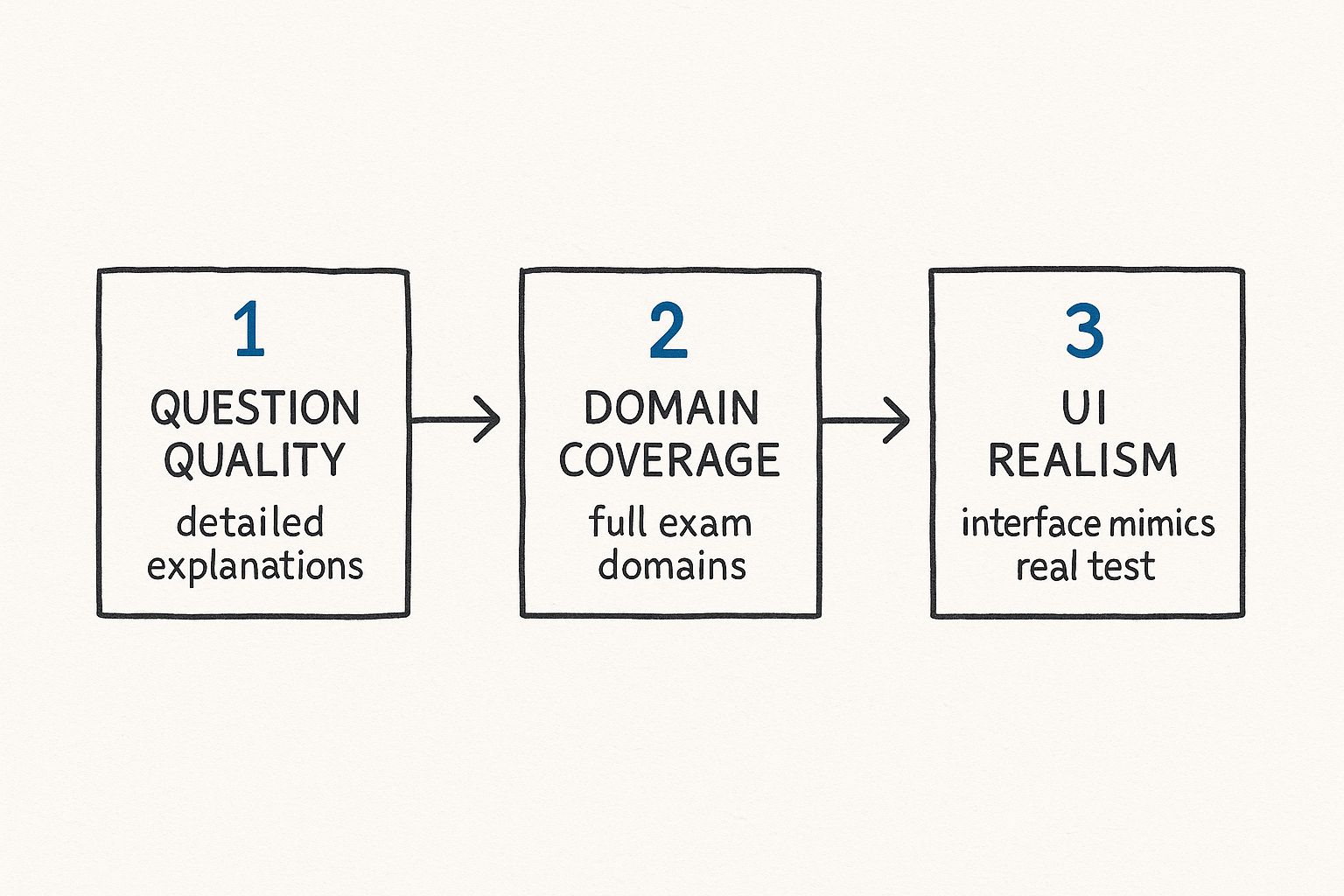
- Question Quality: Are the questions well-written, unambiguous, and reflective of the exam's difficulty and style? Do they test conceptual understanding rather than rote memorization?
- Domain Coverage: Does the test comprehensively cover all specified domains and topics outlined in the official exam blueprint? A good test should highlight your weaknesses across the entire curriculum.
- UI Realism: Does the practice test interface closely mimic the actual exam environment? Familiarity with the navigation, flagging options, and timer can significantly reduce exam-day stress.
A provider that excels across all three pillars offers the most authentic and beneficial simulation of the real certification experience.
Finding Reliable Providers
Identifying truly reliable practice test providers is a strategic step. Your initial and most authoritative source should always be the official materials from the certification authority themselves. For AWS, this means leveraging resources like the official AWS practice exams available on Skill Builder. Similarly, for Azure, consult Microsoft Learn; for PMP, refer to PMI's official resources. These official offerings provide the most authentic reflection of the exam.
Beyond official sources, research reputable third-party providers renowned for their meticulously crafted, challenging content and comprehensive performance analytics. Look for platforms that offer features such as detailed explanations for each answer, score breakdowns by domain, and performance trends over time.
Pro Tip: The Power of Interface Familiarity Never underestimate the psychological advantage of a practice test's user interface realism. A platform that precisely replicates the actual exam environment – including navigation, question flagging, and timer functionality – is invaluable. Becoming comfortable with this setup before exam day can significantly reduce anxiety and allow you to dedicate your full mental capacity to the questions rather than wrestling with the interface.
How to Build Your Practice Test Strategy

Engaging with practice tests randomly, without a structured strategy, is akin to navigating a complex IT project without a clear architectural design. While you might eventually reach your objective, the process will be inefficient and fraught with detours. To truly harness the power of practice tests for certifications like AWS, Azure, or ITIL, you need a dynamic, multi-stage strategy that adapts as your knowledge and confidence evolve. This strategic approach transforms simply taking tests into an active, iterative learning cycle.
The most effective starting point for any certification journey often precedes intensive study: begin with a full-length practice exam. This initial assessment serves as your baseline. As discussed, set aside any concern for your score; the primary objective is to forge an honest, objective map of your current knowledge landscape. This foundational test illuminates your weakest domains, providing an immediate, personalized study plan from day one. It's like a network scan identifying vulnerabilities before you begin patching.
The Phased Approach to Practice
Armed with your baseline assessment, you can construct a sophisticated practice routine tailored to each phase of your study journey. The key is to deploy the right type of practice at the optimal moment:
- Reinforcement Quizzes: After concluding a specific module—such as AWS S3 storage classes, IAM policies, Azure Virtual Networks, or ITIL service operations—immediately engage with short, topic-specific quizzes. This immediate self-assessment reinforces newly acquired knowledge, validates comprehension, and prevents misconceptions from solidifying before you progress.
- Mid-Point Mock Exams: Several weeks into your structured study, undertake another full-length practice exam. Consider this your interim performance review. It objectively illustrates your progress, highlights remaining stubborn knowledge gaps, and allows you to strategically adjust your study focus for the crucial final stretch.
A robust certification strategy inherently involves a deep dive into foundational principles. For instance, a comprehensive understanding of various authentication methods is paramount for confidently tackling questions related to securing AWS resources, whether it's understanding Federated Identities or OAuth 2.0. This holistic, interconnected knowledge is frequently the differentiator between passing and failing. For a more exhaustive approach, explore our guide on how to prepare for AWS certification, which provides detailed frameworks for success.
Simulating the Real Exam Experience
During the crucial final 1-2 weeks leading up to your certification exam, your strategic focus must pivot. This phase is less about absorbing new concepts and more about solidifying existing knowledge, building mental resilience, and perfecting your time management. This is the optimal period for undertaking full-length, timed mock exams under the most stringent, real-exam conditions possible.
Critical Guideline: Conduct every practice exam as if it were the actual certification test. This means no consulting notes, no external searches for answers, and no unauthorized breaks. The objective is to rigorously train your brain to perform optimally under pressure, fostering an environment where you feel you’ve 'been there, done that' before entering the testing center.
By consistently simulating the high-stakes environment, the actual exam day will feel significantly less daunting. This familiarity allows you to channel all your cognitive energy into dissecting questions and formulating answers, rather than being distracted by the unfamiliarity of the setting or the relentless pace of the clock.
Mastering the Post-Test Review: Your Path to Improvement
Completing a practice test is merely the first step; the true learning catalyst ignites after you click 'submit.' Simply reviewing your score and moving on represents one of the most significant missed opportunities in any certification preparation journey. The profound insights lie in meticulously dissecting your results, comprehending the root cause of every incorrect answer, and even critically re-evaluating why certain questions were answered correctly.
This analytical post-test review is how you transmute a raw score into a highly targeted, actionable study plan. The objective extends beyond merely identifying errors; it's about understanding the rationale behind each mistake and identifying the underlying knowledge gap. Mastering this crucial phase is often the decisive factor distinguishing a truly prepared IT professional from one relying on hopeful aspirations.
Build a Knowledge Gap Tracker
An indispensable tool in this rigorous review process is a "Knowledge Gap Tracker," which can be a simple spreadsheet, a dedicated notebook, or a digital note-taking application. Here, you will meticulously log every question you answer incorrectly on your practice exams. This isn't an exercise in self-reproach; it's a powerful, active learning strategy that compels you to directly confront your weaknesses, yielding far greater learning retention than passive textbook review.
This structured approach can dramatically accelerate your mastery. Consider implementing a tracker with these essential fields:
- Question Summary: A concise description of the topic tested (e.g., "Optimizing AWS Lambda cold starts," "PMP process group interaction," or "Azure AD Connect synchronization issues").
- My Selected Answer & Rationale: The option you chose, critically accompanied by the reasoning you applied at the time. This reveals your thought process.
- Correct Answer & Explanation: The correct option, along with a summary of the official explanation provided by the practice test.
- Core Concept/AWS Service/Topic: The specific knowledge domain or AWS service requiring further study (e.g., Amazon S3 Glacier, VPC Endpoints, Azure AD Conditional Access, ITIL Continual Service Improvement).
- Official Doc/Reference Link: A direct link to the relevant AWS documentation, Microsoft Learn article, PMI PMBOK section, or ITIL publication for deep-dive research.
Cumulatively, this tracker transforms from a mere record of errors into a dynamic, personalized roadmap guiding your journey to certification success. For a more comprehensive framework, explore our complete guide on identifying and addressing knowledge gaps.
Don't Just Focus on the Red X's
A crucial 'pro-tip' often neglected by candidates is to critically review questions you answered correctly. It's tempting to glance at a green checkmark and assume mastery, but honest self-assessment is vital. Ask yourself: Was this answer derived from confident, deep understanding, or was it a fortunate guess from a 50/50 probability?
Critical Self-Assessment: If you cannot articulate why your chosen answer is unequivocally correct, and why all other options are definitively incorrect, then you have not yet achieved true mastery of that underlying concept.
Thoroughly reviewing your correct answers serves to solidify that knowledge, transforming a lucky guess on a practice exam into a reliably correct answer on the actual certification test. This deepens your conceptual understanding, which is paramount for scenario-based questions in certifications like AWS Solutions Architect or Azure Administrator.
For every question reviewed – whether initially answered correctly or incorrectly – implement one final, indispensable step: Always go to the source. Do not simply accept the practice test's explanation. Seek out the official AWS documentation, Microsoft Learn module, PMI PMBOK guide, or ITIL publication that elaborates on the topic. This fundamental habit of referencing authoritative sources is what genuinely connects theoretical knowledge to practical application, fostering the profound understanding necessary for certification success and real-world IT competence.
Common Mistakes to Avoid With AWS Practice Tests

Utilizing practice tests is distinct from leveraging them effectively. Many IT professionals inadvertently fall into common traps that, rather than aiding preparation, can actively impede it.
The most prevalent and perilous error is rote memorization of question-and-answer pairs. While you might become adept at recognizing specific questions from a particular practice bank, this superficial familiarity bypasses genuine conceptual understanding. This cultivates a hazardous false confidence that rapidly dissipates when encountering a slightly rephrased or scenario-modified question on the actual AWS, Azure, or PMP exam. True certification tests assess your ability to apply knowledge, not just recall facts.
Another significant pitfall is test fatigue. Relentlessly grinding through multiple practice exams without adequate breaks or, crucially, without dedicated review time, often leads to burnout and diminishing returns. Genuine learning and improvement occur not during the act of answering questions, but in the deliberate, analytical process of reviewing your results and understanding the underlying principles.
Don't Put All Your Eggs in One Basket
Relying exclusively on a single source for practice tests can create a skewed perspective. Each provider, even reputable ones, possesses a unique style, question phrasing, and emphasis. Becoming overly accustomed to one style can leave you unprepared for the nuances and varied approaches of the actual certification exam.
To genuinely prepare for the inherent unpredictability and breadth of official exams—be it the AWS Certified Solutions Architect, Azure DevOps Engineer, or even the ITIL Foundation—it is essential to diversify your practice test sources. Engaging with multiple high-quality resources exposes you to a broader spectrum of question formats, phrasing, and conceptual applications, fostering a more robust and adaptable understanding of the material. These practice tests are foundational for IT professionals globally seeking to validate their cloud skills. AWS, for example, continuously refreshes its certifications to mirror current real-world job roles, as exemplified by the new AWS Certified CloudOps Engineer – Associate exam, specifically designed for those managing AWS workloads. Understanding the value of AWS certifications is key to impacting your career trajectory.
Indicator of Readiness: A truly effective practice test should challenge you, pushing the boundaries of your current knowledge. If you consistently achieve scores of 100% with ease, this is often a red flag. It typically indicates that the material is either insufficiently challenging or, more concerningly, outdated. At this point, it is crucial to seek out more rigorous and current resources.
Common Questions About AWS Practice Tests
As IT professionals delve deeper into their AWS certification preparation, a range of common questions often arise regarding the optimal use of practice tests. Addressing these concerns proactively can significantly enhance your study efficiency and bolster your confidence as you approach the exam.
How Many Practice Tests Should I Really Take?
This is a frequently asked question among certification candidates. While there isn't a universal 'magic number,' a highly effective strategy observed across numerous successful IT professionals involves undertaking 3 to 5 high-quality, full-length practice exams. The emphasis here is unequivocally on quality and strategic utilization, not mere quantity.
Instead of mass-cramming tests in the final hours, strategically space them out during your critical final weeks of study. This allows you to consistently track your progress, reinforce learning, and precisely identify specific knowledge domains that still require focused attention. It's an iterative feedback loop.
What's a "Good Enough" Score to Pass?
A common query revolves around the 'ideal' score to achieve on practice tests. While official passing scores for AWS exams (and other certifications like Azure or PMP) can fluctuate and are often unpublicized, a robust benchmark for MindMesh Academy students is to consistently target 85-90% or higher on high-quality practice exams.
Why aim for such a high threshold? This significant buffer provides a crucial safety net against potential exam-day anxieties, unexpected question phrasing, or the occasional 'curveball' that any certification authority might introduce. Consistently achieving scores in this range demonstrates genuine mastery of the concepts, indicating application-level understanding rather than just rote memorization of facts.
Key Perspective: The fundamental purpose of practice tests extends far beyond simply attaining a high score. Their true value lies in their ability to meticulously expose your knowledge gaps, transforming weaknesses into precise targets for improvement. Consequently, a lower score on your initial diagnostic test should never be viewed as a failure, but rather as an invaluable, detailed roadmap guiding your subsequent study efforts.
Are Free AWS Practice Tests Worth My Time?
The discussion around the utility of 'free versus paid' practice tests is perennial. While free tests can occasionally serve as a preliminary, cursory knowledge check on a very specific topic, a cautious approach is imperative. Many readily available free resources are critically outdated, overly simplistic, or plagued by inaccuracies.
Building your primary certification preparation strategy solely on such free materials is a high-risk endeavor, likely leading to unwelcome surprises on exam day. While your immediate objective is mastering AWS services, a broader understanding of the cloud ecosystem, including how services are packaged and sold through managed cloud hosting platforms like Cloudways, can offer valuable peripheral insight.
Our definitive advice? For the core of your certification preparation, consistently prioritize official AWS resources (or those from your chosen certification body) and invest in reputable, paid practice exams known for their quality, currency, and detailed explanations. Relegate free practice tests to a supplemental role, never as the foundational pillar of your study strategy.
Are you ready to transcend mere guessing and truly master your chosen certification domain? MindMesh Academy offers meticulously curated practice tests and evidence-based study plans designed to empower IT professionals like you to achieve certification with unwavering confidence. Elevate your preparation and secure your career advantage. Start your journey today at AWS Cloud Practitioner Practice Exams.
Ready to Get Certified?
Prepare with expert-curated study guides, practice exams, and spaced repetition flashcards at MindMesh Academy:

Written by
Alvin Varughese
Founder, MindMesh Academy
Alvin Varughese is the founder of MindMesh Academy and holds 15 professional certifications including AWS Solutions Architect Professional, Azure DevOps Engineer Expert, and ITIL 4. He's held senior engineering and architecture roles at Humana (Fortune 50) and GE Appliances. He built MindMesh Academy to share the study methods and first-principles approach that helped him pass each exam.